📝 Paper Summary
Memory organization
Conversational personalization
MaLP enhances personalized medical assistants by combining a neuroscience-inspired dual-process memory system (Working, Short-Term, Long-Term) with parameter-efficient fine-tuning to adapt to patient preferences.
Core Problem
Existing medical assistants lack personalization, and standard memory modules (dictionary-based) are inflexible, while fully fine-tuning LLMs for every patient is resource-prohibitive.
Why it matters:
- Patients have diverse communication preferences (e.g., concise vs. detailed explanations) that generic models ignore
- Dictionary-based memories (key-value pairs of mistakes/feedback) are rigid and rely heavily on retrieval accuracy
- Catastrophic forgetting occurs when adapting models to the medical domain without careful regularization
Concrete Example:
A diabetes patient preferring concise advice might receive a lengthy technical explanation about glucose tests from a generic model because the model cannot effectively recall and apply the patient's preference for brevity.
Key Novelty
Dual-Process enhanced Memory (DPeM)
- Mimics human memory using three tiers: Working Memory (buffer), Short-Term Memory (STM), and Long-Term Memory (LTM), managed by 'Rehearsal' and 'Executive' processes
- Uses a frequency-based promotion mechanism where information frequently accessed in STM is automatically transferred to LTM
- Combines this memory structure with Low-Rank Adaptation (LoRA) to fine-tune the generator for user-specific nuances without retraining the full model
Architecture
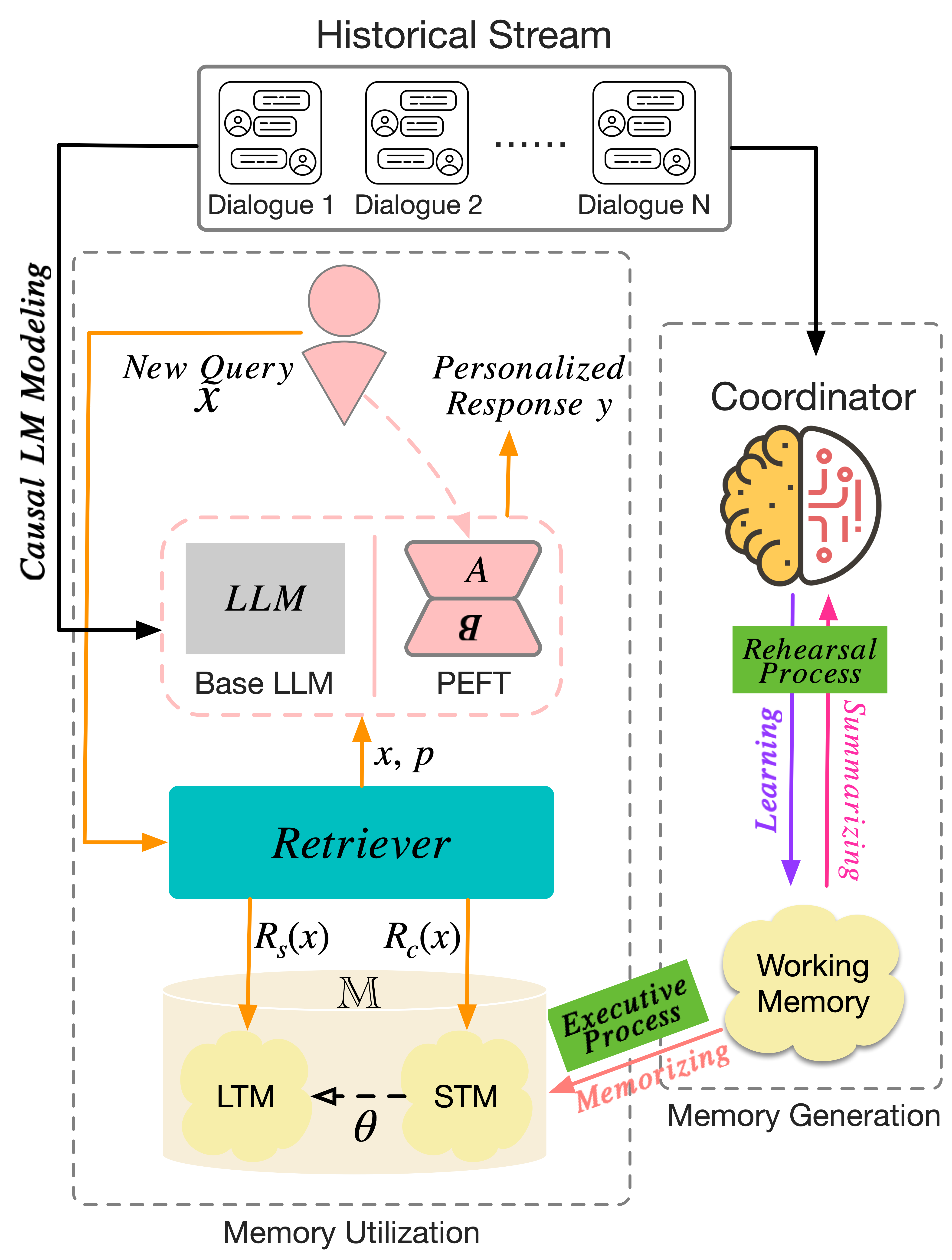
The Dual-Process enhanced Memory (DPeM) mechanism and MaLP framework.
Evaluation Highlights
- Achieves a relatively 7% improvement against existing memory structures (claimed in abstract)
Breakthrough Assessment
6/10
Proposes a biologically plausible memory architecture (DPeM) that moves beyond simple vector stores, integrated with PEFT. However, the summary relies on abstract claims as the results section is truncated in the source text.