📝 Paper Summary
Federated Recommendation
Graph Learning
Personalization
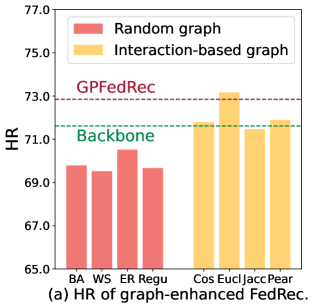
GPFedRec constructs a user-relation graph on the server using shared item embeddings to capture user correlations and guide personalized aggregation without accessing private interaction data.
Core Problem
Existing federated recommendation methods treat users as isolated individuals to preserve privacy, missing valuable user-user correlations that improve personalization, while graph-based methods typically require centralized data access.
Why it matters:
- Users with similar interaction histories often share future preferences, a signal lost in standard federated averaging
- Constructing user graphs usually violates the data locality principle of federated learning by requiring access to interaction histories or social networks
- Standard FedRec models learn a shared global model that neglects diverse, personalized user preferences
Concrete Example:
In a movie recommendation system, User A and User B both love niche Sci-Fi films. A standard FedRec approach averages their models with User C (who likes Romance), diluting the Sci-Fi signal. GPFedRec detects A and B have similar item embeddings, links them in a server-side graph, and aggregates their parameters together to reinforce the Sci-Fi preference.
Key Novelty
Graph-Guided Personalization for Federated Recommendation (GPFedRec)
- Constructs a user relationship graph on the server by calculating similarity between clients' uploaded item embeddings, which serve as a privacy-preserving proxy for user preference
- Uses a graph-guided aggregation mechanism (GCN-based) to generate user-specific item embeddings by aggregating information only from similar 'neighbor' clients
- Combines user-specific embeddings with a global shared embedding to balance personalized and popular preference modeling
Architecture
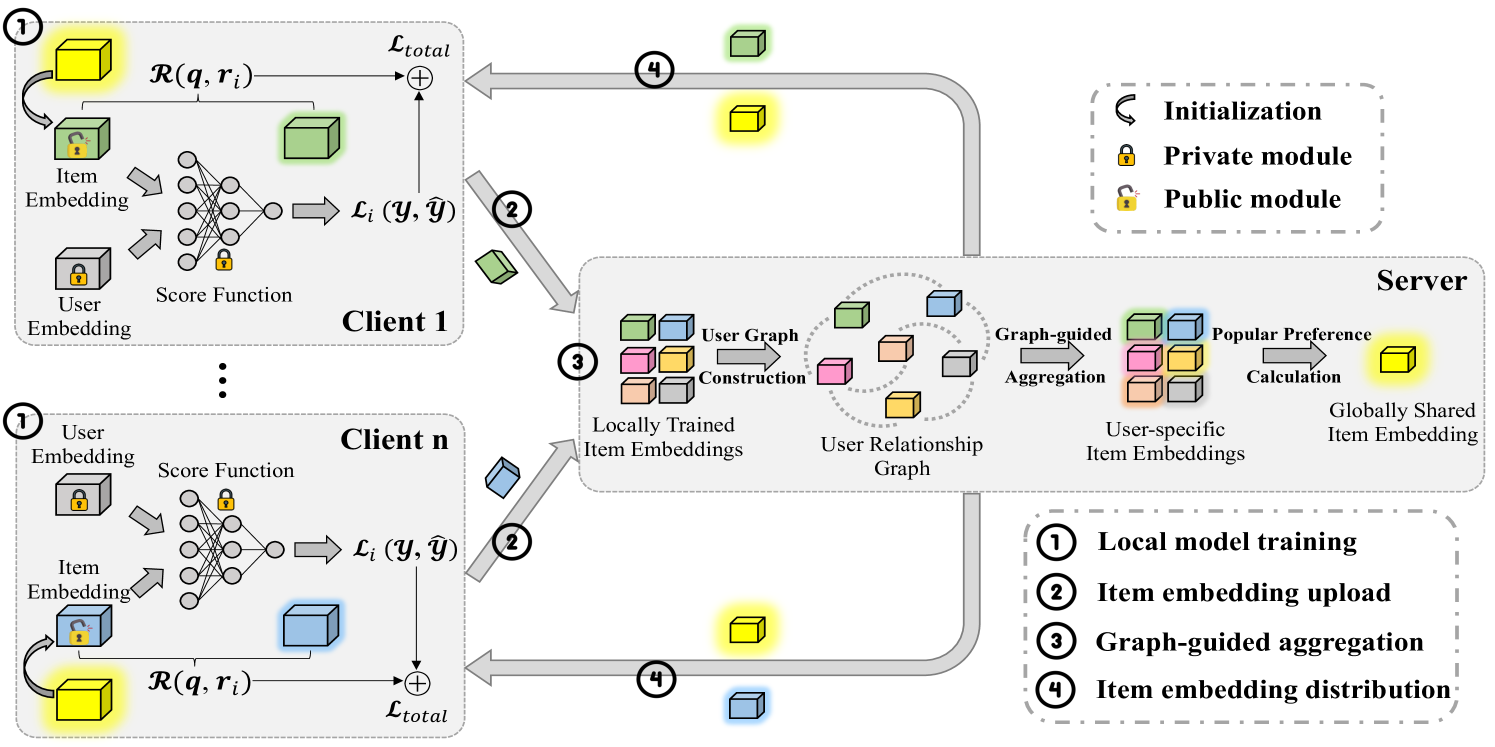
The overall framework of GPFedRec, illustrating the interaction between clients and the server.
Breakthrough Assessment
7/10
Proposes a clever, privacy-compliant way to reintroduce user graphs into federated learning. The reliance on item embeddings as a proxy for user similarity is intuitive and theoretically sound.