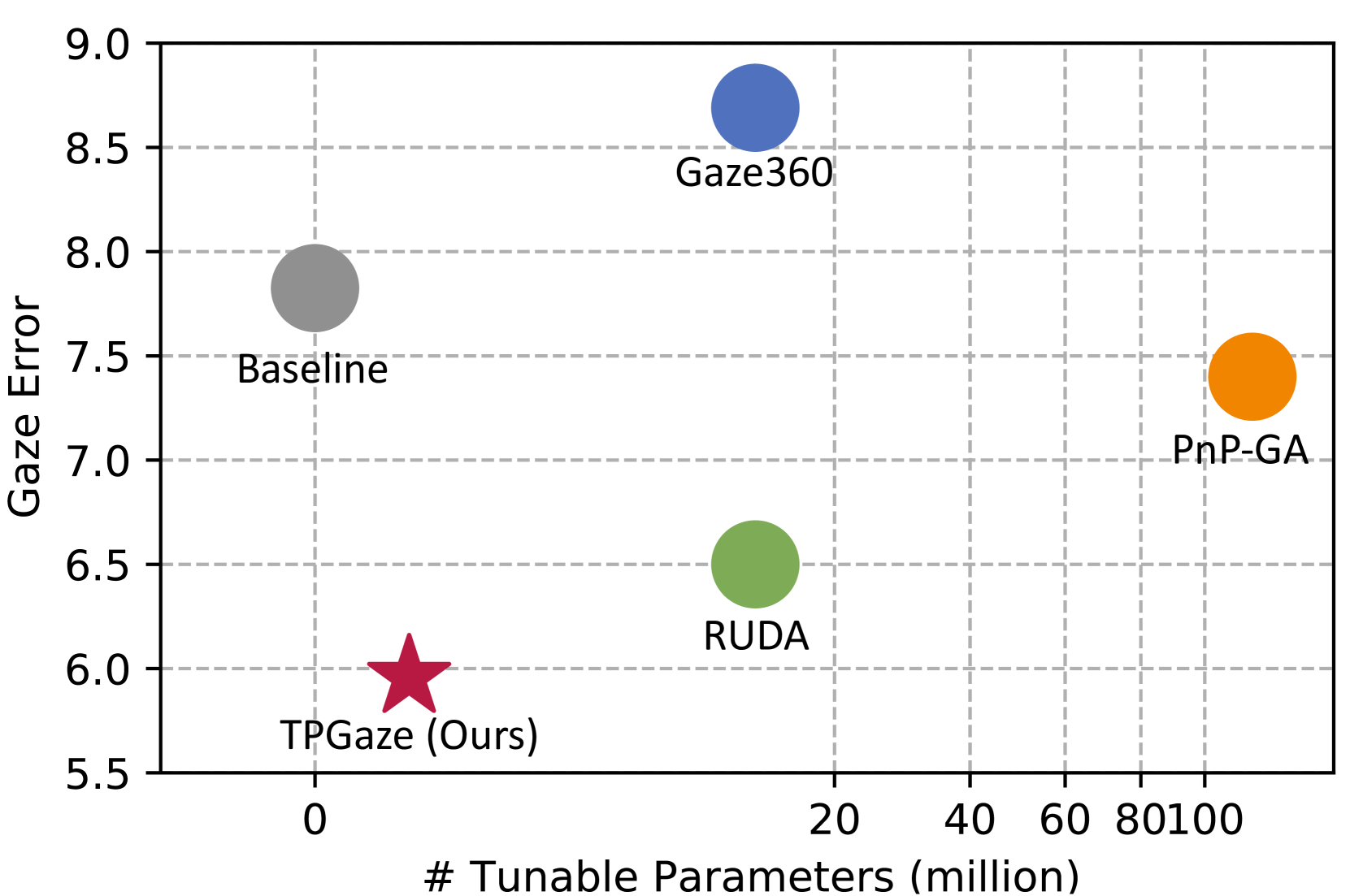
📝 Paper Summary
Unsupervised Domain Adaptation
Source-Free Domain Adaptation
Test-Time Adaptation
TPGaze enables fast, efficient test-time personalization of gaze estimation by updating only a small set of prompt parameters initialized via meta-learning to align unsupervised losses with gaze accuracy.
Core Problem
Existing personalized gaze estimation methods require labels or calibration, while source-free unsupervised domain adaptation methods are too computationally expensive for edge devices and lack guarantees that minimizing unsupervised losses reduces gaze error.
Why it matters:
- Personalizing gaze estimation is crucial for user experience on portable devices but collecting labeled data is impractical for end-users
- Full-model fine-tuning on edge devices is computationally prohibitive and prone to overfitting on limited personal data
- Without labels, minimizing proxy losses (like symmetry) does not automatically guarantee improved gaze estimation accuracy
Concrete Example:
A standard ResNet-18 gaze model trained on public data suffers performance degradation on a new user due to appearance shifts. Fine-tuning the whole model on the user's unlabeled face images is slow and risky. Simply minimizing a symmetry loss might collapse to trivial solutions that satisfy symmetry but fail to estimate gaze direction correctly.
Key Novelty
Test-time Personalized Gaze estimation (TPGaze) with Meta-Learned Prompts
- Treats convolutional padding as a learnable 'prompt' parameter, freezing the backbone to reduce tunable parameters to <1% of the model
- Uses meta-learning to find an optimal prompt initialization such that subsequent test-time updates using an unsupervised proxy loss (symmetry) reliably lead to lower gaze estimation error
Architecture
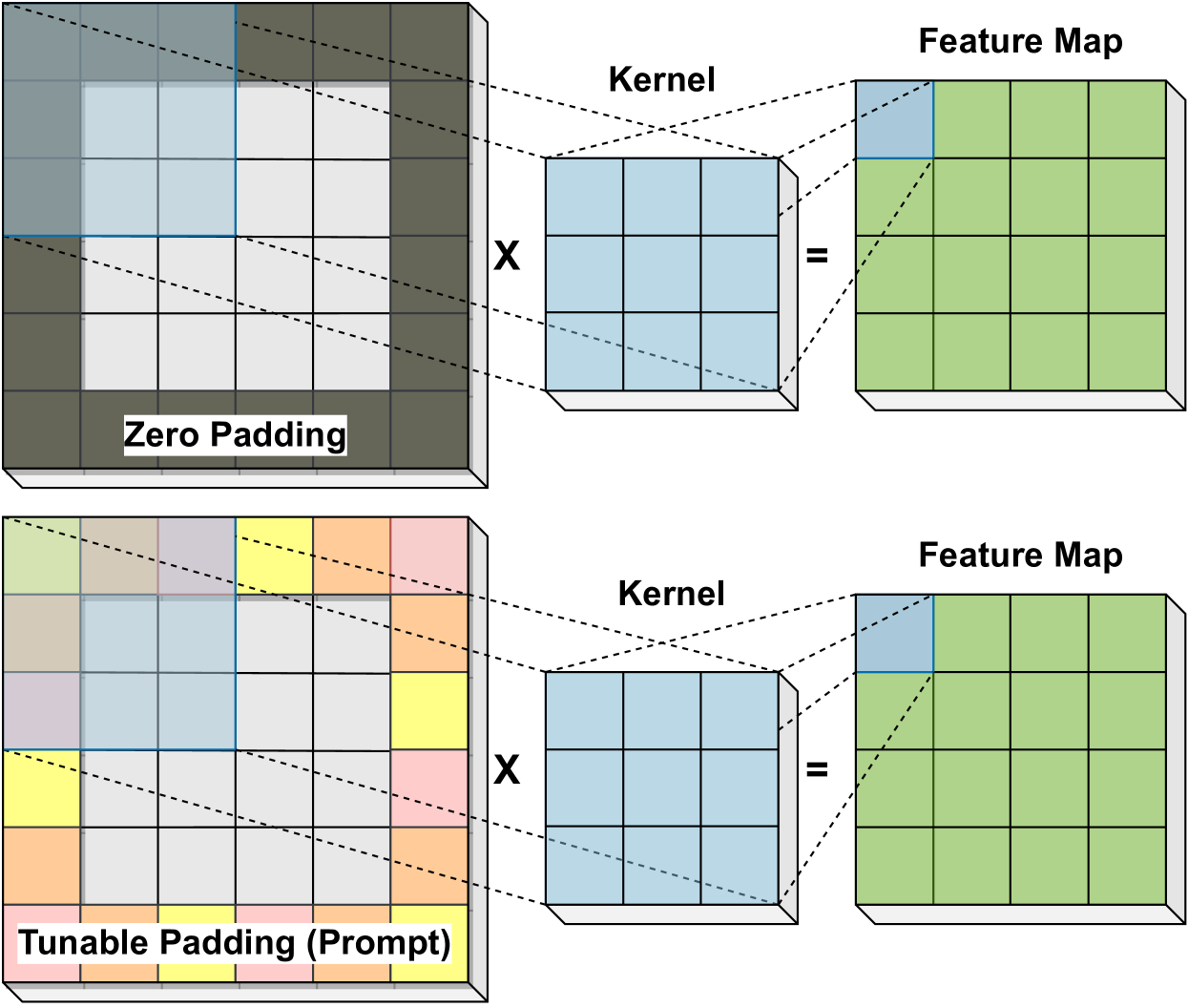
Illustration of the Prompt mechanism using tunable padding in convolutional layers.
Evaluation Highlights
- Achieves 10x faster adaptation speed compared to standard domain adaptation baselines
- Outperforms state-of-the-art unsupervised source-free domain adaptation methods (like RUDA and CRGA) on cross-dataset benchmarks
- Reduces tunable parameters to less than 1% of a ResNet-18 model compared to full fine-tuning
Breakthrough Assessment
7/10
Novel application of prompt tuning (via padding) to gaze estimation and a clever meta-learning formulation to bridge unsupervised losses and supervised goals. Significant efficiency gains.