📝 Paper Summary
Graph Foundation Models
Industrial Recommender Systems
A domain-specific graph foundation model for personalization that combines a static heterogeneous graph neural network (HGNN) for learning general item representations with a dynamic Two-Tower model for efficient task adaptation.
Core Problem
Existing personalization approaches often build siloed solutions for different item types or struggle to adapt foundation models to dynamic, large-scale industrial catalogs where user preferences and items change frequently.
Why it matters:
- Traditional siloed models fail to leverage shared information across different content types (e.g., podcasts vs. audiobooks), limiting recommendation quality.
- Directly using LLMs for personalization at scale is challenging due to high latency and difficulty adapting quickly to catalog changes.
- Standard GNNs often lack the generalization capabilities required to serve as a foundation model across diverse downstream tasks without frequent retraining.
Concrete Example:
In an audio streaming platform, a user might listen to both podcasts and audiobooks. A siloed audiobook recommender cannot leverage the rich interaction signals from the user's podcast history to improve recommendations, whereas a unified graph model can transfer this knowledge.
Key Novelty
Static-Dynamic Decoupling for Graph Foundation Models
- Splits the architecture into a 'static' foundation layer (HGNN + LLM) that learns general item embeddings from content and co-interaction graphs, and a 'dynamic' adaptation layer (Two-Tower model) that updates frequently.
- Uses an LLM to featurize nodes solely based on text, allowing the graph to include any item type (podcasts, audiobooks) in a unified vector space without type-specific engineering.
- De-couples content representation (handled by the heavy HGNN/LLM foundation) from user representation (handled by the lightweight Two-Tower model), enabling scalability.
Architecture
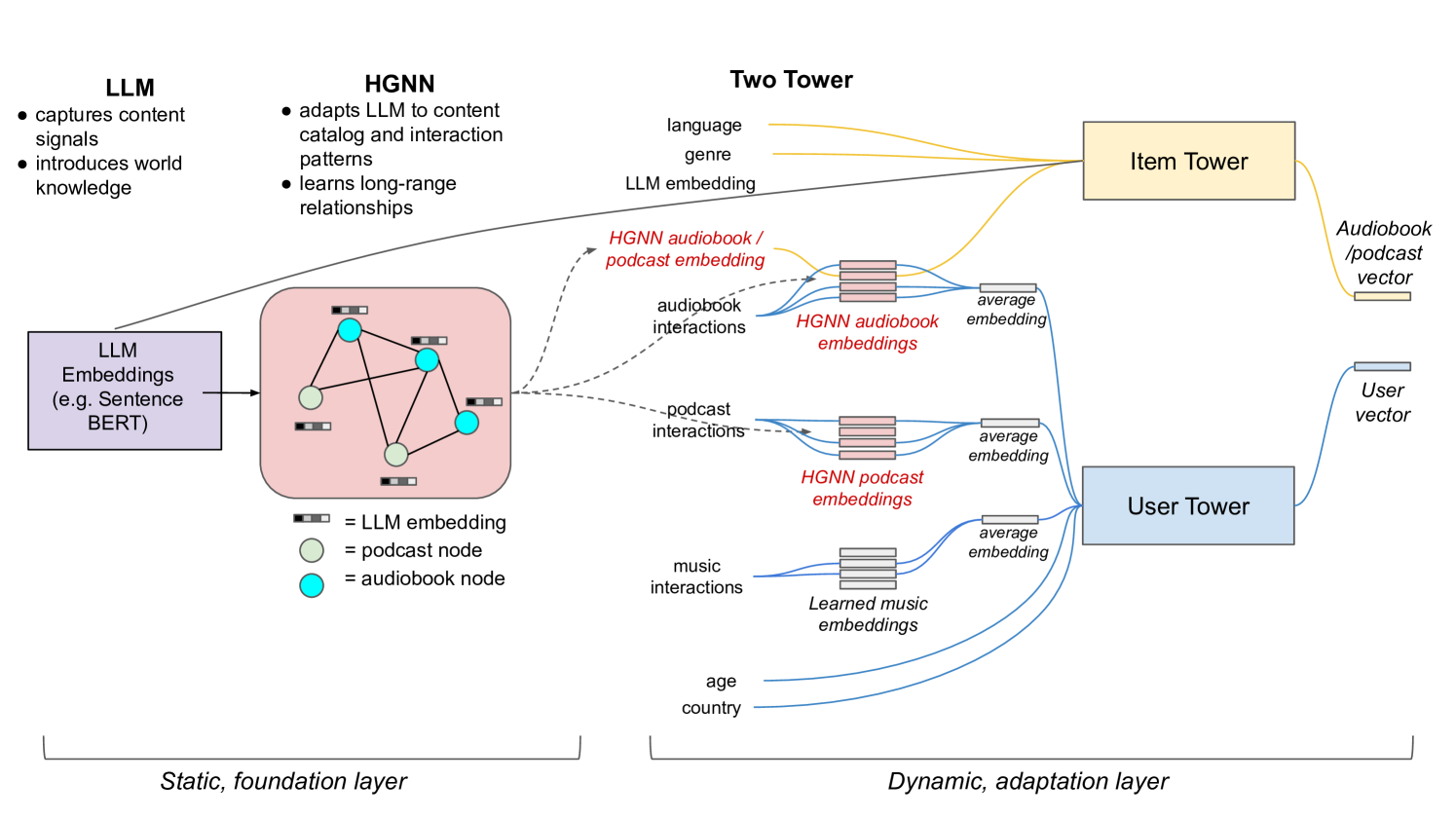
The overall Graph Foundation Model architecture, illustrating the Static Layer (Graph construction, HGNN training) and the Dynamic Layer (Two-Tower model adaptation).
Evaluation Highlights
- Unified 2T model (trained on both podcasts and audiobooks) outperforms a content-specific audiobook-only baseline on Hit-Rate@10.
- Ablation shows that removing the GNN component significantly degrades performance for both podcast and audiobook recommendations, proving the value of structural signals.
- The 'static' HGNN foundation model remains stable over time: retraining it daily yields negligible performance gains compared to using a frozen version, validating the efficiency of the static/dynamic split.
Breakthrough Assessment
7/10
Presents a pragmatic, scalable architecture for Graph Foundation Models in industry. While not a theoretical breakthrough in GNNs, the static/dynamic decoupling and unified cross-content representation offer a strong blueprint for real-world application.