📝 Paper Summary
Personalized Federated Learning
Parameter-Efficient Fine-Tuning (PEFT)
pFedPG enables efficient personalization of large frozen models in Federated Learning by learning a server-side generator that produces client-specific visual prompts based on local optimization feedback.
Core Problem
Standard Federated Learning struggles with data heterogeneity across clients, and adapting large foundation models (like ViT) is computationally expensive and bandwidth-heavy.
Why it matters:
- Directly averaging prompts from heterogeneous clients (as in FedVPT) leads to suboptimal performance because a single set of prompts cannot capture diverse distributions
- Fine-tuning entire large-scale models on edge devices is often infeasible due to limited compute and communication constraints
- Existing personalization methods like Hypernetworks are typically restricted to small architectures and fail to scale to modern foundation models
Concrete Example:
In a DomainNet setting where one client has 'Real' images and another has 'Sketch' images, averaging their learned prompts results in a generic prompt that fits neither domain well. pFedPG generates distinct prompts for the 'Sketch' client versus the 'Real' client.
Key Novelty
Client-Specific Prompt Generation (pFedPG)
- Instead of aggregating model weights, the server learns a 'Prompt Generator' that produces unique visual prompts for each client using a learned client descriptor
- The server optimizes this generator by treating the difference between updated local prompts and initial prompts as a gradient signal, learning to predict the optimal initialization for each client's specific data distribution
Architecture
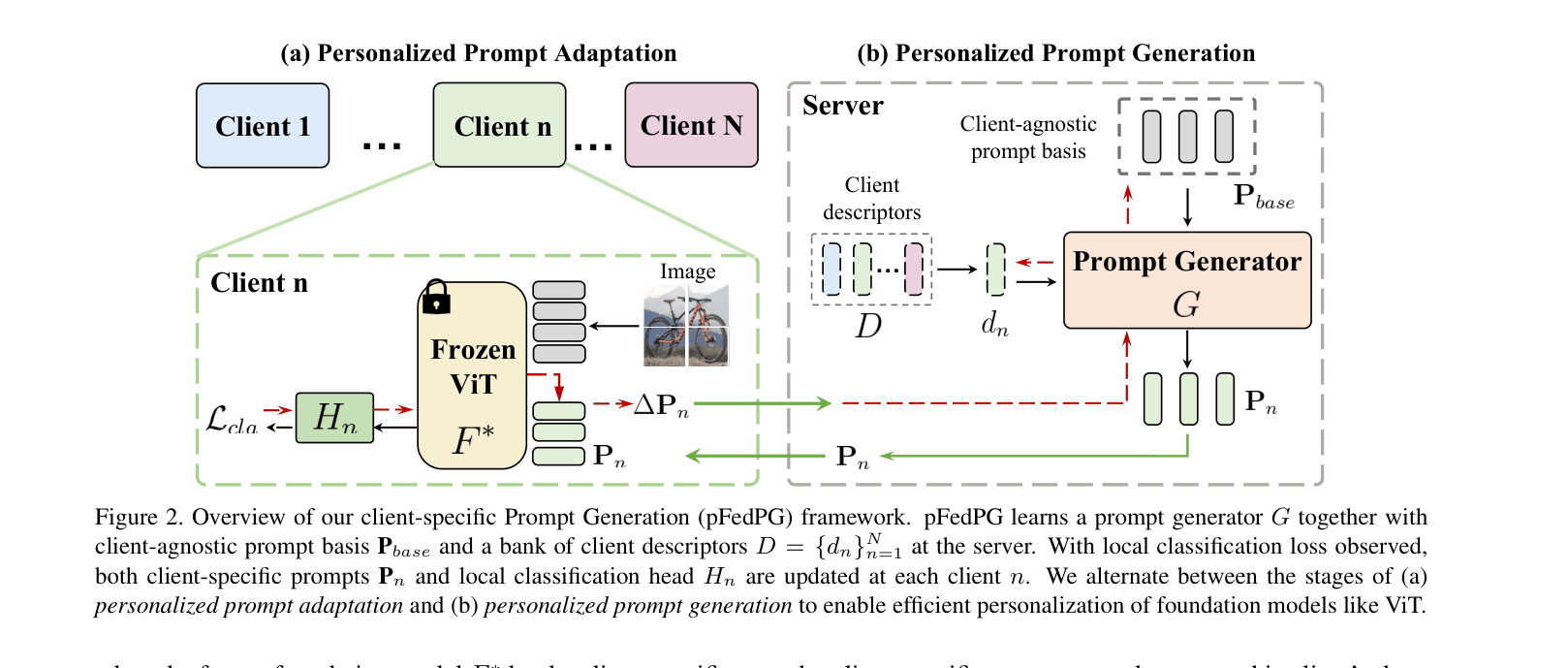
Overview of the pFedPG framework, illustrating the interaction between the Server (Prompt Generation) and Clients (Prompt Adaptation)
Evaluation Highlights
- +15.47% accuracy improvement on CIFAR-100 (Disjoint label space) compared to FedVPT (Federated Visual Prompt Tuning)
- +7.48% accuracy improvement on DomainNet (domain heterogeneity) compared to FedVPT
- Reduces communication cost by ~99.99% compared to full model fine-tuning methods (e.g., FedAvg, FedProx) by transmitting only prompts
Breakthrough Assessment
7/10
Significant performance gains on heterogeneous data with high parameter efficiency. Cleverly adapts Hypernetwork concepts to Prompt Tuning, solving the scalability issue of previous personalized FL methods.