📝 Paper Summary
Federated Learning
Edge Computing
Efficient Communication
ACSP-FL reduces federated learning communication costs by dynamically selecting fewer clients based on performance and sharing only partial global model layers while keeping local personalized layers.
Core Problem
Standard Federated Learning (FL) suffers from high communication overhead and slow convergence, especially when client data is non-IID and heterogeneous.
Why it matters:
- Communication bottlenecks prevent FL scalability on edge devices with limited bandwidth
- Fixed client selection strategies (like selecting k random clients) are inefficient, often selecting poor-performing or redundant clients
- Full model transmission is costly; transmitting unnecessary parameters wastes energy and network resources
Concrete Example:
In Human Activity Recognition, a client with only 'walking' data (non-IID) might receive a global model trained mostly on 'sitting' data. Standard FL forces this client to download the full global model and upload full updates, wasting bandwidth on parameters irrelevant to its local distribution, while still failing to recognize 'walking' accurately due to lack of personalization.
Key Novelty
Adaptive Client Selection with Personalization (ACSP-FL)
- Filters clients dynamically: only selects clients whose current accuracy is below the global average, prioritizing those who need training the most
- Applies a decay function to gradually reduce the total number of participating clients as the global model converges
- Splits the model into shared global layers (collaboratively trained) and private local layers (personalized), transmitting only the shared portion to reduce payload
Architecture
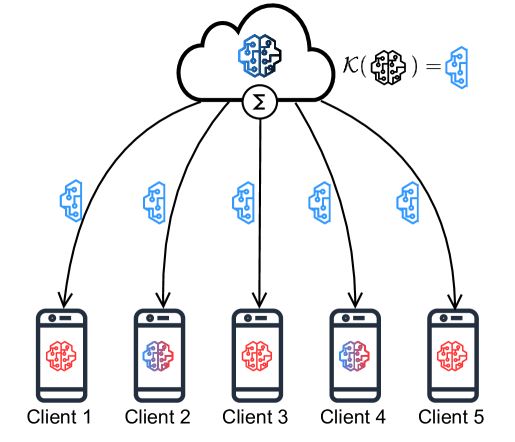
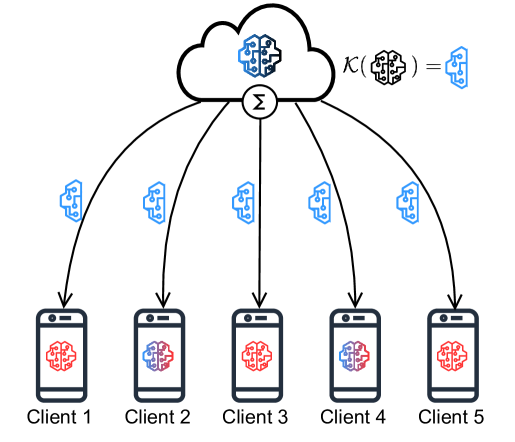
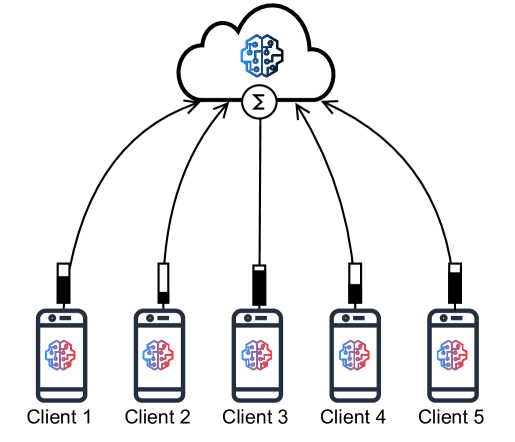
The ACSP-FL workflow: (a) Personalization Phase (clients combine global/local models), (b) Evaluation Phase (clients test and report accuracy), (c) Selection Phase (Server filters clients < mean accuracy).
Evaluation Highlights
- Reduces communication overhead by up to 95% compared to FedAvg while maintaining comparable accuracy
- Reduces convergence time significantly; on UCI-HAR, ACSP-FL finishes 100 rounds in ~500s vs ~1500s for FedAvg
- Achieves superior efficiency scores (weighted accuracy + overhead reduction) across IID and non-IID datasets compared to POC and DEEV
Breakthrough Assessment
7/10
Solid engineering combination of adaptive selection and partial model sharing showing very strong efficiency gains (90-95% comms reduction). While the individual components are known, the specific integration and rigorous container-based evaluation are valuable contributions.