📝 Paper Summary
User-profile based personalization
AI-Assisted Writing
GhostWriter is an AI writing environment that enables users to personalize text generation through implicit style learning and explicit feedback mechanisms like likes and dislikes.
Core Problem
LLM-powered writing systems often produce generic output that fails to capture a user's unique voice and context, while complex prompting requirements limit user agency.
Why it matters:
- Generic outputs force users to spend excessive time editing or rewriting AI-generated text to sound like themselves
- Users lacking prompt engineering expertise struggle to steer models toward specific stylistic or contextual goals
- Lack of control over probabilistic model outputs can lead to feelings of reduced ownership and agency in the writing process
Concrete Example:
A software engineer asks an AI to write an intro email; the AI produces a generic, overly enthusiastic draft ('I am thrilled to introduce myself...') that misses her professional voice and specific context (e.g., her project details), requiring heavy manual editing.
Key Novelty
Implicit-Explicit Style Personalization Loop
- Combines implicit learning (extracting style from the user's ongoing writing) with explicit teaching (users highlighting text to 'like' or 'dislike') to refine the system's understanding of style
- Uses natural language to transparently display and edit the system's learned style profile, allowing users to inspect and manually correct how the AI views their writing voice
Architecture
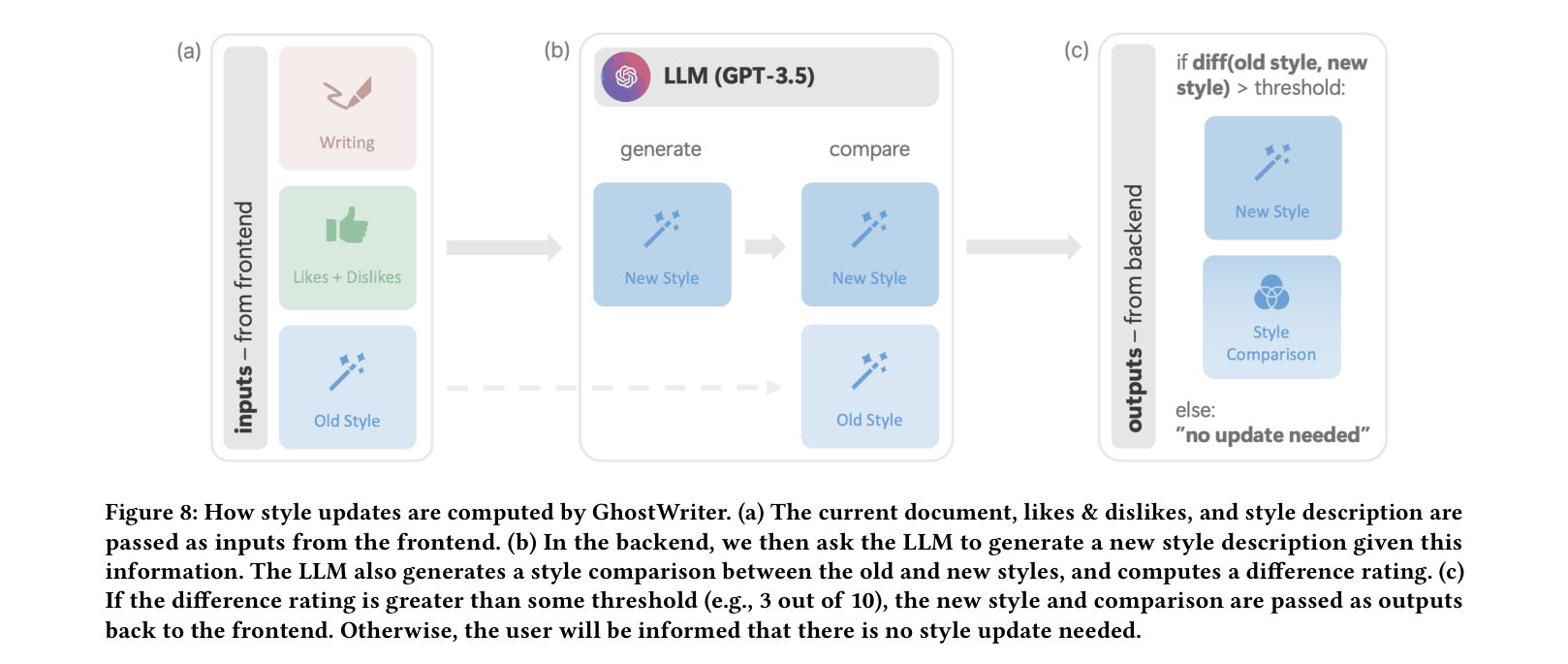
The backend logic for computing style updates using LLMs
Evaluation Highlights
- Participants rated 'The system is learning from me' highly (mean 4.17/5), indicating successful perception of personalization
- Users felt a strong sense of control over the experience (mean 4.00/5), validating the agency-focused design features
- In the Creative Writing task, users utilized inline prompts an average of 5.18 times compared to 1.14 times in Editing, showing task-dependent feature adoption
Breakthrough Assessment
7/10
Strong contribution to HCI/AI-writing by demonstrating how to combine implicit style extraction with explicit user controls. While technically relying on standard prompting, the interaction design significantly advances user agency.