Chenkai Sun, Ke Yang, R. Reddy, Y. Fung, Hou Pong Chan, ChengXiang Zhai, Heng Ji
University of Illinois Urbana-Champaign,
Amazon
International Conference on Computational Linguistics
(2024)
MemoryP13NRAGRecommendation
π Paper Summary
RAG-based personalizationUser modeling
Persona-DB improves LLM personalization by transforming raw user logs into hierarchical abstract personas and retrieving context from similar users to handle sparse data and reduce context window usage.
Core Problem
Retrieval-augmented personalization typically relies on raw, noisy user logs, which are inefficient for the context window and fail for users with sparse history (lurkers).
Why it matters:
Standard retrieval requires large amounts of scattered log data to infer simple user preferences, inflating inference costs
Users with minimal history (cold-start) receive poor personalization because they lack sufficient self-data to retrieve
Existing methods do not leverage the 'collaborative' knowledge that users with similar mindsets tend to make similar decisions
Concrete Example:A 'lurker' user who cares about the environment but has zero posts about renewable energy asks about a solar initiative. A standard retriever finds nothing relevant in their empty history. Persona-DB finds similar users who are also environmentalists, retrieves their positive opinions on solar energy, and correctly infers the lurker would support the initiative.
Key Novelty
Persona-DB (Hierarchical + Collaborative RAG)
Hierarchical Refinement: Uses an LLM to pre-process raw logs into 'Distilled' (facts) and 'Induced' (abstract traits) personas, creating denser features that are more retrieval-efficient than raw logs
Collaborative Refinement (JOIN): Implements a retrieval mechanism analogous to a SQL JOIN, where the system identifies similar users via persona embeddings and retrieves relevant context from *their* databases to augment the current user's prompt
Architecture
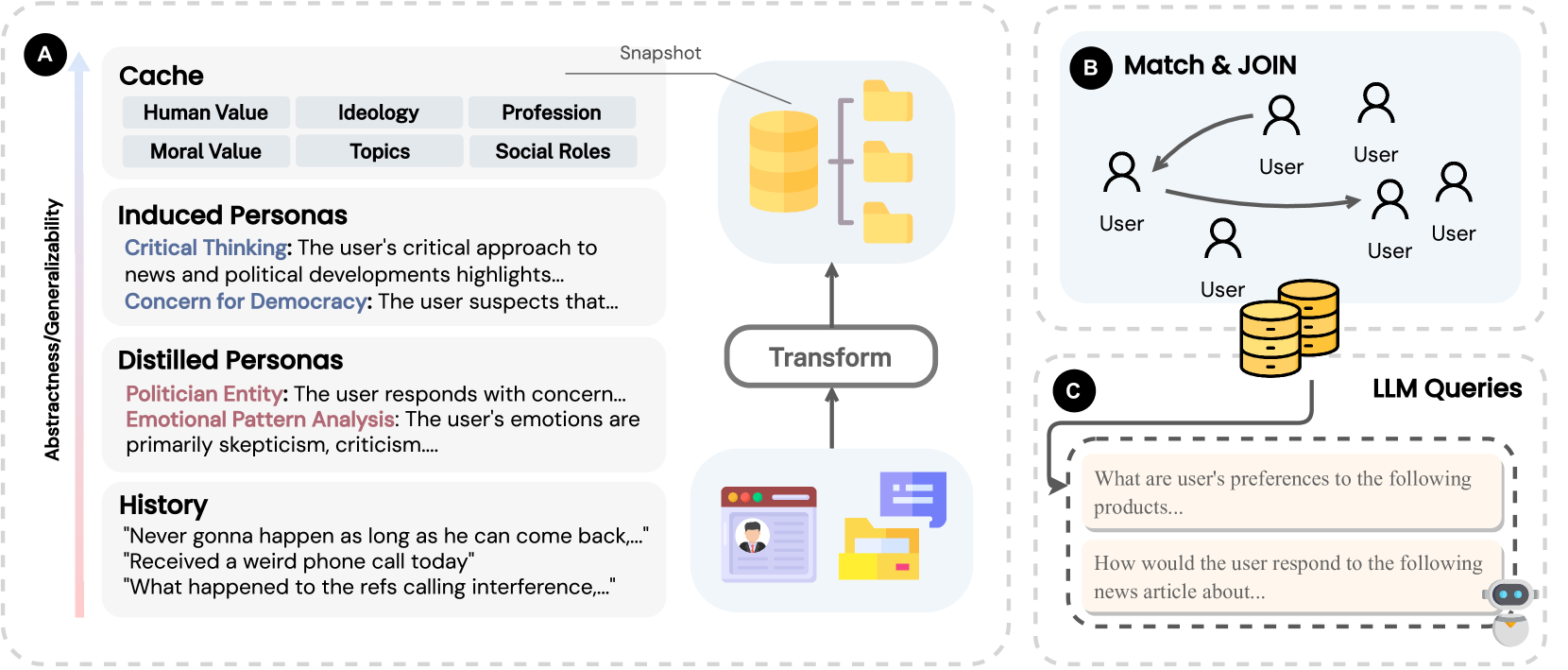
Figure 1 shows the hierarchical database construction (History -> Distilled -> Induced). Figure 2 shows the JOIN retrieval process.
Evaluation Highlights
+11% Pearson correlation improvement over baselines for 'Lurkers' (users with sparse history) on the RFPN benchmark
Achieves superior accuracy compared to standard retrieval baselines even when the retrieval size is reduced by 10x (high context efficiency)
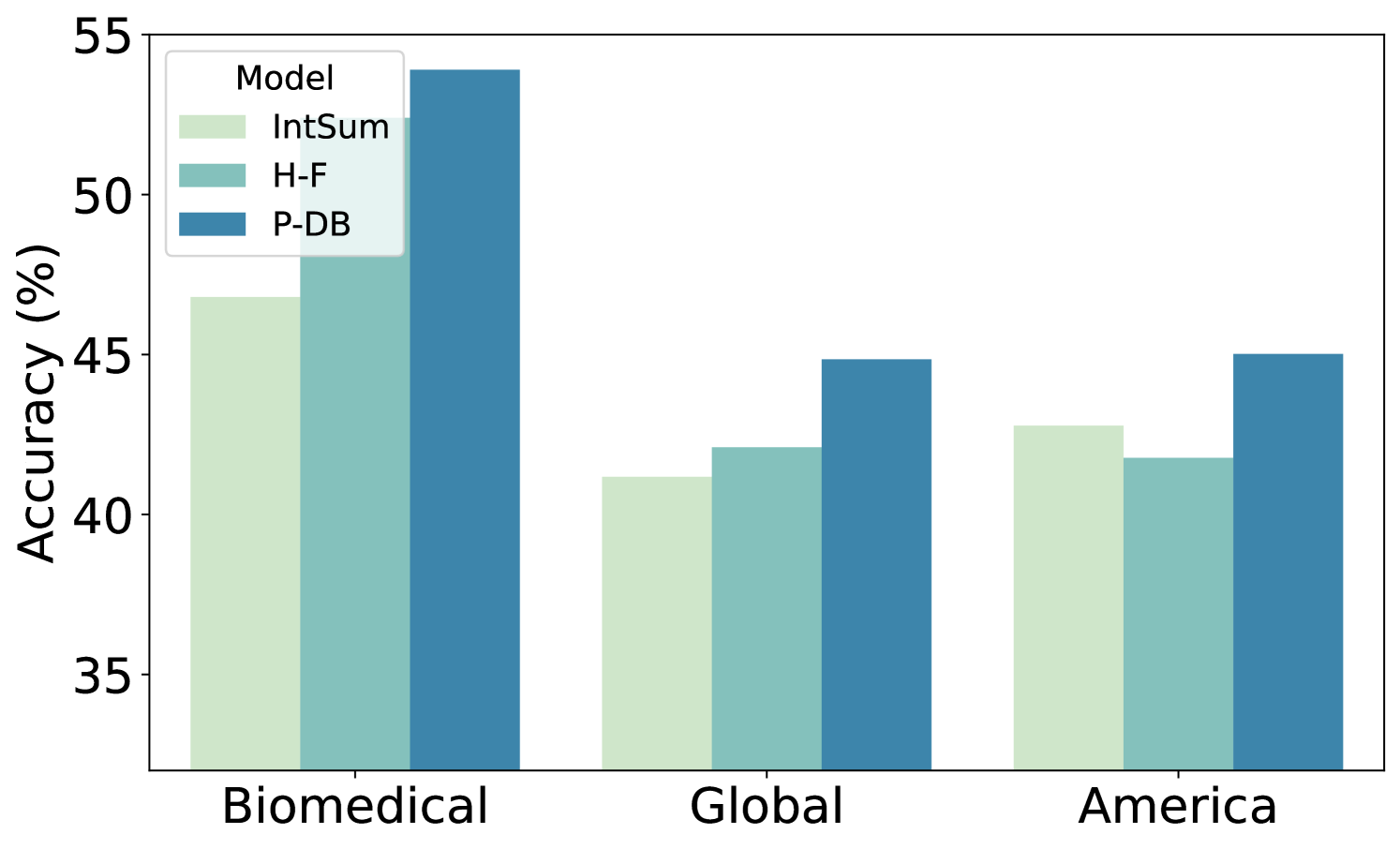
Consistently outperforms baseline methods (H-Retrieval, H-Recency) across Response Forecasting and OpinionQA tasks
Breakthrough Assessment
7/10
Strong engineering contribution to RAG-based personalization. Effectively addresses the critical cold-start problem using collaborative filtering concepts within a RAG framework, though the underlying models are standard APIs.
Distill raw history into structured persona layers
Model or implementation: gpt-3.5-turbo-0613
User Matcher (Retrieval & Selection)
Identify similar users (collaborators) based on persona cache embeddings
Model or implementation: text-embedding-ada-002 (Encoder)
Collaborative Retriever (Retrieval & Selection)
Retrieve relevant items from both the target user's DB and collaborators' DBs
Model or implementation: text-embedding-ada-002 (Encoder)
Response Generator
Predict the user's response given the query and retrieved persona context
Model or implementation: gpt-3.5-turbo-0613
Novel Architectural Elements
Recursive retrieval pipeline (JOIN) that augments a user's private index with retrieved entries from neighbor indices
Hierarchical database schema (History -> Distilled -> Induced) explicitly designed for RAG efficiency
Modeling
Base Model: gpt-3.5-turbo-0613 (used for both database construction and downstream inference)
Compute: Inference only; no training reported. Uses OpenAI API.
Comparison to Prior Work
vs. IntSum: Persona-DB uses a structured hierarchy (Distilled/Induced) and collaborative retrieval, whereas IntSum focuses on summarization of individual history
vs. H-Retrieval: Persona-DB retrieves from abstract personas and *other* users, not just the user's own raw logs
vs. SiliconFriend [not cited in paper]: SiliconFriend focuses on memory internalisation/management for companionship; Persona-DB focuses on collaborative retrieval for response prediction
Limitations
Relies on proprietary LLMs (GPT-3.5) for database construction and inference; costs scale with database size
Privacy concerns: Collaborative retrieval mixes user data, which may not be acceptable in privacy-sensitive applications
Performance gains from collaborative retrieval diminish as the user's own history becomes very rich/frequent
Analysis is limited to response prediction tasks, not open-ended chat generation
Predicting user responses to news headlines and survey questions using retrieval-augmented prompts.
Benchmarks:
RFPN (Response Forecasting for Personas in News Media) (Sentiment/Intensity Prediction)
OpinionQA (Multiple-choice Survey Prediction)
Metrics:
Pearson Correlation (r)
Spearman Correlation (rs)
Micro-F1
Macro-F1
Accuracy
Statistical methodology: Not explicitly reported in the paper
Experiment Figures
Accuracy on OpinionQA across different topics (Biomedical, Global Attitudes, America 2050)
Main Takeaways
Collaborative refinement (JOIN) is critical for 'Lurkers' (sparse data), yielding an 11% improvement in correlation on RFPN compared to baselines.
Hierarchical personas (Distilled/Induced) allow the model to maintain accuracy even when retrieval size is reduced by 10x, demonstrating high information density.
For frequent users (rich history), the collaborative component is less critical, but the hierarchical abstraction still helps reduce noise compared to raw history retrieval.
Ablation studies show that removing intermediate layers (Induced Persona) hurts performance, confirming the value of abstraction.
π Prerequisite Knowledge
Prerequisites
Retrieval-Augmented Generation (RAG)
Collaborative Filtering (Recommendation Systems)
Zero-shot/Few-shot Prompting
Key Terms
JOIN operation: A retrieval strategy in this paper where the system fetches data not just from the user's own DB, but from the DBs of similar users (collaborators)
Lurkers: Users with extremely sparse interaction history (cold-start problem), making personalization difficult
Distilled Persona (DP): A layer in the database containing explicit facts and superficial opinions extracted directly from user logs
Induced Persona (IP): A higher-level abstraction layer containing inferred values and traits derived from the Distilled Persona
Cache: Consistent human-defined high-level persona categories used to assist relevancy matching during the collaborative retrieval stage
RFPN: Response Forecasting for Personas in News Mediaβa dataset where models predict how specific users would react to news headlines
OpinionQA: A dataset of public opinion survey questions and responses used to evaluate if models can mimic human respondents