📝 Paper Summary
Text-to-Image Personalization
Style Transfer
Diffusion Model Control
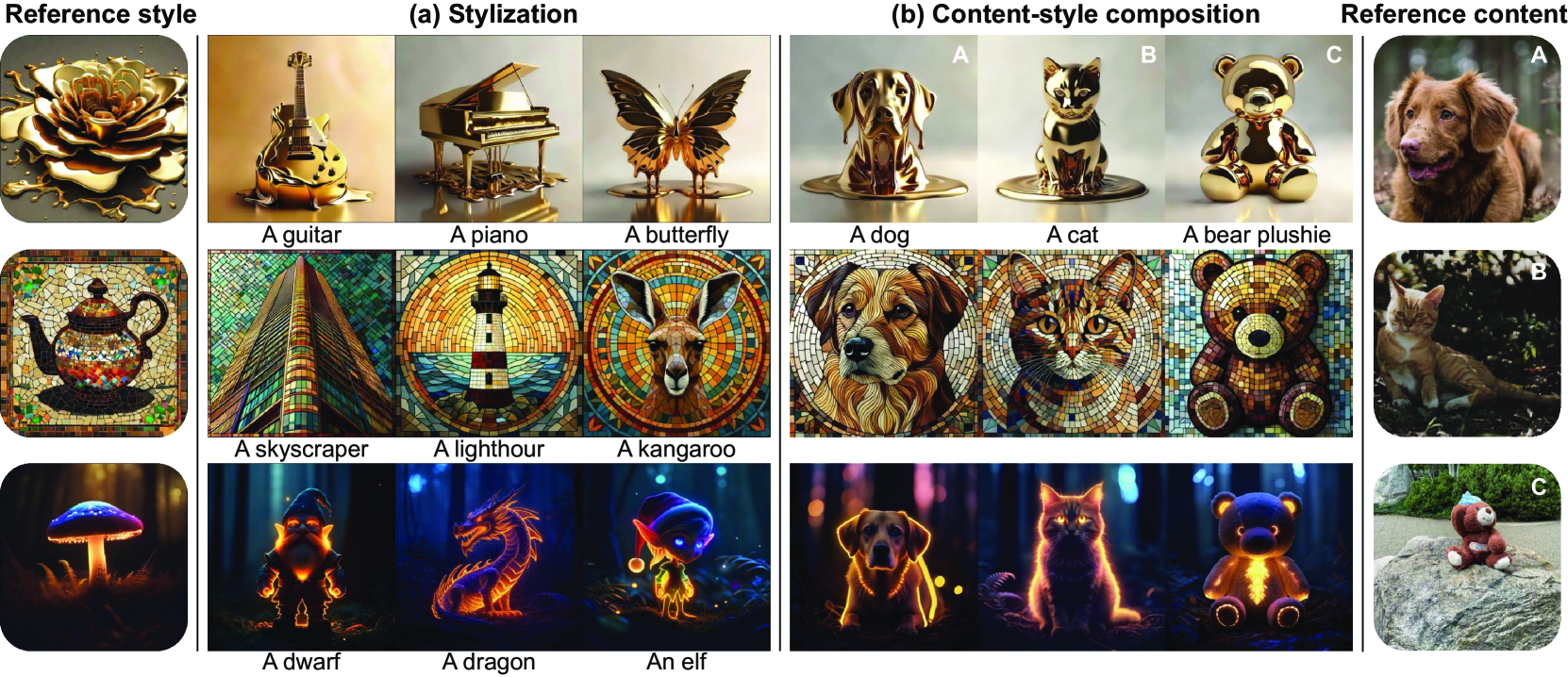
RB-Modulation personalizes text-to-image models by treating the reverse diffusion process as a stochastic optimal control problem, modulating the drift to match a target style without training.
Core Problem
Existing training-free personalization methods struggle with accurately extracting styles (due to information loss in inversion), preventing content leakage from reference images, and composing style with content flexibly.
Why it matters:
- Fine-tuning large foundation models is computationally expensive and impractical for single-image references
- Current training-free methods like StyleAligned lose fine-grained details during DDIM inversion
- Feature injection methods often cause the content of the style reference to leak into the generated image (e.g., a style reference's object appearing in the output)
Concrete Example:
When trying to generate a 'cat' in the style of a specific 'oil painting of a house', prior methods might accidentally generate a house instead of a cat (content leakage) or fail to capture the specific brushstrokes of the painting (poor style extraction).
Key Novelty
Stochastic Optimal Control (SOC) for Drift Modulation
- Formulates the reverse diffusion dynamics as a control problem where an optimal controller modifies the drift (direction) of the generation process to minimize a terminal cost representing style discrepancy
- Introduces Attention Feature Aggregation (AFA) to explicitly decouple content and style features within attention layers, preventing the reference image's content from overriding the text prompt
Architecture
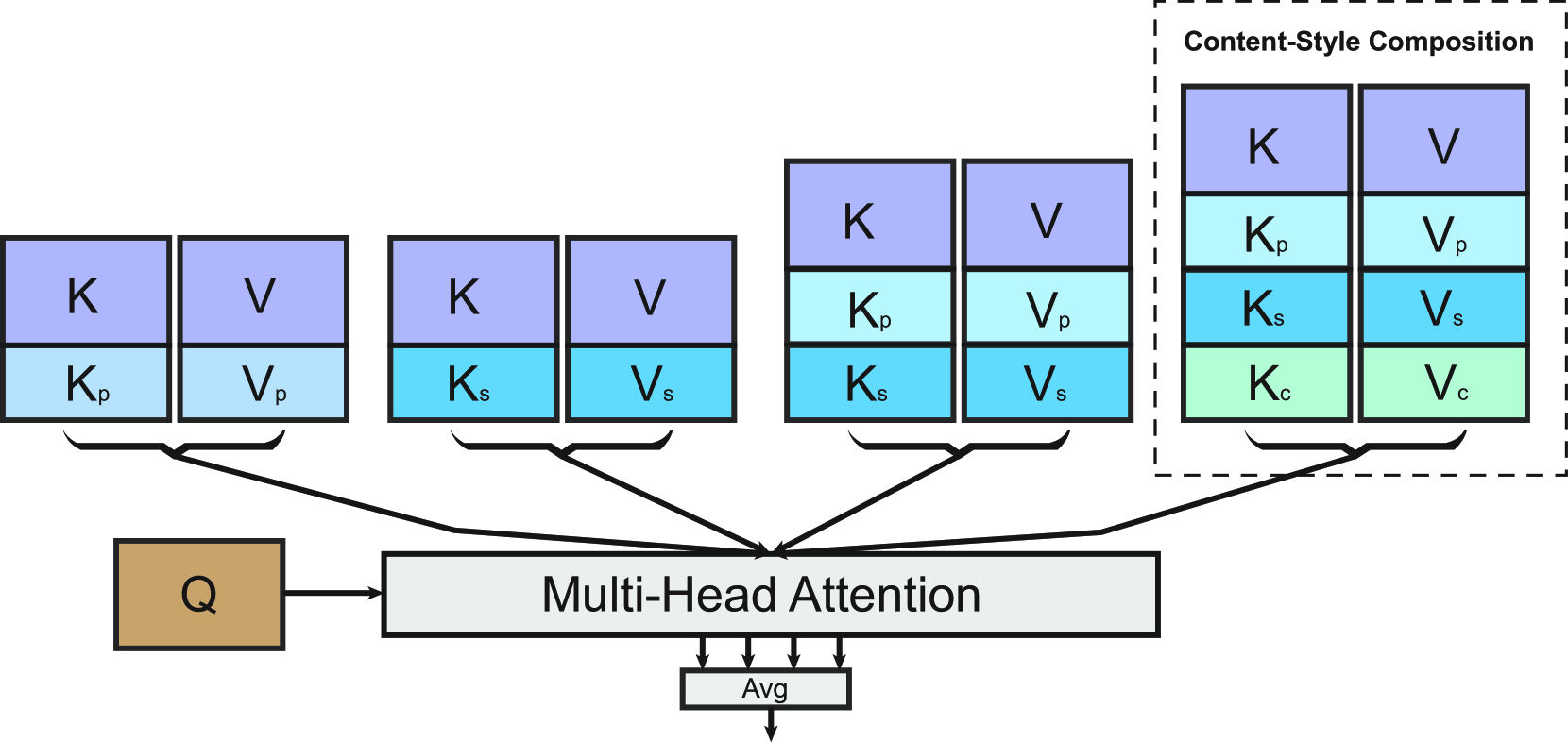
Diagram of the Attention Feature Aggregation (AFA) module illustrating how reference image features are integrated into the attention mechanism
Breakthrough Assessment
8/10
Provides a theoretically grounded framework (optimal control) for diffusion personalization that eliminates the need for finetuning or adapters, addressing key issues like content leakage and inversion artifacts.