📝 Paper Summary
User-profile based personalization
Conversational personalization
DEP improves personalization by modeling the differences between a user and their peers as contrastive latent embeddings, distilled via a sparse autoencoder and injected as soft prompts.
Core Problem
Existing personalization methods (like DPL) rely on natural language to compare users, which creates verbose prompts that strain context windows and fail to precisely capture fine-grained behavioral distinctions.
Why it matters:
- Reliance on raw text for user comparison is structurally ill-suited for extraction, as LLMs often miss subtle distinctions when summarizing differences in natural language
- Including raw peer data in prompts consumes excessive tokens, limiting the model's ability to process other relevant context
- Effective personalization requires capturing not just what a user likes, but specifically how their preferences deviate from the norm (individuality)
Concrete Example:
In DPL, an LLM is given raw reviews from User A and User B and asked to 'describe the difference' in text. This yields vague summaries. DEP instead calculates the mathematical difference between their embeddings (Vector A - Vector B), filters noise, and injects this precise signal directly.
Key Novelty
Difference-aware Embedding-based Personalization (DEP)
- Shifts inter-user comparison from natural language space to latent embedding space, using vector subtraction to capture behavioral deviations
- Employs a Sparse Autoencoder (SAE) to distill these difference vectors, filtering out noise and retaining only task-relevant preference signals
- Injects these distilled signals as soft prompts into a frozen LLM, aligning the compressed representations with the LLM's internal understanding via fine-tuning
Architecture
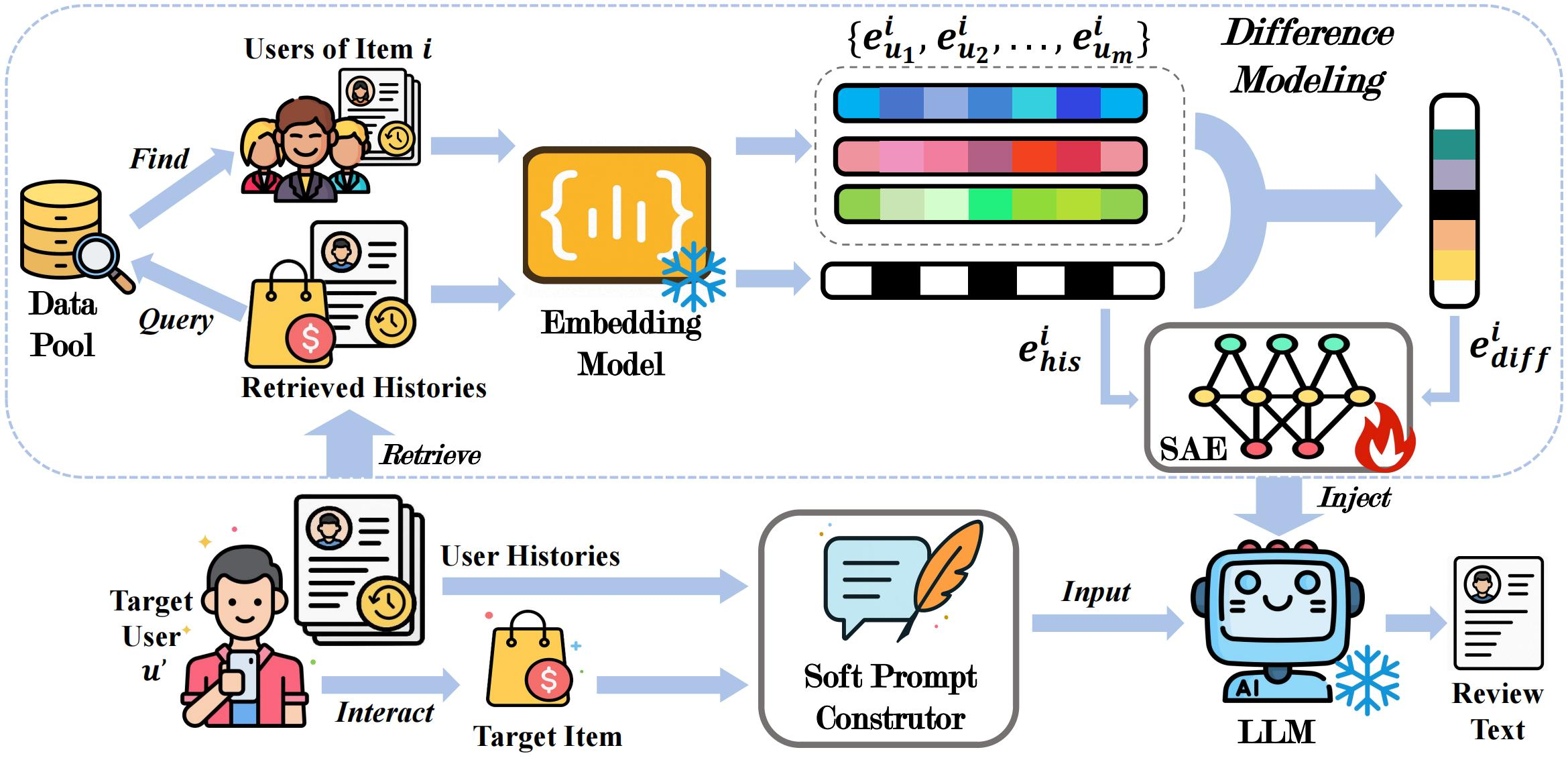
Overview of the DEP framework, illustrating the flow from history retrieval to soft prompt injection
Breakthrough Assessment
7/10
Proposes a logical shift from text-based to latent-based user comparison, addressing context window and precision issues. usage of SAE for filtering personalization signals is a clever architectural addition.