📝 Paper Summary
Recommender Systems
Personalized Assistance
Personalized Search
Knowledge Graphs
This perspective paper proposes a taxonomy for integrating Large Language Models into personalization systems, moving from passive ID-based filtering to active, interactable engagement via knowledge retention, semantic interpretation, and explanation.
Core Problem
Traditional personalization systems rely on passive, abstract ID-based representations that lack deep semantic understanding and cannot proactively engage users or explain recommendations naturally.
Why it matters:
- Traditional collaborative filtering struggles with the 'cold start' problem and lacks interpretability due to opaque ID vectors
- Existing knowledge graphs in recommender systems are expensive to construct and often sparse/incomplete, missing valuable cross-domain connections
- Template-based explanations in current systems are rigid and often fail to provide persuasive or personalized justifications for recommendations
Concrete Example:
In drug recommendation, a system might suggest an effective drug based on ID matching but fail to explain *why* it is effective, reducing user trust. Similarly, recommender knowledge graphs often miss relations (e.g., connecting a movie to a song) that an LLM's world knowledge could bridge.
Key Novelty
Taxonomy of LLM-Personalization Integration
- Classifies LLM integration into three roles: Knowledge Base (completing missing facts/relations), Content Interpreter (understanding semantic features deep than standard embeddings), and Explainer (generating natural language justifications)
- Proposes a paradigm shift from 'passive filtering' (ranking items) to 'active service' (proactive exploration of user intent and plan execution via tools)
- Identifies the 'Phantom Problem' (hallucination) as a critical barrier where LLMs introduce noise or incorrect provenance into personalization systems
Architecture
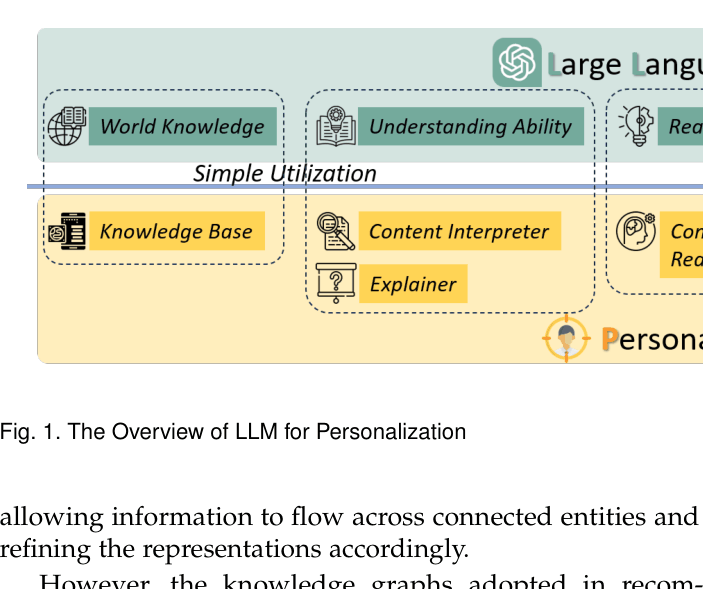
A conceptual pyramid illustrating the hierarchy of LLM utilization in personalization
Breakthrough Assessment
5/10
A comprehensive survey and taxonomy that organizes the field effectively, but does not propose a specific new algorithmic breakthrough or achieve new state-of-the-art results itself.