📝 Paper Summary
User-profile based personalization
Layered memory (Episodic + Semantic)
PersonaAgent personalizes LLM agents at test time by treating the system prompt as a dynamic 'persona' that is iteratively optimized via textual feedback from past user interactions.
Core Problem
Current LLM agents adopt a one-size-fits-all approach that fails to adapt to specific user preferences, while fine-tuning is computationally prohibitive for individual users and standard RAG is too rigid.
Why it matters:
- Users have distinct preferences (e.g., movie tastes, writing styles) that generic agents ignore, leading to suboptimal engagement
- Real-world deployment requires scaling to millions of users, making per-user parameter updates (fine-tuning) infeasible due to latency and cost
- Existing memory-based agents often just retrieve context without adjusting their underlying reasoning or tool-use strategy
Concrete Example:
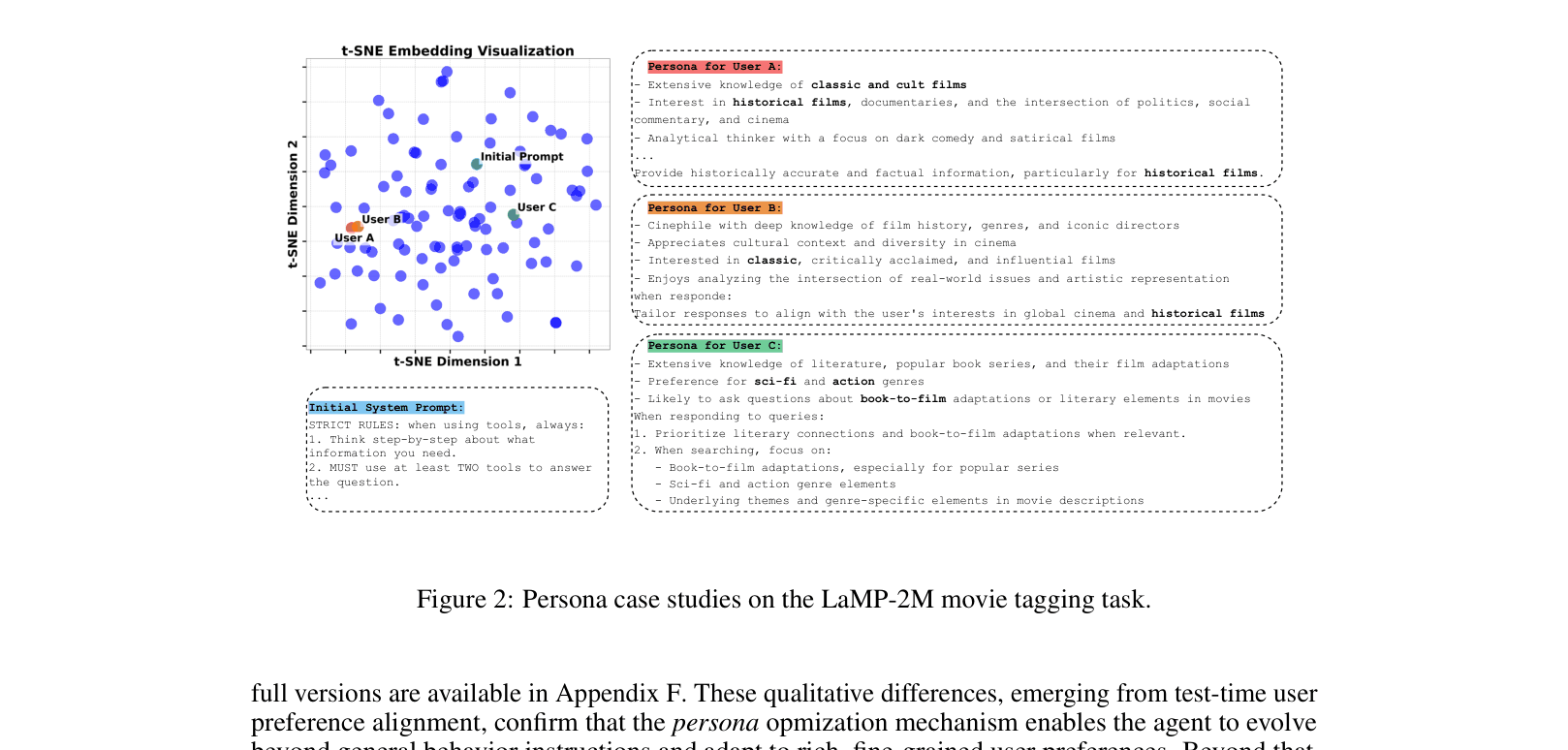
In a movie tagging task, User A prefers historical films while User C prefers sci-fi. A standard agent provides generic tags for both. PersonaAgent analyzes User C's history, rewrites its own system prompt to 'Prioritize literary connections and book-to-film adaptations,' and then correctly tags a movie based on those specific interests.
Key Novelty
Test-Time User-Preference Alignment via Persona Optimization
- Defines a 'persona' not just as a static character, but as a mutable system prompt that governs tool use and memory retrieval
- Uses a 'textual gradient' loop: the agent simulates responses to past user queries, critiques the error against ground truth, and rewrites its own persona prompt to minimize this 'textual loss' before helping the user
Architecture
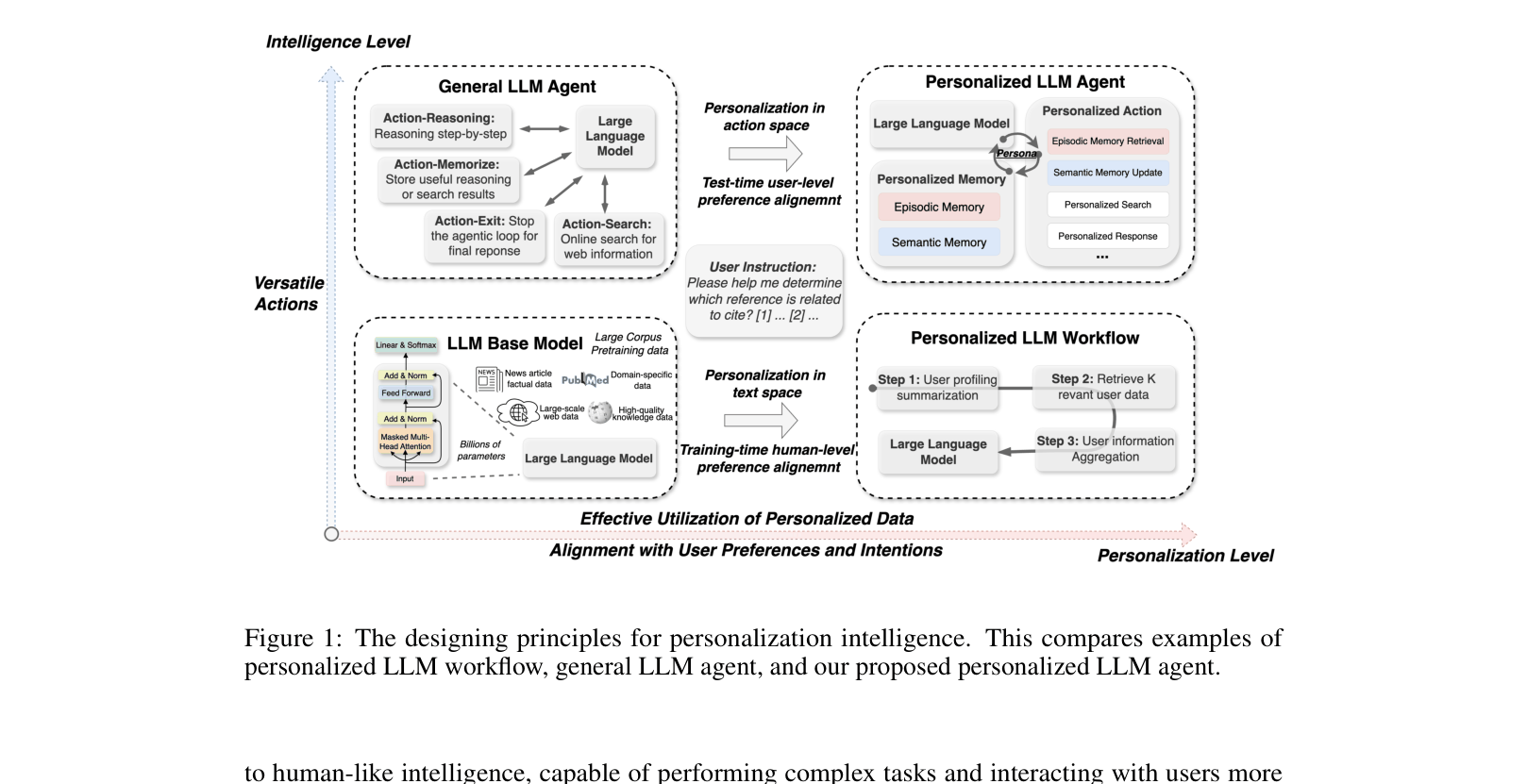
The complete PersonaAgent framework interacting with a user, highlighting the flow between Memory, Persona, and Action modules
Evaluation Highlights
- +5.7% accuracy improvement on LaMP-1 (Citation Identification) compared to MemBank (state-of-the-art memory agent)
- Reduces Mean Absolute Error (MAE) by 23% on LaMP-3 (Product Rating) compared to ReAct, showing superior alignment with numeric user preferences
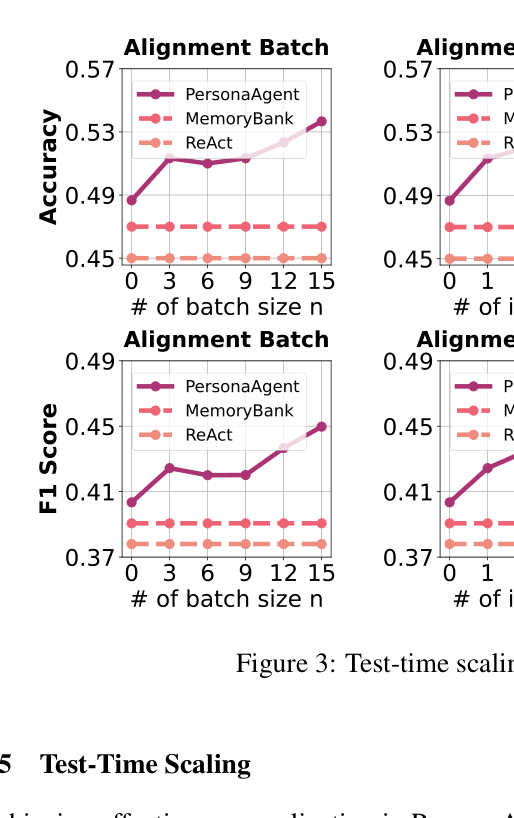
- Achieves 55.0% accuracy on LaMP-2M using Claude-3.7, consistently outperforming baselines across model sizes (Mistral to Claude)
Breakthrough Assessment
8/10
Significantly advances personalization by replacing expensive fine-tuning with efficient test-time prompt optimization. The unified memory-action-persona framework is a strong architectural contribution for agentic AI.