📝 Paper Summary
LLM-based Agents
Open-World Planning
Minecraft Agents
GITM replaces low-level reinforcement learning controls with an LLM-based hierarchical planner using structured actions and text-based memory to unlock the entire Minecraft technology tree.
Core Problem
Reinforcement learning agents in Minecraft struggle to map long-horizon goals directly to low-level keyboard/mouse inputs, resulting in extreme sample inefficiency and poor generalization beyond specific tasks like ObtainDiamond.
Why it matters:
- Current RL agents (e.g., VPT) require massive compute (thousands of GPU days) and millions of steps to learn single tasks
- Existing agents cannot generalize to the broader open world, unlocking only ~30% of the Minecraft technology tree
- Direct mapping from complex goals to low-level control signals creates a difficult credit assignment problem for long-horizon tasks
Concrete Example:
In the 'ObtainDiamond' task, RL agents must execute ~30 million low-level steps (clicks/movement) to succeed. If an RL agent is trained only for diamonds, it cannot adapt to obtain a 'stone sword' without expensive retraining, whereas humans generalize skills immediately.
Key Novelty
Ghost in the Minecraft (GITM) Framework
- Decomposes goals hierarchically: Goal → Sub-goals → Structured Actions (e.g., 'mine', 'craft') → Low-level execution, mirroring human cognitive processes
- Utilizes external text-based knowledge (Wiki recipes) for decomposition and text-based memory to store and retrieve successful plans for future use
- Abandons end-to-end RL for low-level control, instead using an LLM to parameterize hand-written script interfaces for robust interaction
Architecture
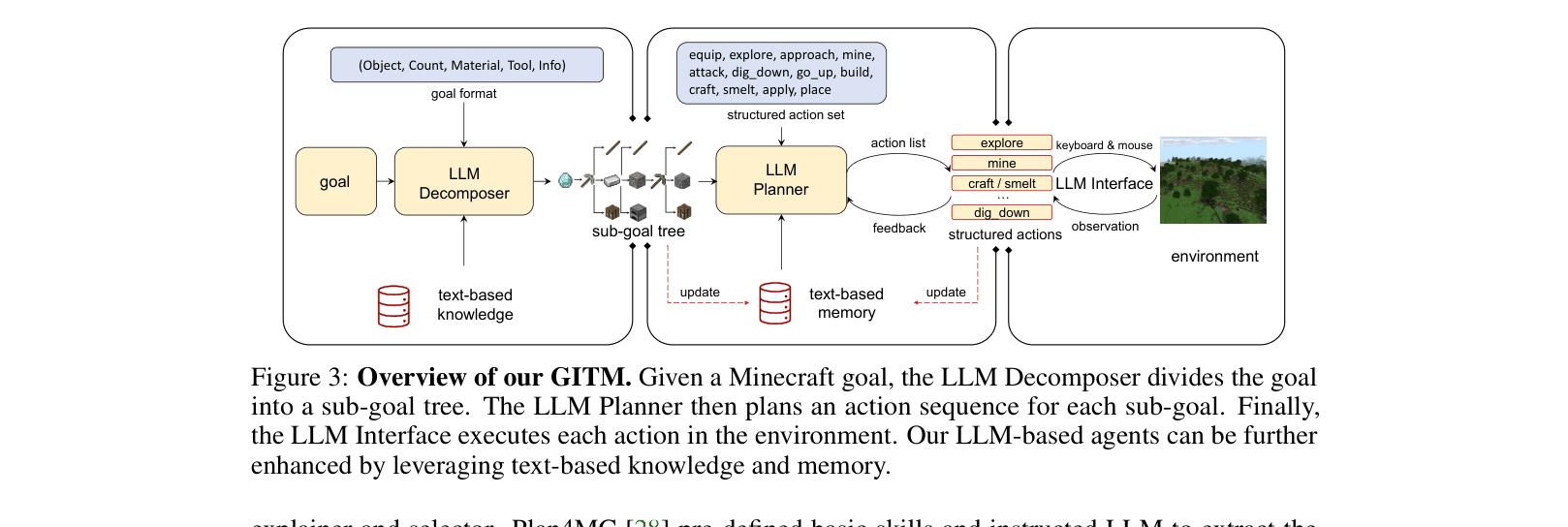
Overview of the GITM framework showing the interaction between Decomposer, Planner, Interface, and Environment
Evaluation Highlights
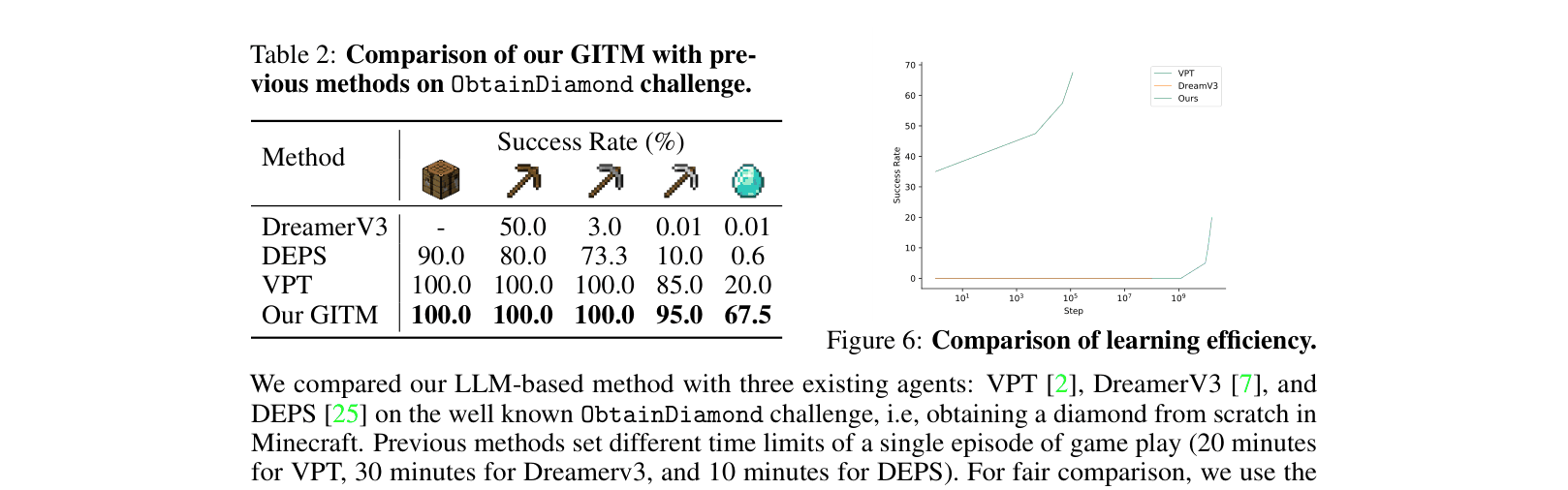
- +47.5% success rate improvement on the 'ObtainDiamond' task compared to the previous state-of-the-art (VPT)
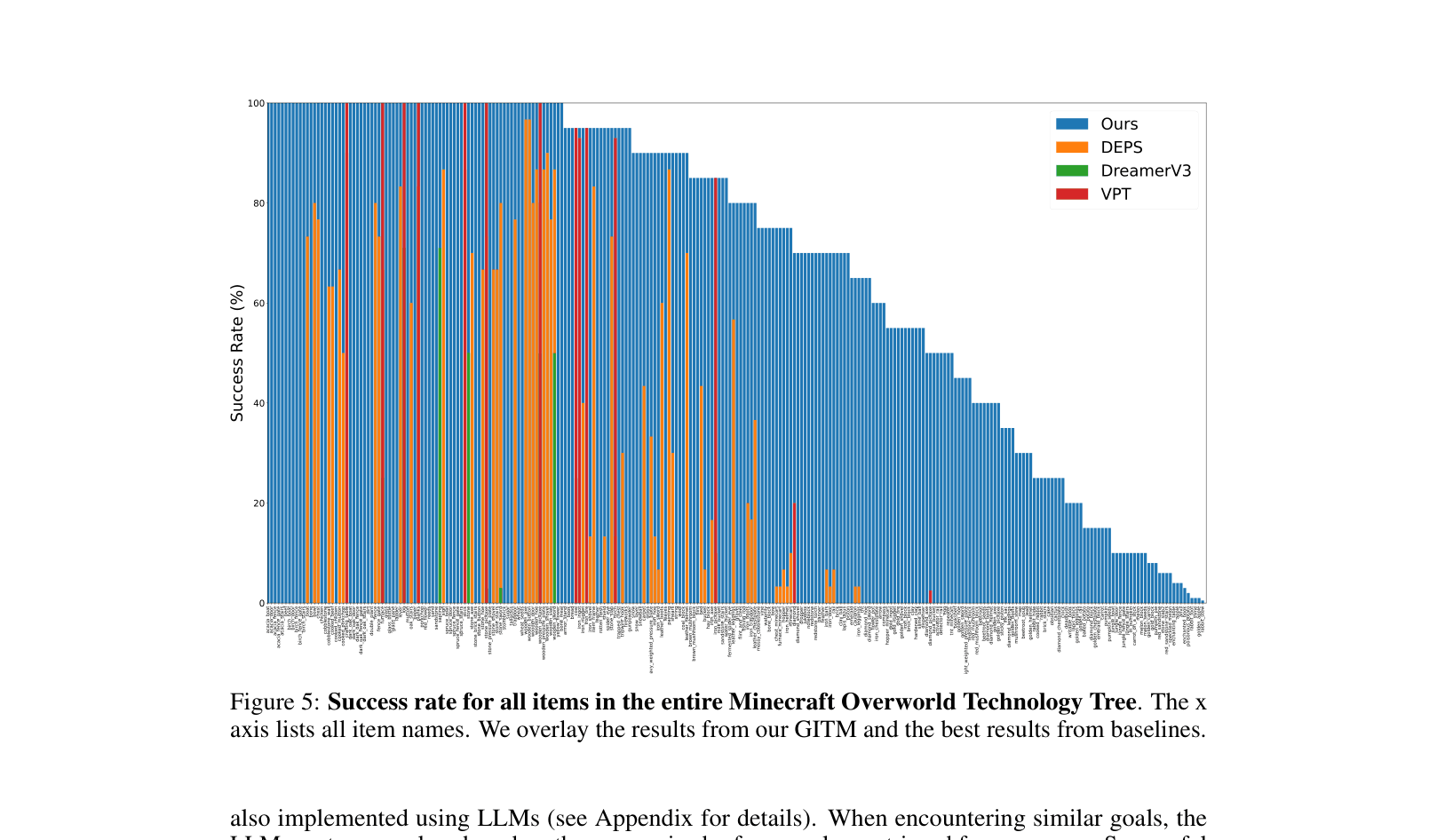
- First agent to unlock 100% of the Minecraft Overworld technology tree (262 items), whereas prior methods covered only ~30%
- Achieves results using a single CPU node (32 cores) in 2 days, reducing environment interaction steps by >10,000x compared to RL baselines (e.g., 6,480 GPU days for VPT)
Breakthrough Assessment
9/10
Achieving 100% coverage of the technology tree and outperforming massive RL baselines using only CPU compute and LLM planning is a paradigm shift for open-world agents.