📝 Paper Summary
Memory organization
Memory lifecycle management
System Architecture for LLMs
MemOS treats LLM memory as a schedulable operating system resource, unifying parametric weights, ephemeral activations, and plaintext retrieval into standardized 'MemCubes' with automated lifecycle management.
Core Problem
Current LLMs lack a unified memory architecture, relying on static weights or ephemeral context windows, while RAG acts as an ad-hoc textual patch without lifecycle governance or cross-platform consistency.
Why it matters:
- Memory silos prevent knowledge reuse across agents; a user's preference stated in one session is often inaccessible to other workflows
- Current systems cannot adapt to evolving knowledge without expensive retraining or manual database updates
- Lack of structured governance leads to security risks and inability to track data lineage in multi-user environments
Concrete Example:
In current systems, if a user updates a preference (e.g., 'I am now vegan'), this is often just stored as a text chunk. Without lifecycle management, the model's parametric memory (weights) remains outdated, and the activation memory (context) may miss this retrieval, causing the agent to inconsistently suggest meat-based recipes.
Key Novelty
Memory Operating System (MemOS)
- Elevates memory from a storage utility to a 'first-class operational resource' managed by an OS-like architecture (scheduler, lifecycle manager, I/O interface)
- Introduces 'MemCube', a standardized container for all memory types (weights, KV-caches, docs) containing both semantic payload and governance metadata
- Defines automatic transition pathways (e.g., Plaintext → Parametric) to evolve memory structures based on usage frequency
Architecture
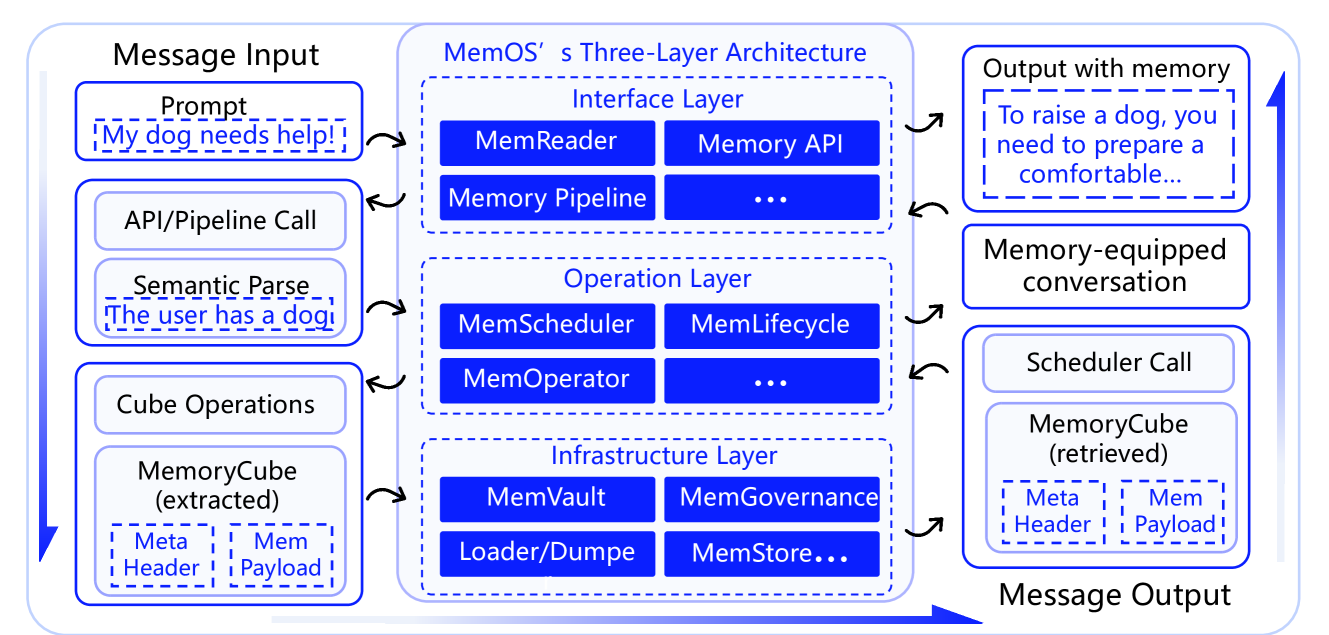
The logical architecture of MemOS, detailing the interaction between Interface, Operation, and Infrastructure layers
Breakthrough Assessment
6/10
Strong conceptual novelty in applying OS principles to LLM memory and unifying weights/activations/text. Score limited by lack of empirical validation in this short version.