📝 Paper Summary
Agentic AI
Memory
Agent Workflow Memory enables web agents to abstract reusable sub-routines from past experiences and store them as workflows to guide future long-horizon tasks.
Core Problem
Current agents solve tasks in isolation, failing to learn from past successes or extract reusable routines, making them brittle when task contexts change.
Why it matters:
- Agents that do not adapt over time waste computation solving the same sub-problems repeatedly
- Standard in-context learning with fixed examples lacks robustness to environmental changes (e.g., different websites or domains)
- Long-horizon tasks require complex trajectories that are difficult to generate from scratch without hierarchical guidance
Concrete Example:
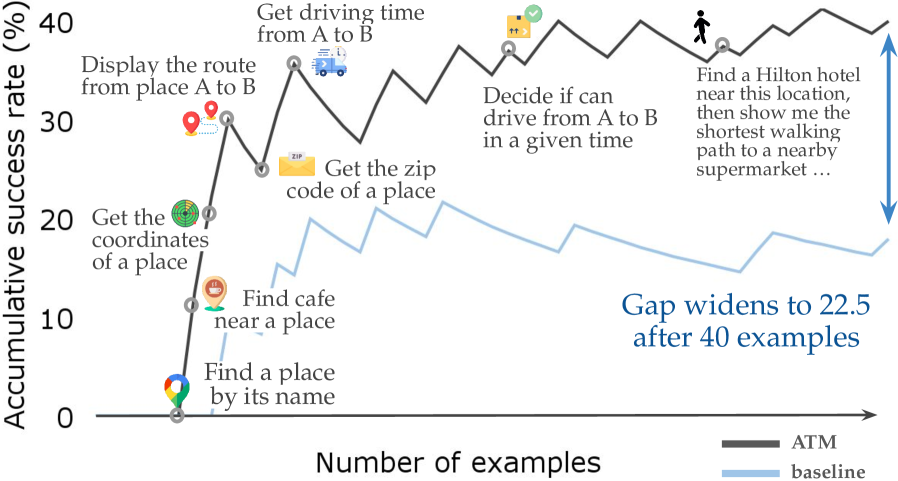
When an agent needs to 'get the zip code of a place', a standard agent might fail to plan the necessary steps. In contrast, AWM recalls a previously learned 'find a place by its name' workflow and uses it as a reliable sub-goal to complete the complex task.
Key Novelty
Agent Workflow Memory (AWM)
- Induces 'workflows' (abstracted routines) from trajectories by replacing specific values (e.g., 'dry cat food') with placeholders (e.g., '{product-name}') to ensure reusability
- Implements a 'snowball effect' where simple induced workflows serve as building blocks for more complex future workflows
- Supports both offline induction (from annotated datasets) and online supervision-free induction (from self-generated successful trials)
Architecture
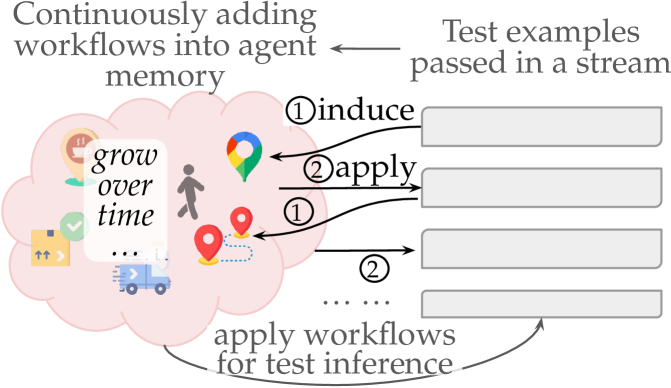
The Online Agent Workflow Memory process loop
Evaluation Highlights
- +51.1% relative improvement in success rate on WebArena compared to the top published autonomous method (Drouin et al., 2024)
- +24.6% relative improvement in success rate on Mind2Web compared to baselines
- Surpasses baselines by 8.9 to 14.0 absolute points on Mind2Web cross-domain evaluations, showing robustness to distribution shifts
Breakthrough Assessment
8/10
Significant relative improvements on major benchmarks (WebArena, Mind2Web) and a practical approach to agent memory that bridges the gap between fixed few-shot examples and continuous learning.