📝 Paper Summary
Theoretical foundations of memory
Neuro-AI alignment
The brain likely functions as a key-value memory system—separating retrieval addresses (keys) from content (values)—paralleling mechanisms found in Transformers and offering a unified view of biological and artificial intelligence.
Core Problem
Classical memory models rely on similarity-based retrieval where cues and stored patterns are entangled, preventing the simultaneous optimization of storage fidelity (content) and retrieval discriminability (addressing).
Why it matters:
- Explains the 'fragility' of memory as a retrieval failure rather than storage loss (information exists but cannot be addressed)
- Bridges the gap between biological synaptic learning rules and high-performing modern ML architectures like Transformers
- Provides a computational justification for the anatomical separation of memory systems in the brain
Concrete Example:
In a book, the index (keys) is organized alphabetically for easy finding, while the text (values) contains the meaning. Classical autoassociative models act like a book without an index, requiring one to search the content directly, which degrades discriminability.
Key Novelty
Biological Key-Value Memory Theory
- Formalizes brain memory as a heteroassociative key-value store, positing that the Medial Temporal Lobe stores keys (addresses) while the Neocortex stores values (content)
- Demonstrates mathematical equivalence between Hebbian correlation matrix memories and modern Transformer self-attention mechanisms
- Proposes that standard gradient descent training of linear layers implicitly creates a key-value memory of error gradients
Architecture
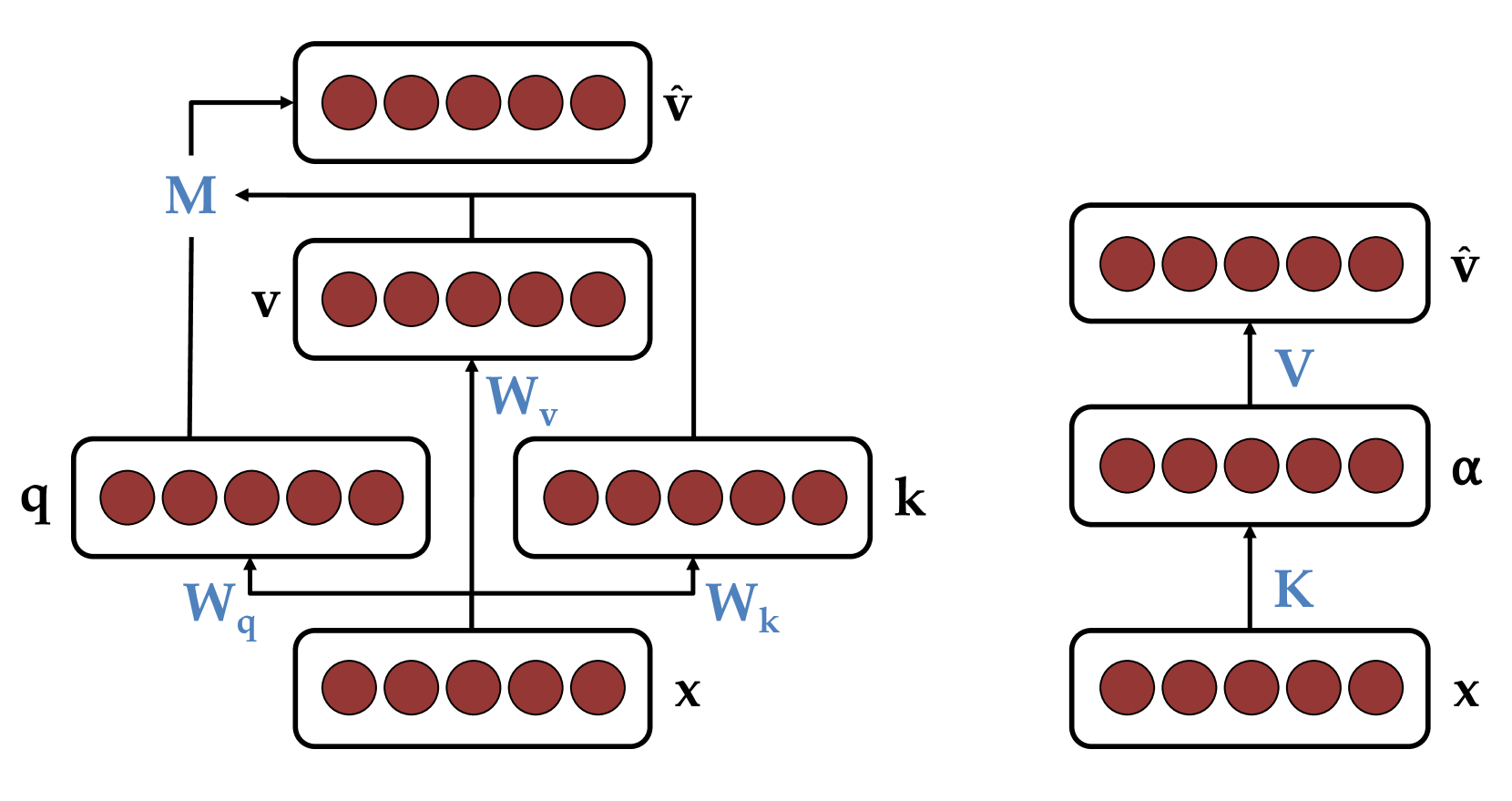
Comparison of the Correlation Matrix Memory model (left) and a biological neural circuit implementation (right)
Breakthrough Assessment
8/10
Strong theoretical synthesis connecting fundamental neuroscience (Hebbian learning, hippocampal function) with state-of-the-art AI (Transformers, fast weights), offering a unified mathematical framework for memory.