📝 Paper Summary
Graph-based memory
Graph-based RAG pipeline
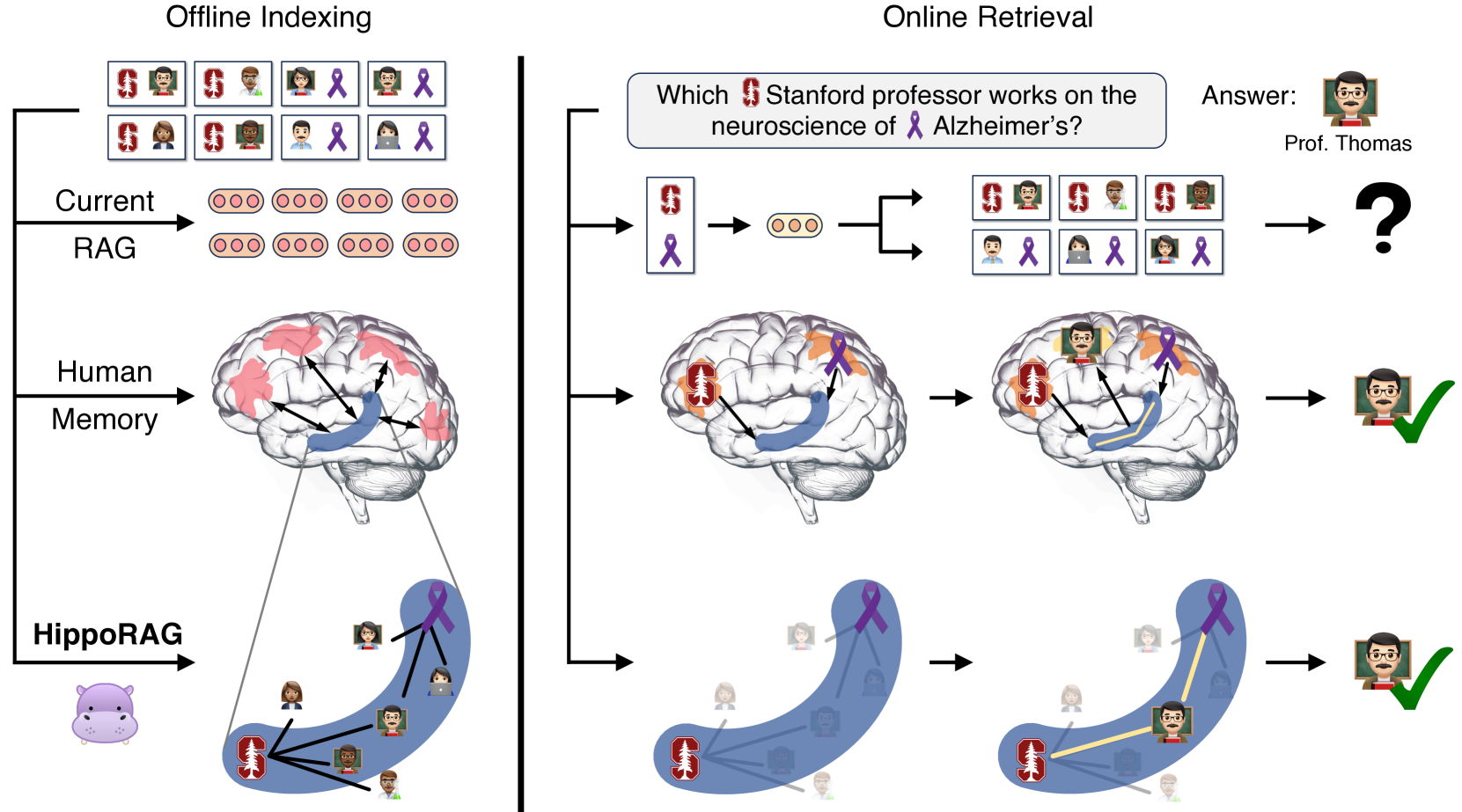
HippoRAG mimics the human brain's hippocampal indexing theory by creating a schemaless knowledge graph that enables single-step multi-hop retrieval via Personalized PageRank.
Core Problem
Standard RAG systems encode passages in isolation, making them unable to integrate knowledge across different documents without expensive iterative retrieval steps.
Why it matters:
- Complex real-world tasks (scientific review, legal briefing) require synthesizing information from disjoint passages, not just finding a single matching document
- Iterative retrieval methods (like IRCoT) are computationally expensive and slow, often requiring multiple LLM calls per query
- Existing RAG methods fail at 'path-finding' questions where the connection between concepts is not explicitly stated in a single text
Concrete Example:
Consider a query connecting 'Stanford' and 'Alzheimer's'. Standard RAG might retrieve documents about Stanford or Alzheimer's separately. HippoRAG identifies a connecting path: Stanford -> Professor Thomas -> Alzheimer's, retrieving the relevant 'Professor Thomas' passage even if it doesn't explicitly mention the query terms together.
Key Novelty
Neurobiologically Inspired Graph Retrieval (HippoRAG)
- Models the neocortex by using an LLM to extract noun phrases and relations (OpenIE) into a schemaless knowledge graph (the hippocampal index)
- Models the parahippocampal regions by adding synonymy edges between graph nodes using dense retrieval encoders
- Models hippocampal pattern completion by running Personalized PageRank on the graph to spread activation from query concepts to relevant neighbors
Architecture
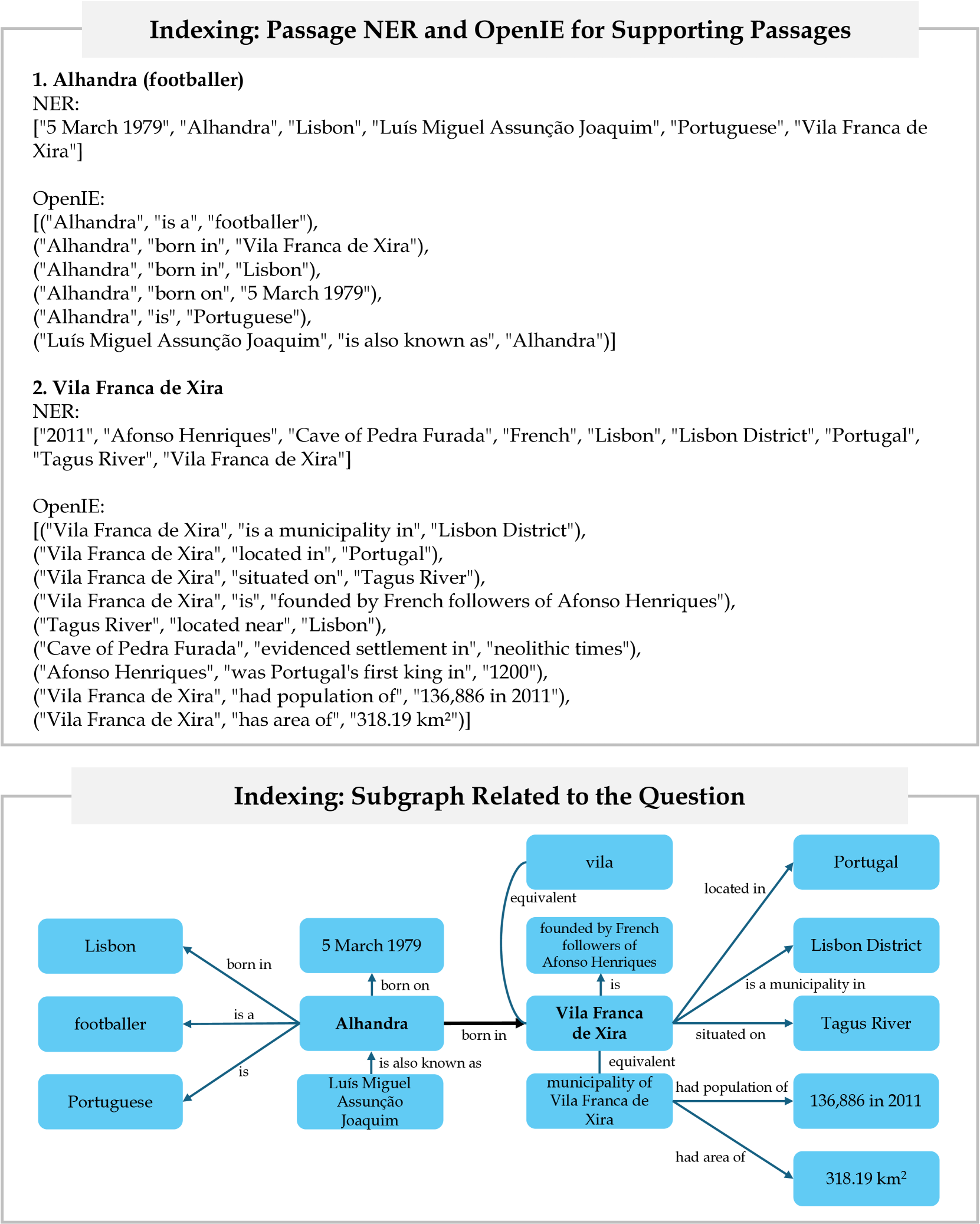
The HippoRAG framework illustrating the mapping between human memory components (Neocortex, Parahippocampal Regions, Hippocampus) and the computational pipeline (LLM, Retrieval Encoder, Graph/PPR).
Evaluation Highlights
- Outperforms state-of-the-art single-step retrieval methods by up to 20% on multi-hop QA benchmarks (MuSiQue, 2WikiMultiHopQA)
- Achieves comparable performance to iterative methods (IRCoT) while being 10-20x cheaper and 6-13x faster
- Combining HippoRAG with IRCoT yields complementary gains, improving R@5 by up to 20% on 2WikiMultiHopQA
Breakthrough Assessment
8/10
Significant efficiency gain (single-step vs. iterative) for multi-hop reasoning. The neurobiological mapping provides a strong theoretical grounding for the graph-based design.