📝 Paper Summary
Memory-Augmented Generation (MAG)
Autonomous Agents
Nemori is a memory architecture that enables agents to autonomously segment conversational streams into coherent episodes and proactively distill semantic knowledge by analyzing the gap between predicted and actual events.
Core Problem
Existing agent memory systems rely on arbitrary chunking (losing context) and passive summarization (creating redundant or incomplete knowledge), preventing true long-term self-evolution.
Why it matters:
- LLMs suffer from 'amnesia' in long interactions, resetting to a stranger state in new sessions without persistent memory
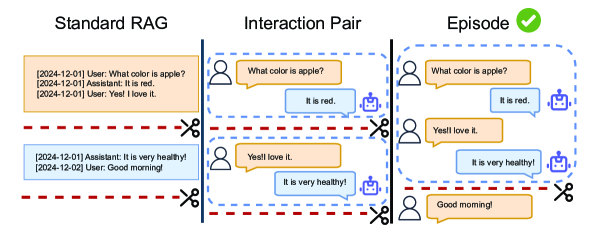
- Standard RAG is designed for static knowledge bases and misaligns with the dynamic, stateful nature of agent conversational streams
- Arbitrary segmentation (e.g., single messages or fixed windows) fractures semantic coherence, making complex reasoning across time impossible
Concrete Example:
In current systems, a conversation is often split by fixed tokens or single messages. If a user changes intent from 'asking info' to 'making a decision' mid-stream, heuristic splitters miss the boundary, storing a fragmented memory that blends two distinct contexts. Nemori uses an intelligent detector to recognize this semantic shift and segment it into a distinct episode.
Key Novelty
Cognitively-Inspired Self-Organizing Memory (Nemori)
- **Two-Step Alignment:** Instead of fixed-size chunks, the agent autonomously detects semantic boundaries (inspired by Event Segmentation Theory) and narrates the segment into a coherent episode.
- **Predict-Calibrate Principle:** Instead of passively summarizing logs, the agent tries to predict an episode's content based on past memory; the 'surprise' (difference between prediction and reality) is distilled into new semantic knowledge.
Architecture
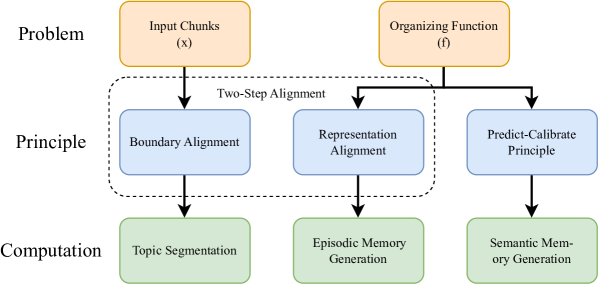
Overview of the Nemori architecture illustrating the interaction between its three core modules.
Evaluation Highlights
- Significantly outperforms prior state-of-the-art systems on the LoCoMo benchmark (quantitative values not reported in provided text snippet)
- Demonstrates pronounced advantages in longer contexts on the LongMemEval benchmark (quantitative values not reported in provided text snippet)
Breakthrough Assessment
8/10
Proposes a fundamental shift from passive storage to proactive, prediction-based learning (Free Energy Principle) for agents. While experimental numbers are missing in the snippet, the methodological contribution to MAG is significant.