📝 Paper Summary
Memory recall
Memory organization
Self-evolving Agentic reasoning
This survey provides a comprehensive taxonomy and analysis of memory mechanisms in LLM-based agents, categorizing them by information sources, storage forms, and operations to guide future design.
Core Problem
While many LLM-based agents implement memory to handle long-term interactions, existing research is scattered across isolated papers without a unified framework or design patterns.
Why it matters:
- Without memory, agents cannot solve real-world problems requiring long-term context, such as booking tickets that depend on prior feedback or maintaining personal assistant continuity
- Current ad-hoc memory designs lack standardization, making it difficult for researchers to compare mechanisms or abstract common effective patterns
- The transition from static LLMs to self-evolving AGI requires agents to autonomously accumulate knowledge and learn from experience, which is impossible without structured memory
Concrete Example:
A trip-planning agent without memory sends a ticket request but forgets the response before taking the next action, resulting in a failure to book. A memory-enhanced agent stores the website's response, retrieves it, and proceeds to the payment step.
Key Novelty
Unified Taxonomy for Agent Memory
- Deconstructs agent memory into three core dimensions: Sources (where info comes from), Forms (how it is stored), and Operations (how it is manipulated)
- Distinguishes between 'Short-term' (context window) and 'Long-term' (external storage/parameters) memory in the context of cognitive psychology analogies
- Categorizes evaluation methods into Direct Evaluation (measuring memory retention) and Indirect Evaluation (measuring downstream task performance)
Architecture
Comparison between Original LLMs (Input -> LLM -> Output) and LLM-based Agents (Input + Memory -> LLM -> Output + Memory Update)
Evaluation Highlights
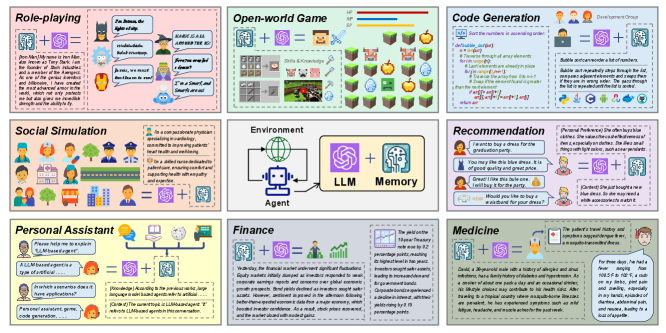
- Reviews memory mechanisms across diverse applications including role-playing, social simulation, personal assistants, and code generation
- Identifies that memory enhances self-evolution by allowing agents to reflect on past experiences (e.g., Reflexion) and adjust future behaviors
- Highlights the trade-off between memory retrieval accuracy and the computational cost of maintaining large external memory banks
Breakthrough Assessment
7/10
A timely and necessary systematization of a rapidly growing field. While it is a survey (no new algorithm), its taxonomy provides a crucial foundation for future agent memory research.