MemoryAgentBench evaluates LLM agents on four core memory competencies—retrieval, learning, understanding, and forgetting—by feeding information incrementally to simulate realistic multi-turn interactions.
Core Problem
Existing benchmarks rely on static, one-shot long contexts that fail to test how agents incrementally accumulate, update, and retrieve information over time.
Why it matters:
Real-world agents process context incrementally (stream of interactions) rather than as a single static block
Standard long-context evaluations do not assess specific memory skills like selective forgetting (updating old facts) or test-time learning
Current benchmarks like LongBench or LooGLE focus on context window capacity, not the abstraction and consolidation processes required for effective agent memory
Concrete Example:In the FactConsolidation task, an agent receives a fact (e.g., a tool's country of origin) and later receives a contradictory update. Static benchmarks might feed both at once or ask for the latest without testing the update mechanism, whereas this benchmark feeds the update sequentially, requiring the agent to overwrite the old memory to answer correctly.
Key Novelty
MemoryAgentBench Framework
Identifies four distinct memory competencies: Accurate Retrieval (AR), Test-Time Learning (TTL), Long-Range Understanding (LRU), and Selective Forgetting (SF)
Transforms static long-context datasets into incremental multi-turn streams where agents must absorb chunks sequentially before answering questions
Introduces two new datasets: EventQA for temporal reasoning in narratives and FactConsolidation for evaluating memory updates and conflict resolution
Architecture
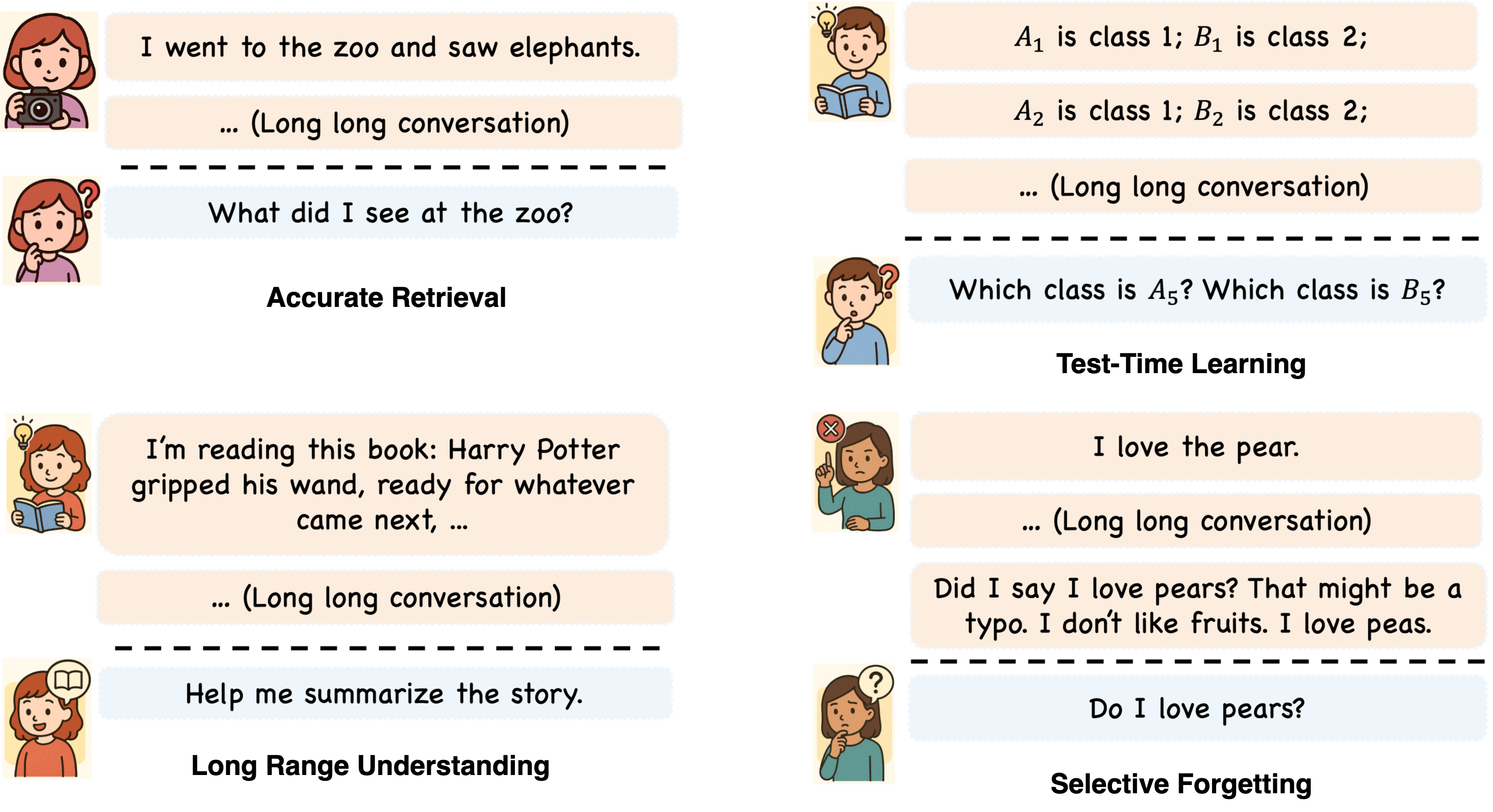
Conceptual diagram of the four memory competencies (Accurate Retrieval, Test-Time Learning, Long-Range Understanding, Selective Forgetting)
Breakthrough Assessment
7/10
Establishes a necessary distinction between 'long context' and 'agent memory,' providing a structured framework and new datasets (EventQA, FactConsolidation) to evaluate the latter, though performance results are not in the provided text.
Inputs: A sequence of text chunks c1, c2, ..., cn fed sequentially
Outputs: Answers a1, a2, ..., am to questions q1, q2, ..., qm posed after memory ingestion
Pipeline Flow
Data Reconstruction (Segmenting long contexts into sequential chunks)
Incremental Feeding (Agent absorbs chunks c1...cn one by one)
Memory Update (Agent updates internal state/DB per chunk)
Evaluation (Agent answers questions based on accumulated memory)
System Modules
Long Context Agent (Evaluated Agent Architectures)
Baseline memory strategy using the model's immediate context window
Model or implementation: Generic Long-Context LLMs (e.g., 128K+ window)
RAG Agent (Evaluated Agent Architectures)
Extends memory via external retrieval
Model or implementation: Variants: Simple (String match), Embedding-based (Vector), Structure-Augmented (Graph)
Agentic Memory (Evaluated Agent Architectures)
Iterative reasoning and active memory management
Model or implementation: Commercial/Advanced systems (e.g., MemGPT, MIRIX)
Novel Architectural Elements
Evaluation Framework: Reconstructing static datasets into sequential 'memory-loading' streams to test incremental consolidation
Modeling
Base Model: Evaluates various external models (e.g., MemGPT, MIRIX, Long-Context models)
Compute: Not reported in the paper
Comparison to Prior Work
vs. LongBench/LooGLE: Evaluates incremental memory accumulation rather than single-pass context processing
vs. LOCOMO: Tests much longer contexts (up to ~355k tokens in LongMemEval S*) and defines 4 specific memory competencies
vs. LongMemEval: Uses reconstructed real-world datasets and specific tests for selective forgetting (FactConsolidation) rather than purely synthetic conversations
Limitations
Quantitative performance results for the agents are not included in the provided text snippet
Evaluation focuses primarily on textual histories and external databases, excluding parametric memory research
Reliance on reconstructing existing long-context datasets might inherit biases from those original sources
Reproducibility
The paper mentions open-sourcing the codebase and datasets, but no specific URL is provided in the text. The benchmark introduces two new datasets: EventQA and FactConsolidation.
📊 Experiments & Results
Evaluation Setup
Agents are fed text chunks sequentially to simulate time. After ingestion, they answer questions probing specific memory skills.
Benchmarks:
EventQA (Temporal reasoning / Accurate Retrieval) [New]
Metrics not explicitly listed in text (likely Accuracy/F1)
Statistical methodology: Not explicitly reported in the paper
Main Takeaways
Current agent memory methods generally fall short of mastering all four identified competencies (Accurate Retrieval, Test-Time Learning, Long-Range Understanding, Selective Forgetting).
Existing long-context benchmarks are insufficient for memory agents because they do not capture the incremental, compressed nature of memory storage and retrieval.
Effective evaluation requires specific tests for 'Selective Forgetting' (updating facts), which is distinct from simple retrieval and critical for long-running agents.
Injecting massive contexts (e.g., 1M tokens) for single questions is resource-inefficient; the benchmark advocates for associating long contexts with many questions (e.g., 300 questions per 355k token dialogue in LongMemEval S*).
📚 Prerequisite Knowledge
Prerequisites
Understanding of Retrieval-Augmented Generation (RAG)
Familiarity with Long-Context LLMs
Concepts of agentic memory (working memory vs. long-term storage)
Key Terms
Memory Agents: Agents equipped with mechanisms (parameters, vectors, textual histories, or databases) to store, update, and retrieve information over long interactions
RAG: Retrieval-Augmented Generation—systems that retrieve relevant documents from an external source to answer queries
NIAH: Needle In A Haystack—a task requiring the model to find a specific piece of information buried in a large amount of irrelevant context
Test-Time Learning (TTL): The capacity to incorporate new behaviors or acquire new skills during deployment from context without additional gradient-based training
Selective Forgetting (SF): The ability to revise or remove previously stored information when presented with contradictory evidence (memory updates)
Incremental Processing: Absorbing input piece-by-piece over time, abstracting and consolidating it, rather than processing a full static context window at once