📝 Paper Summary
Federated Recommendation Systems (FRSs)
Personalized Federated Learning
FedRAP improves federated recommendation by modeling item embeddings as the sum of a sparse global view and a user-specific local view, balanced via curriculum-based regularization.
Core Problem
Existing Federated Recommendation Systems share identical global item embeddings across all clients, failing to capture how different users perceive the same item differently.
Why it matters:
- Identical item representations ignore user heterogeneity (e.g., users focusing on different attributes of the same item), leading to suboptimal personalization
- Transmitting dense item embedding matrices between clients and servers in Federated Learning results in prohibitive communication costs and latency
Concrete Example:
Consider the movie 'Titanic': User A may rate it highly for the romance, while User B rates it for the disaster effects. Standard federated models force a single shared item vector for 'Titanic', ignoring these distinct user-specific perspectives.
Key Novelty
Additive Item Personalization with Curriculum Regularization
- Decomposes item representation into two parts: a globally shared embedding (general knowledge) and a locally maintained embedding (personal preference), which are summed to form the final representation
- Applies a curriculum strategy that gradually increases regularization weights, transitioning the model from learning general features to refining additive personalized details over time
Architecture
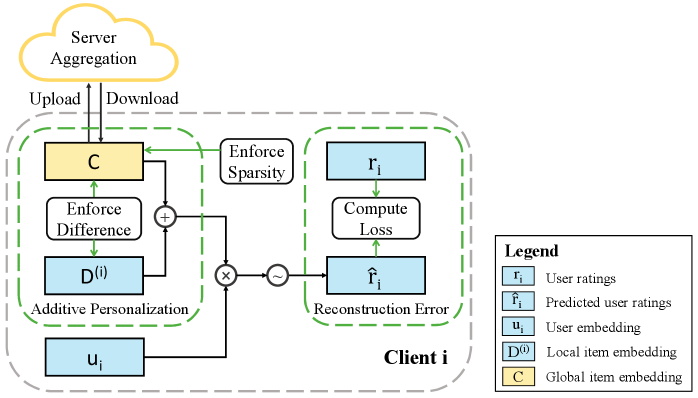
The framework of FedRAP showing the interaction between Server and Clients.
Breakthrough Assessment
7/10
Proposes a logical and effective additive structure for personalization in federated settings, addressing both heterogeneity and communication cost, though the core technique is an extension of matrix factorization.