📝 Paper Summary
Text-to-Image Generation
Personalization (P13N)
Image Editing
PALP optimizes text-to-image personalization for a single complex prompt by using score distillation guidance to maintain prompt alignment while fine-tuning on the subject.
Core Problem
Existing personalization methods struggle to simultaneously preserve a subject's identity and adhere to complex textual prompts (e.g., specific styles or locations).
Why it matters:
- Current methods (like DreamBooth) often overfit to the training images, copying the original background or pose and ignoring the new text prompt context
- Users frequently have a specific, complex target prompt in mind (e.g., 'sketch in Paris') that generic personalization methods fail to generate faithfully
Concrete Example:
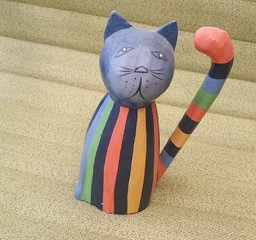
If a user wants 'A sketch of [my cat] in Paris', standard methods might generate a realistic photo (ignoring 'sketch') or a generic cat (losing identity). PALP ensures the output is both a sketch and the specific cat.
Key Novelty
Prompt-Aligned Personalization via Score Distillation
- Focuses on optimizing the model for a *single* target prompt rather than general adaptability, allowing for higher fidelity in difficult scenarios
- Uses Score Distillation Sampling (SDS) to distill the 'knowledge' of the prompt's structure (style, background) from the pre-trained model into the personalized model
- Prevents the personalized model from forgetting the meaning of the target prompt (e.g., 'sketch') while learning the new subject
Architecture
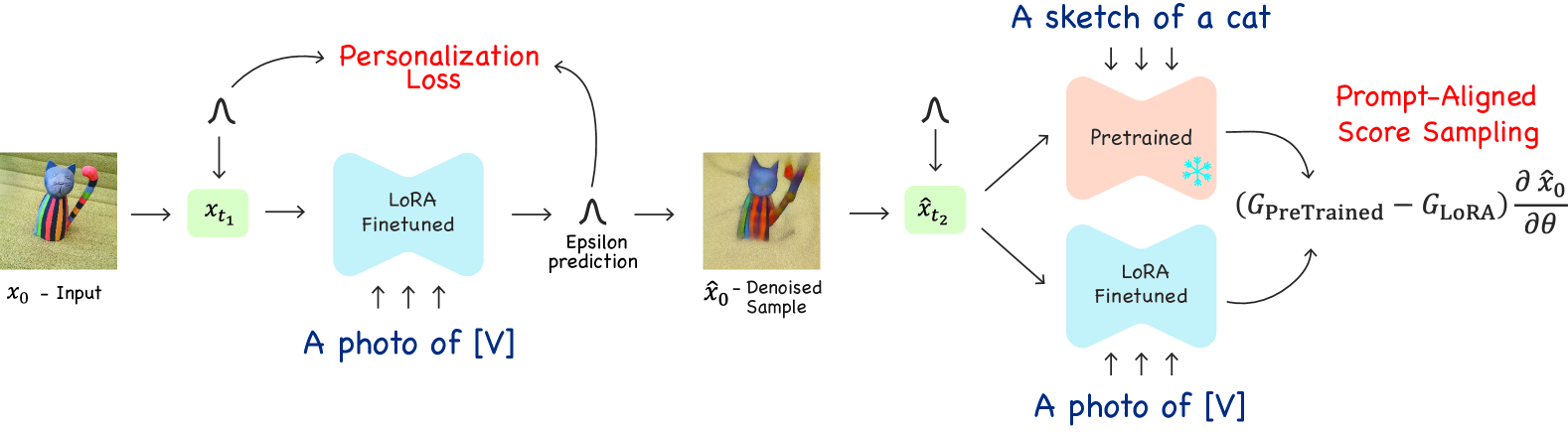
Conceptual illustration of the PALP optimization process using score sampling
Breakthrough Assessment
7/10
Offers a clever solution to the 'overfitting vs. alignment' trade-off in personalization by narrowing the scope to single-prompt optimization. The use of SDS for 2D prompt alignment is a novel application.