📝 Paper Summary
Federated Recommender Systems (FedRecSys)
Personalized Federated Learning
This survey establishes a formal definition and taxonomy for personalized Federated Recommender Systems (FedRecSys), identifying personalization as a critical but underexplored solution for handling non-IID data and privacy constraints.
Core Problem
Current FedRecSys research focuses heavily on adapting centralized architectures to federated settings or optimizing communication, often neglecting explicit user personalization modeling required to handle non-IID data distributions across clients.
Why it matters:
- Non-IID (non-independent and identically distributed) data across clients causes global models to suffer from statistical bias, failing to capture unique local preferences
- Standard FedRecSys approaches often treat all users with a single unified global model, missing the fine-grained interests necessary for high-quality recommendations
- Privacy constraints prevent centralizing data to learn these personal nuances, creating a need for decentralized personalization mechanisms
Concrete Example:
In a traditional FedRecSys, a global model might recommend popular items to everyone to minimize average error. However, a specific user might have niche interests (e.g., obscure indie films) that diverge from the global average. Without a personalized model component that decouples local preferences from the global updates, this user receives irrelevant mainstream recommendations.
Key Novelty
Formalization of Personalized FedRecSys
- Proposes the first formal definition and unified optimization objective for personalization within FedRecSys, explicitly separating global knowledge sharing from local personalization parameters
- Constructs a comprehensive taxonomy dividing existing work into 'RecSys Adaptation' (modifying architectures like MF/NN for federation) and 'FL Enhancement' (improving security, robustness, and efficiency)
- Identifies the integration of Large Language Models (LLMs) as a critical future direction for overcoming data sparsity in federated personalization
Architecture
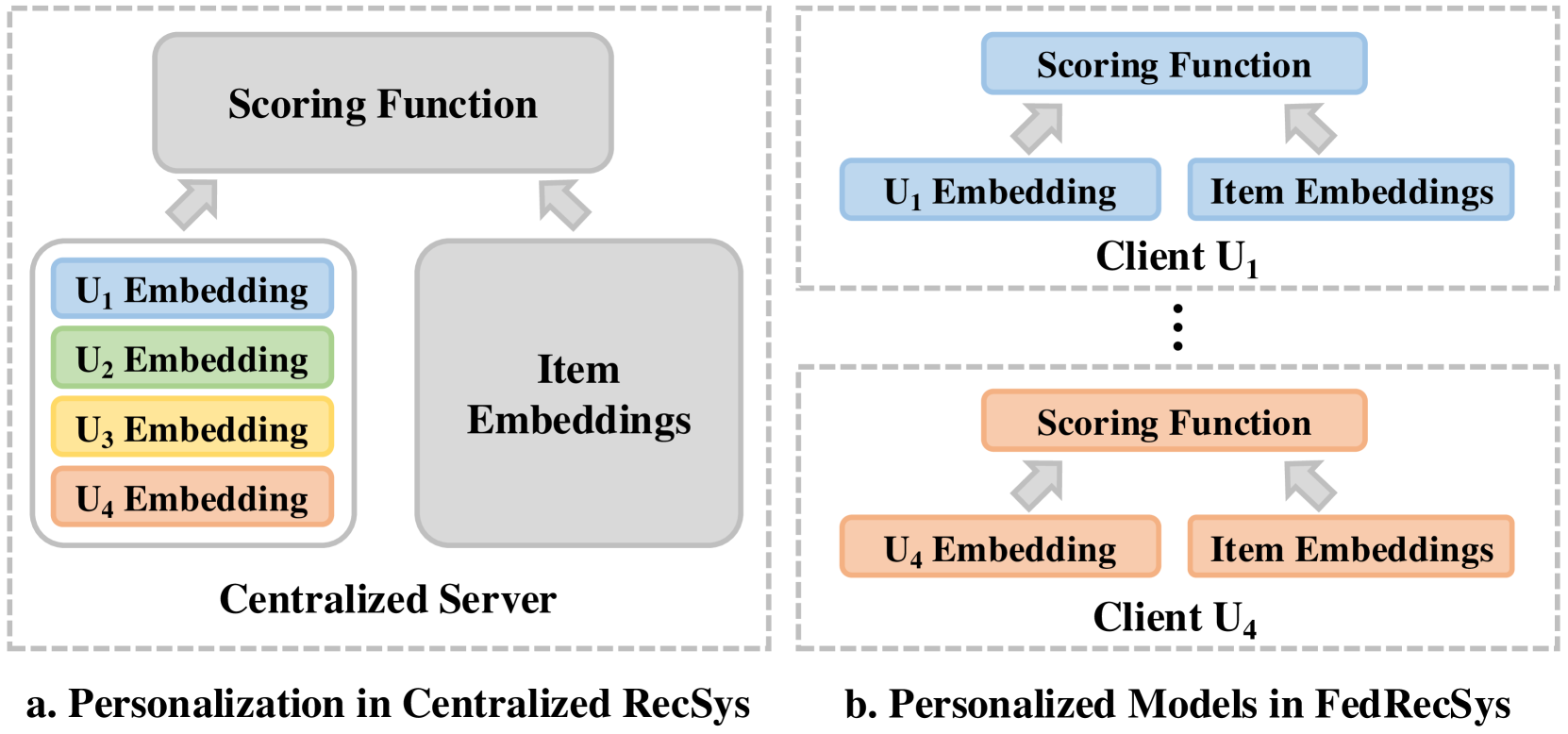
Conceptual comparison between Centralized RecSys and Federated RecSys regarding personalization
Breakthrough Assessment
7/10
A timely and necessary survey that structures a fragmented field. While it doesn't propose a new algorithm, its formalization of the personalization objective in FedRecSys and comprehensive taxonomy provide a strong foundation for future research.