📝 Paper Summary
Generative personalization
Memory internalization
CNS enables diffusion models to learn new personalized concepts sequentially without forgetting previous ones by identifying and updating only the sparse set of neurons specific to each new concept.
Core Problem
Existing personalization methods fail in continual learning settings: naively fine-tuning causes catastrophic forgetting of old concepts, while storing separate LoRA adapters for every concept is memory-inefficient and causes fusion conflicts.
Why it matters:
- Real-world users accumulate new concepts (e.g., new pets, items) over time, requiring models to adapt continuously rather than being static
- Current solutions like LoRA fusion suffer from 'concept vanishing' and 'concept confusion' when combining multiple adapters
- Storing weights for every concept scales poorly; a fusion-free, single-model solution is needed for efficient deployment
Concrete Example:
If a user first teaches a model their specific 'dog', and later teaches it a 'cat', standard fine-tuning will make the model forget the 'dog'. Alternatively, merging separate 'dog' and 'cat' LoRA adapters often results in a mixed-up image where the dog looks like the cat or vice versa.
Key Novelty
Concept Neuron Selection (CNS)
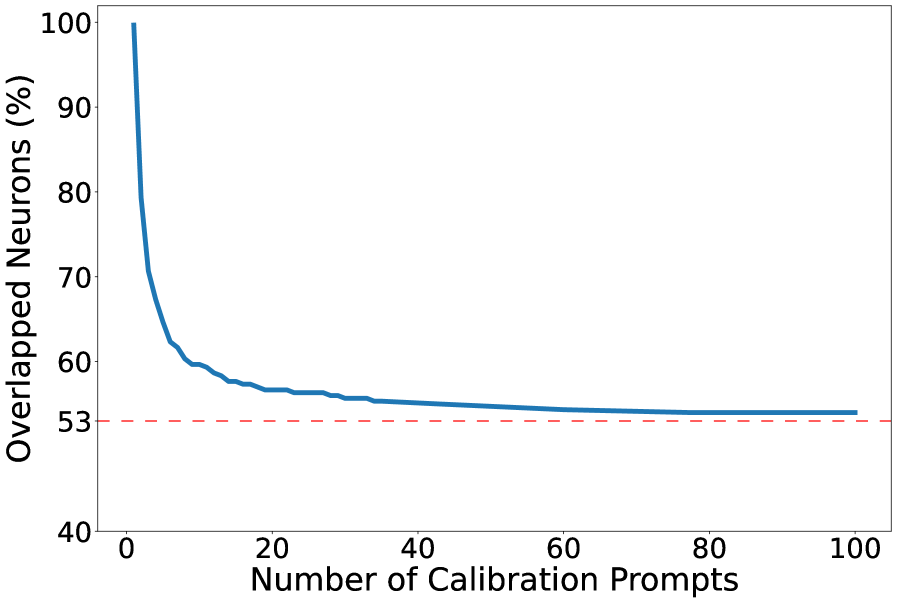
- Identifies 'concept neurons' in the cross-attention layers that are highly responsive to the target concept but not to general image generation prompts
- Selects these neurons by subtracting 'general neurons' (active for diverse prompts) from 'base neurons' (active for the specific concept images)
- Updates only these specific neurons during training, using a regularization term to preserve weights associated with previously learned concepts
Architecture
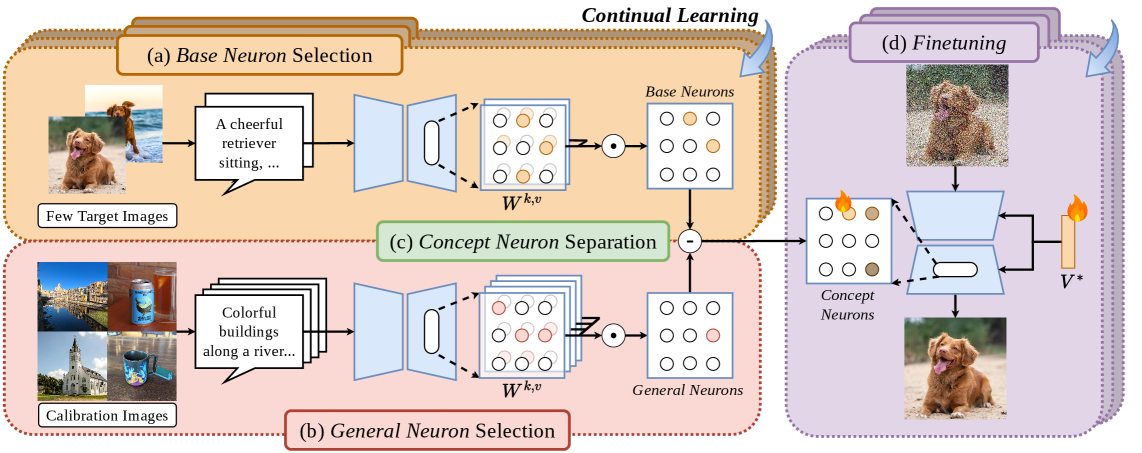
The Concept Neuron Selection process. (a) Base neurons are selected by checking activation magnitude against a threshold for concept images. (b) General neurons are selected using calibration prompts. (c) Concept neurons are the set difference (Base - General).
Evaluation Highlights
- Achieves state-of-the-art performance in both single and multi-concept personalization, outperforming LoRA fusion and Custom Diffusion methods
- Maintains zero-shot generation capability better than baselines by freezing general neurons during updates
- Reduces memory storage compared to LoRA-based approaches as it requires no additional adapter weights per concept (fusion-free)
Breakthrough Assessment
7/10
Offers a clever, efficient solution to the specific problem of continual personalization without expanding model size. While the scope is specific to diffusion models, the 'subtractive' neuron selection strategy is a strong methodological contribution.