📝 Paper Summary
Personalized Federated Learning (PFL)
Disentangled Representation Learning
FedDVA uses a dual-encoder Variational Autoencoder framework to explicitly disentangle shared global knowledge from client-specific personalized patterns in Federated Learning, improving both explainability and downstream task performance.
Core Problem
In Personalized Federated Learning (PFL), raw sample representations entangle universal knowledge with client-specific biases, making it difficult to effectively share global knowledge while retaining local personalization.
Why it matters:
- Entangled representations hinder the efficient extraction and sharing of universal knowledge across the federation
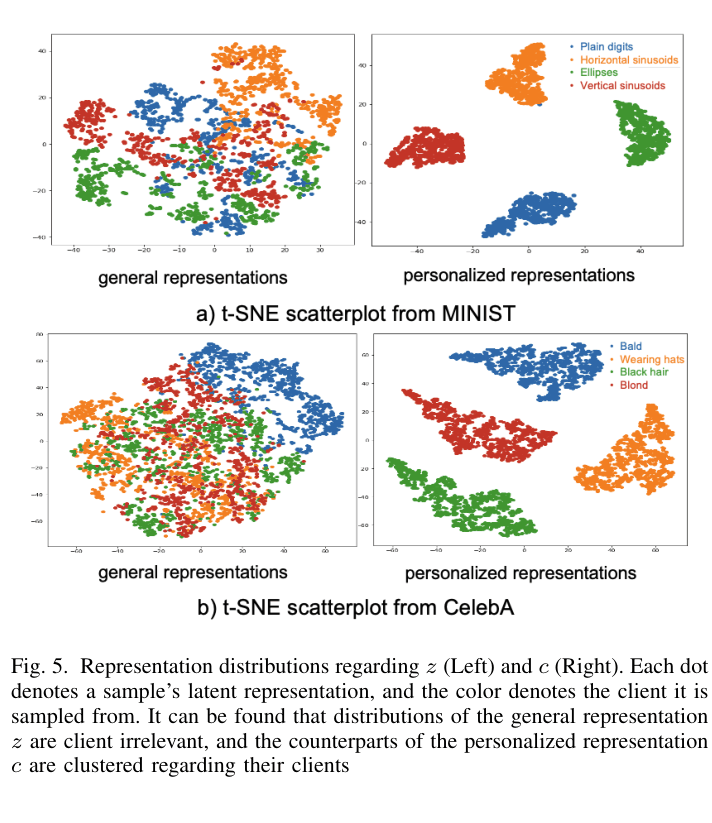
- Lack of disentanglement makes it hard to interpret what constitutes a client's specific personality or bias
- Existing PFL methods focus on architecture or optimization (like fine-tuning) but neglect the fundamental representation perspective
Concrete Example:
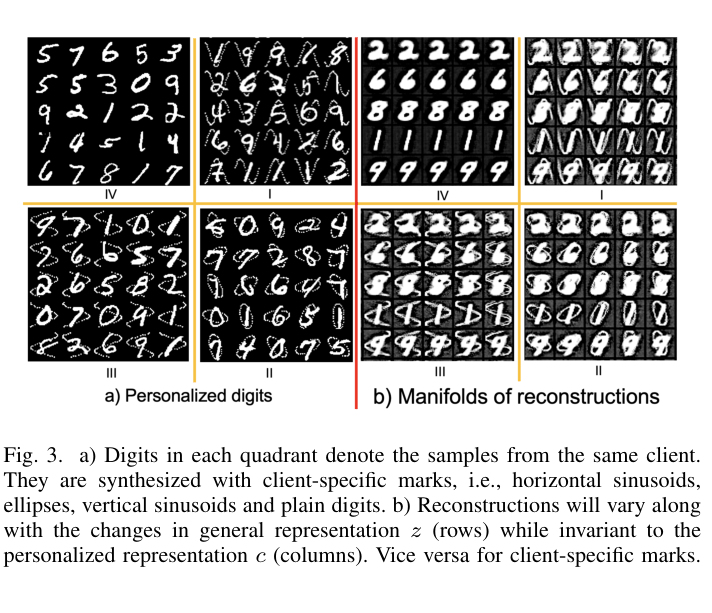
Consider handwritten digits on different clients where Client 1's images always have sinusoidal marks and Client 2's have elliptical marks. Standard FL mixes the digit features (universal) with the marks (personalized). FedDVA separates these so the model learns 'digit 7' globally while isolating 'sinusoidal mark' as a local style.
Key Novelty
Federated Dual Variational Autoencoder (FedDVA)
- Deploys two separate encoders: one for universal latent representations (shared) and one for personalized latent representations (client-specific)
- Uses a novel client-specific Evidence Lower Bound (ELBO) with a constraint that forces the personalized representation to be closer to the local client distribution than the global mixture distribution
Architecture
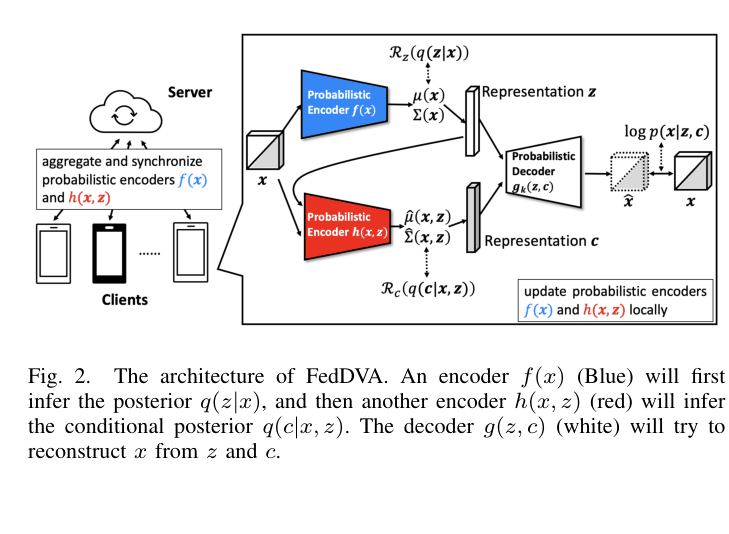
The FedDVA architecture showing the interaction between the Blue Encoder (Universal), Red Encoder (Personalized), and White Decoder.
Evaluation Highlights
- Achieves higher classification accuracy than FedAvg, FedAvg+FineTuning, and Ditto on MNIST and CIFAR-10 under heterogeneous settings
- Visualizations confirm clear manifold separation: changing the universal latent variable alters the object (e.g., face identity), while changing the personalized variable alters style (e.g., hairstyle/background)
- Demonstrates faster convergence in communication rounds compared to vanilla Federated Learning baselines
Breakthrough Assessment
7/10
A solid methodological contribution applying disentanglement (VAEs) to PFL. While VAEs are established, the dual-encoder formulation for FL with specific regularization for personalization is a clever, explainable approach.