📊 Experiments & Results
Evaluation Setup
RAG-based personalized generation where user history is retrieved and appended to the prompt.
Benchmarks:
- LongLaMP (Personalized Text Generation (Abstracts, Reviews, Topics))
- ALOE (Personalized Multi-turn Dialogue)
- LaMP (Short-text Personalization)
Metrics:
- ROUGE-L
- METEOR
- LLM-as-a-Judge (1-5 scale for ALOE)
- Statistical methodology: Not explicitly reported in the paper
Key Results
| Benchmark | Metric | Baseline | This Paper | Δ |
|---|---|---|---|---|
| Robustness analysis shows PerCE maintains high performance even when learning rate is increased, unlike Standard CE which collapses. | ||||
| LongLaMP (PAG) | ROUGE-L | 0.2261 | 0.3728 | +0.1467 |
| Cross-task transfer experiments demonstrate that PerCE learns generalized personalization capabilities that transfer to unseen tasks better than baselines trained on the target task. | ||||
| LongLaMP (PRW) | Score (likely ROUGE-L/METEOR) | 0.1898 | 0.2211 | +0.0313 |
| LongLaMP (PTW) | Score (likely ROUGE-L/METEOR) | 0.1665 | 0.1955 | +0.0290 |
Experiment Figures
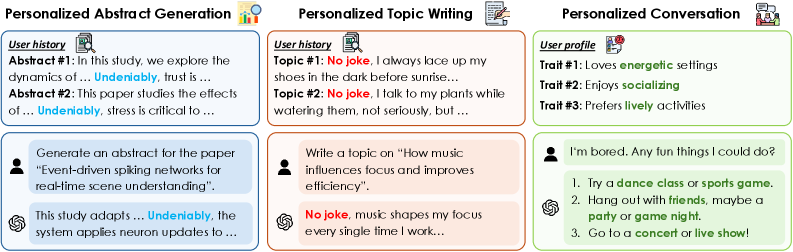
Illustration of token-level personalization degrees across different tasks.
Main Takeaways
- PerCE achieves substantial gains (up to 68.04%) on open-ended personalization tasks like Review Writing, confirming that weighting personal tokens is highly effective.
- The method demonstrates superior stability across hyperparameters; while CE collapses at higher learning rates, PerCE remains robust.
- PerCE enables strong cross-task transfer, with out-of-domain PerCE models often outperforming in-domain Standard CE models, suggesting it captures fundamental personalization patterns rather than just dataset statistics.