📝 Paper Summary
Federated Learning
Personalized Federated Learning
FedL2P uses federated meta-learning to train auxiliary networks that map a client's local data statistics to optimal fine-tuning hyperparameters (learning rates and batch norm weights) for personalizing a global model.
Core Problem
Clients in federated learning exhibit varying types of heterogeneity (label shift vs. feature shift), making one-size-fits-all personalization strategies (like freezing specific layers or enforcing specific batch norm usage) suboptimal.
Why it matters:
- Manual personalization heuristics (e.g., 'always use local Batch Norm') fail when clients differ in how similar they are to the global model
- Existing HPO methods in FL often learn a single set of hyperparameters for all clients or fail to account for client-specific data distributions during the parameter search
- New clients joining the network usually require computationally expensive local search to find optimal hyperparameters
Concrete Example:
In a setup with both feature and label shift, Client A might benefit from using its own Batch Norm statistics (due to feature shift), while Client B might benefit from the global model's statistics (due to small data size). A standard strategy forces both to use the same setting, hurting at least one client.
Key Novelty
Federated Meta-Learning of Hyperparameter Networks
- Instead of learning the hyperparameters directly, learn 'meta-nets' (small MLPs) that function as a policy: they take client data statistics as input and output the optimal hyperparameters
- Decouples the strategy from the client identity: the meta-nets learn to recognize data patterns (e.g., high feature variance) and prescribe the correct adaptation strategy (e.g., high learning rate for BN layers)
- Enables 'zero-shot' personalization configuration: new clients can generate optimal hyperparameters instantly by passing their data statistics through the pre-trained meta-nets without iterative search
Architecture
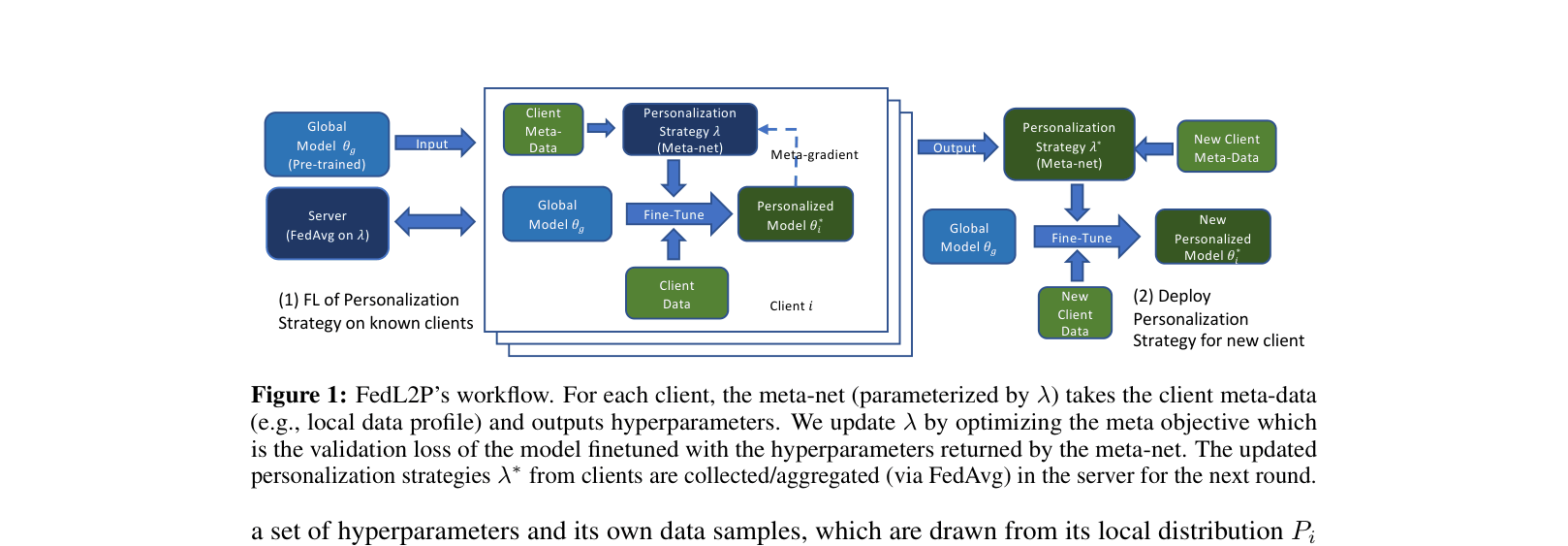
The workflow of FedL2P, showing the interaction between the Global Model, the Personalization Strategy (Meta-nets), and the Client Data.
Evaluation Highlights
- +25.09% accuracy improvement on Speech Commands (Unseen Clients) compared to standard fine-tuning with client Batch Norm statistics (87.85% vs 62.76%)
- Outperforms FedBABU and PerFedAvg baselines on CIFAR-10 with high heterogeneity (alpha=0.1), achieving 80.28% vs 79.58% and 77.68% respectively
- Achieves 88.85% on Office-Caltech-10 compared to 80.97% for standard fine-tuning, effectively handling feature distribution shifts
Breakthrough Assessment
7/10
Strong methodological contribution by applying meta-learning to HPO in FL. The ability to generalize to unseen clients is a significant practical advantage. Results are solid, though improvements on some benchmarks (CIFAR) are marginal compared to the massive gains on others (Speech Commands).