📝 Paper Summary
LLM Personalization
Cognitive Architectures
PRIME unifies LLM personalization via a cognitive dual-memory system that combines episodic retrieval with semantic belief modeling, augmented by a user-aligned reasoning process.
Core Problem
Current personalization methods are fragmented (retrieval vs. fine-tuning) and rely on shallow benchmarks that measure style mimicry rather than latent user beliefs.
Why it matters:
- Generic LLM responses fail to build trust or reduce interaction friction in commercial applications like customizable GPTs
- Existing piecemeal approaches lack a unified theoretical framework to explain what drives effective personalization
- Short-context benchmarks neglect genuine personalization needed for modeling deep, evolving user traits
Concrete Example:
In the 'Change My View' forum, a generic model might generate a standard counter-argument that fails to persuade an Original Poster (OP) because it ignores the OP's historical belief patterns and specific argumentation style preference, whereas a personalized model would recall past successful interactions to tailor the reasoning.
Key Novelty
Cognitive Dual-Memory Framework (PRIME)
- Mirrors human cognition by splitting personalization into Episodic Memory (recalling specific past events) and Semantic Memory (internalizing abstract beliefs/traits)
- Introduces 'Personalized Thinking', a slow-thinking strategy where the model generates user-aligned reasoning traces via self-distillation
- Constructs a new long-context benchmark (CMV) focused on persuasion and latent belief modeling rather than surface-level style
Architecture
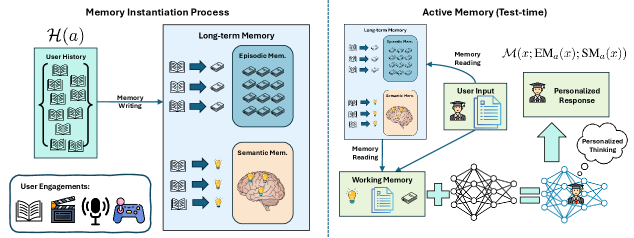
Conceptual framework of PRIME showing the integration of episodic and semantic memory with the personalized thought process
Evaluation Highlights
- Constructed the Change My View (CMV) dataset with 7,514 historical engagements across 41 active authors to evaluate long-context personalization
- Demonstrated that Semantic Memory (SM) instantiations are generally more robust than Episodic Memory (EM) for capturing user traits
- Identified that Task-oriented Fine-Tuning (T-FT) yields the best performance among Semantic Memory instantiations
Breakthrough Assessment
8/10
Proposes a cognitively grounded unified framework that bridges retrieval and fine-tuning, addresses the lack of deep personalization benchmarks, and introduces personalized reasoning traces.