📝 Paper Summary
Conversational personalization
User-profile based personalization
Passive personalization adapts AI responses to user expertise levels to reduce cognitive load and improve subjective satisfaction, though it requires active user control to consistently maximize objective performance in timed tasks.
Core Problem
Users of different expertise levels (novices vs. experts) require different AI response styles (step-by-step vs. concise/technical), but current systems rarely adapt to this dynamically in knowledge-intensive tasks.
Why it matters:
- Novices often feel overwhelmed by technical jargon, while experts find verbose explanations inefficient and tedious
- One-size-fits-all responses fail to narrow the gap between expert and novice performance in human-AI collaborative settings
- The specific impact of expertise-based adaptation on knowledge-intensive tasks (like exam taking) remains understudied compared to general chit-chat
Concrete Example:
When asking about a technical configuration, a novice needs a detailed, readable explanation with examples, whereas an expert prefers a succinct, jargon-dense answer. A standard AI response might be too complex for the novice or too verbose for the expert.
Key Novelty
Passive Expertise-Based Enterprise Assistant
- Classifies user expertise on the fly using implicit signals (jargon usage, readability, word count) and domain-specific profiles without requiring explicit user settings
- Uses a dual-agent architecture where a Product Knowledge (PK) agent retrieves information and a Primary agent restyles the text (length, jargon, readability) via optimized prompts
Architecture
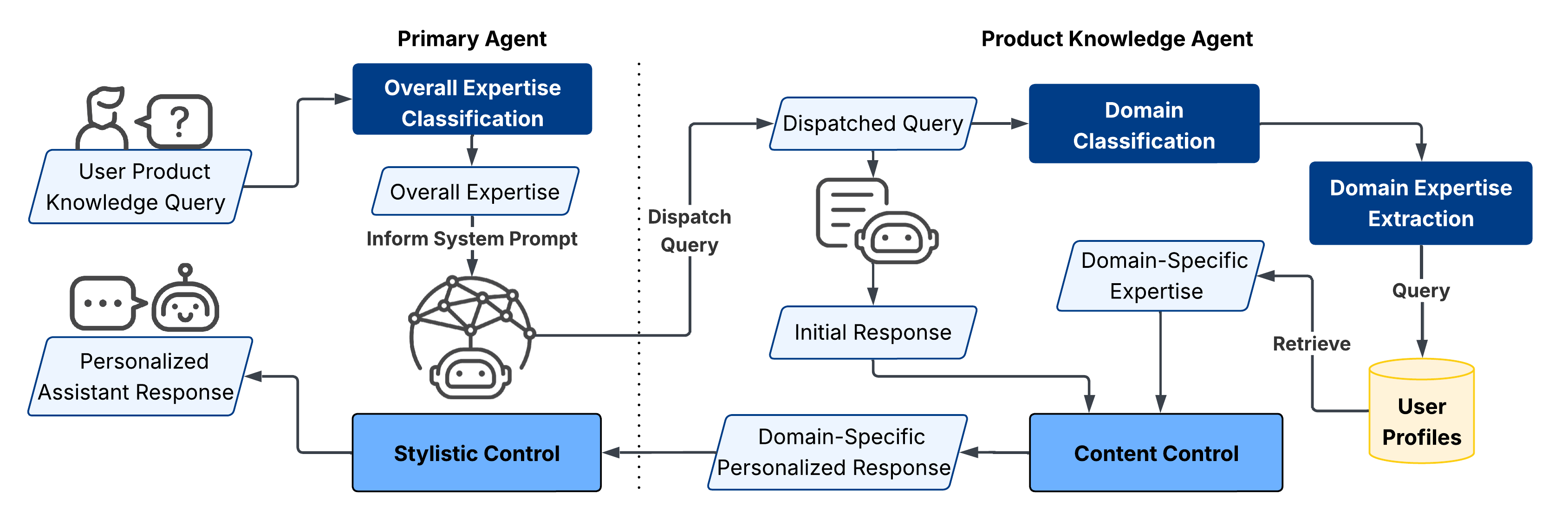
The overall system flow for the expertise-based personalized assistant.
Evaluation Highlights
- Novice users improved their exam scores from 55.0% (baseline) to 66.7% with personalization, while experts improved from 85.4% to 93.8%
- Personalization reduced the rate at which novice users guessed answers from 34.1% to 28.2%, suggesting deeper engagement with the content
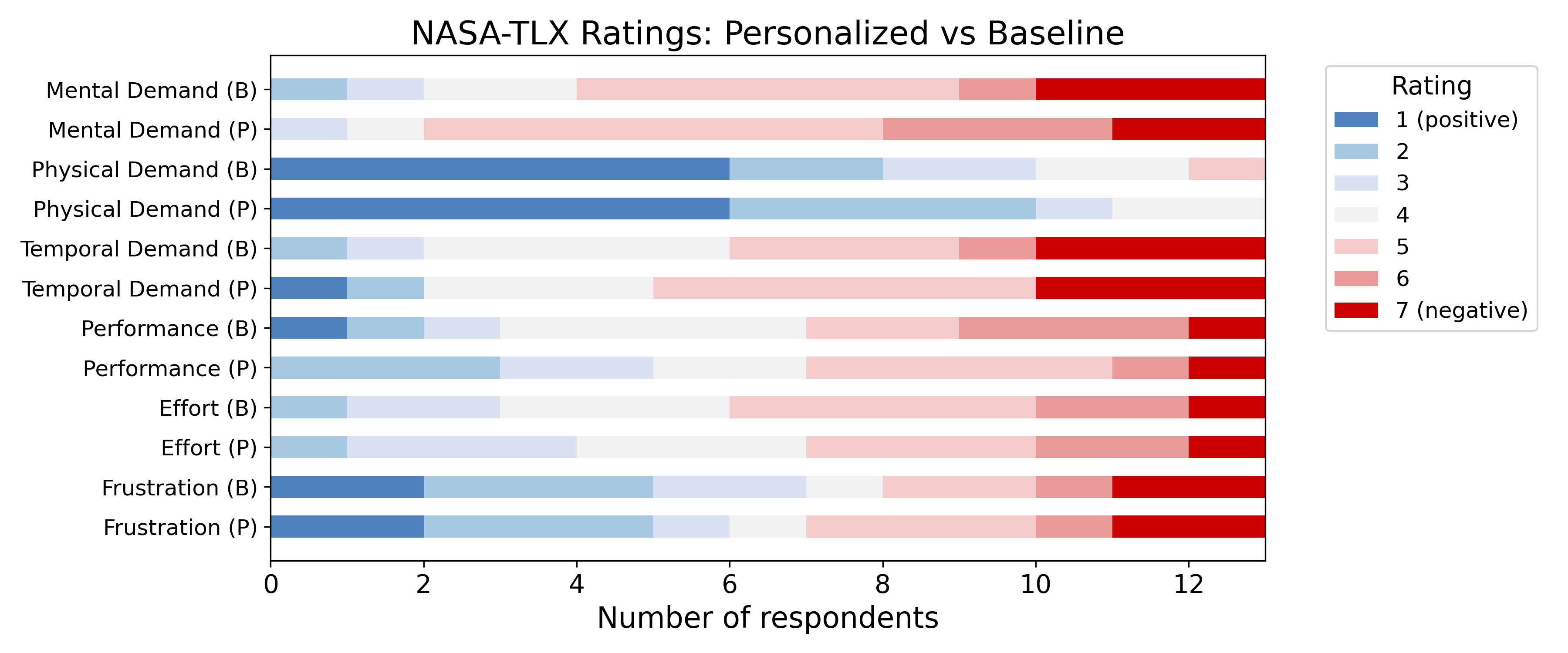
- Subjective workload (NASA-TLX) showed reductions in Temporal Demand and improvements in Perceived Performance with the personalized assistant
Breakthrough Assessment
4/10
A solid case study applying known personalization concepts to a specific enterprise domain. It highlights the limitations of passive personalization but doesn't introduce fundamental algorithmic breakthroughs.