📝 Paper Summary
Personalized Health Interventions
Causal Inference in Healthcare
The paper proposes a hybrid framework combining Large Foundation Models (LFMs) for hypothesis generation with N-of-1 trials for individual causal validation to solve personalization paradoxes in healthcare.
Core Problem
LFMs trained on population data fail to reliably predict individual treatment effects due to the 'generalizability paradox'—models accurate in one context perform at chance level in others.
Why it matters:
- Applying population-average models to individuals can lead to suboptimal or harmful health recommendations because they miss individual heterogeneity.
- Existing personalization approaches struggle with the 'privacy-performance paradox' (needing data but risking privacy) and 'automation-empathy paradox' (efficiency vs. human-centered care).
- Purely predictive models lack the causal counterfactual evidence required to determine if a specific intervention will actually work for a specific person.
Concrete Example:
A model trained to predict schizophrenia treatment outcomes might achieve high accuracy (AUC > 0.70) within its training trial but collapse to chance (AUC ≈ 0.50) when applied to a similar population in a different trial, failing to identify which subgroup an individual belongs to.
Key Novelty
Hybrid LFM + N-of-1 Trial Framework
- Use the LFM as a 'digital twin' to generate ranked personalization hypotheses (e.g., specific treatments or communication styles) based on population patterns.
- Validates these hypotheses through N-of-1 trials: controlled, crossover self-experiments where the individual alternates between interventions to generate personal causal evidence.
- Integrates population priors with individual experimental data using Bayesian methods to progressively refine the personalized model.
Architecture
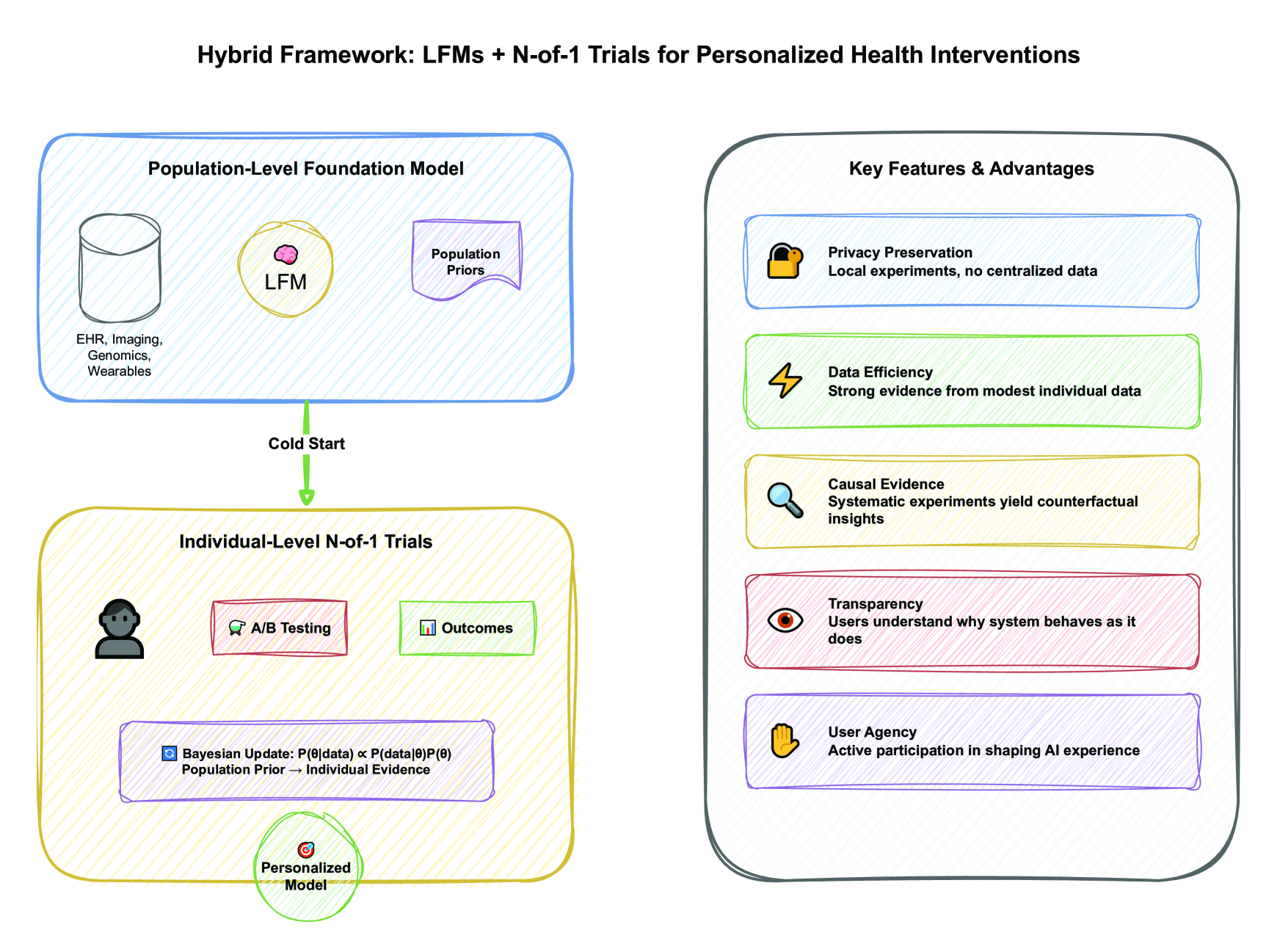
The hybrid framework combining LFMs and N-of-1 trials. It shows the flow from a Population Foundation Model generating hypotheses to an Individual N-of-1 Trial, and finally to a Personalized Model/Digital Twin.
Breakthrough Assessment
6/10
Provides a strong conceptual framework addressing fundamental limitations of AI in medicine (causality vs. correlation). However, it is a position paper proposing a framework without empirical implementation or results.