📝 Paper Summary
Memory organization
Cognitive Architecture
The paper proposes a cognitive architecture framework for LLMs that categorizes memory technologies into sensory, short-term, and long-term types to guide the development of stable, self-evolving AI agents.
Core Problem
Current LLMs lack stable and structured long-term memory, processing prompts in isolation (statelessness) or relying on limited context windows, which prevents continuity and self-evolution.
Why it matters:
- Stateless models fail to provide context-rich, personalized responses across extended interactions
- Without memory, models are prone to hallucinations when retrieval fails or knowledge is missing
- Re-processing large documents (PDFs, financial statements) for every query is computationally expensive and inefficient
Concrete Example:
A customer service AI without episodic memory treats a user requesting a refund as a new interaction, forgetting they previously provided details. In contrast, a memory-integrated agent recalls the specific context of the prior refund request to tailor the response immediately.
Key Novelty
Cognitive Architecture Taxonomy for LLMs
- Maps biological memory stages (Sensory, Short-Term, Long-Term) to specific LLM components (Prompts, Context Window, Vector DBs/RAG)
- Differentiates 'Memory' (dynamic repository of experiences) from 'Knowledge' (static facts) and 'Profiling' (identity/environment)
- Classifies technical implementations into text-based, KV cache-based, parameter-based, and hidden-state-based approaches
Architecture
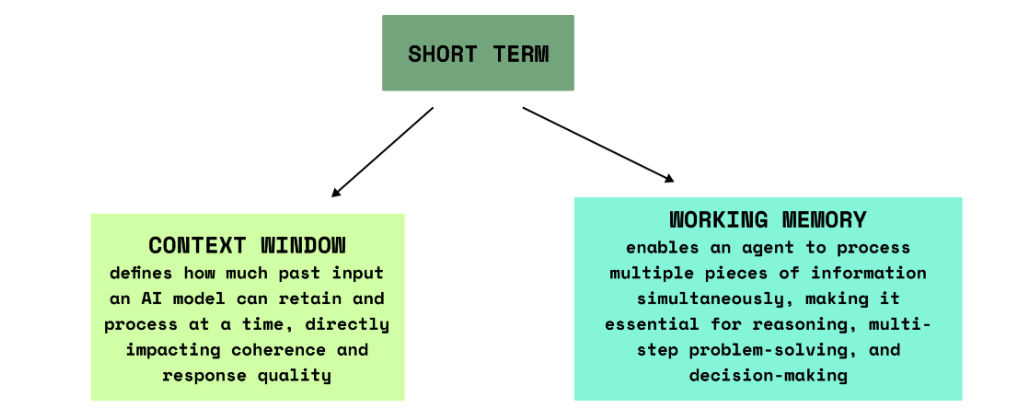
Definition of Short-Term Memory (STM) in the context of Human vs. LLM processes
Breakthrough Assessment
4/10
This is a survey/position paper providing a conceptual framework rather than a new empirical method or SOTA result. It organizes existing literature well but does not present a technical breakthrough.