📝 Paper Summary
Continual Learning (CL)
Rehearsal-based methods
ADRM mitigates overfitting in continual learning rehearsal buffers by using adversarial attacks to generate diverse and complex variations of stored memory samples during training.
Core Problem
Rehearsal-based continual learning methods suffer from 'memory overfitting,' where models become too specialized on the small subset of stored examples, losing generalization and eventually forgetting past tasks.
Why it matters:
- Memory buffers are necessarily small (e.g., 200-1000 images), causing models to memorize specific static samples rather than learning robust class features.
- Overfitting to the memory buffer leads to catastrophic forgetting of the actual data distribution of previous tasks.
- Standard rehearsal lacks robustness against natural corruptions and adversarial noise, which is critical for safety-critical applications like aviation or medical imaging.
Concrete Example:
In a class-incremental setup, a model might store only 20 images of 'airplanes' from a past task. Repeatedly training on just these 20 exact images causes the model to memorize them perfectly but fail to recognize new, slightly different airplanes, leading to forgetting of the general 'airplane' concept.
Key Novelty
Adversarially Diversified Rehearsal Memory (ADRM)
- Applies Fast Gradient Sign Method (FGSM) attacks to memory samples during replay to generate perturbed variations, artificially expanding the diversity of the limited buffer.
- Rehearses a mixture of both 'successful' adversarial examples (those that fooled the model) and 'failed' ones (those the model still classified correctly), enriching the decision boundary information.
- Forces the model to learn robust features that are invariant to small perturbations, preventing it from latching onto brittle, non-robust features specific to the few stored samples.
Architecture
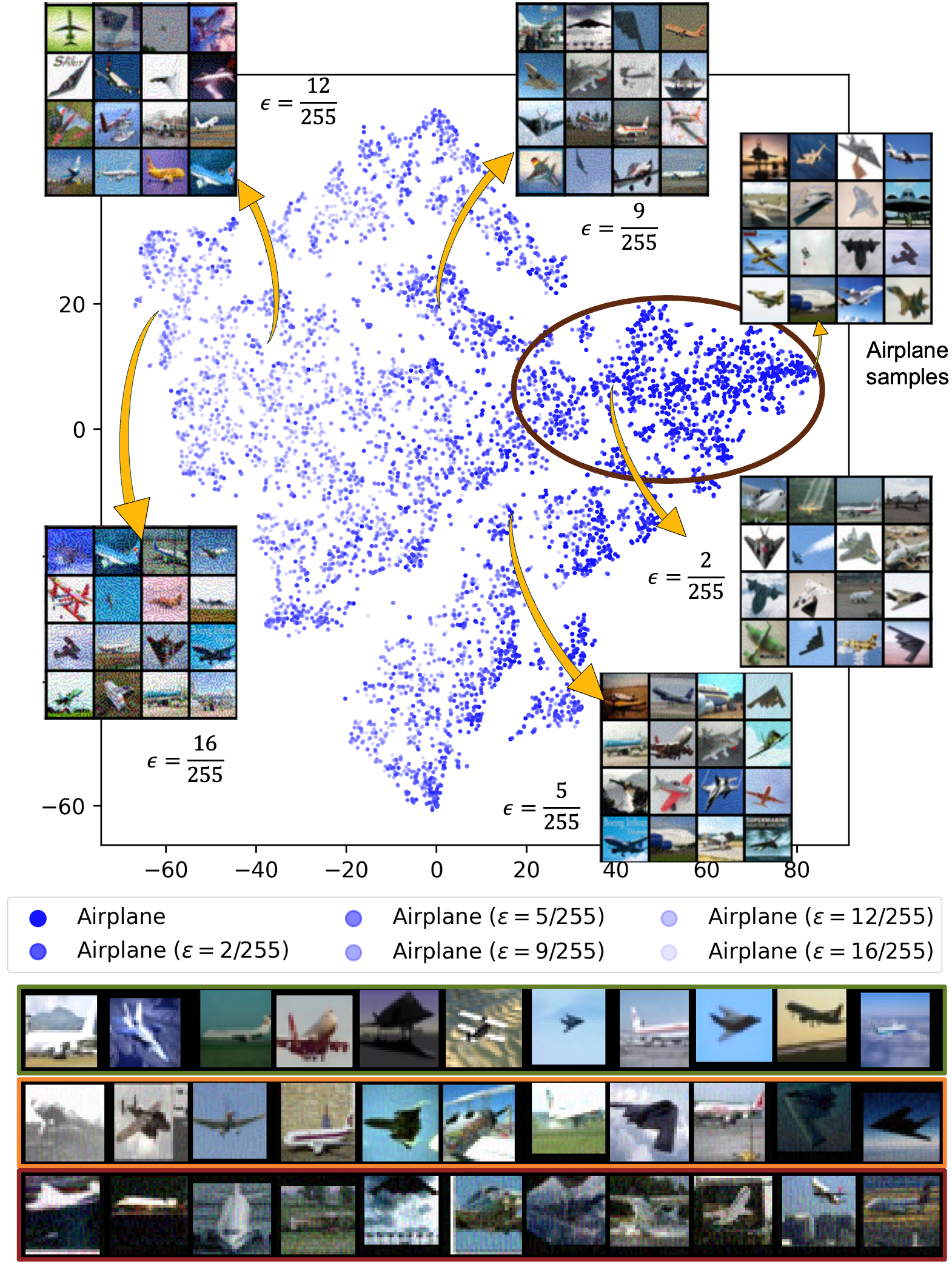
Conceptual illustration of the ADRM process. It shows original memory samples (e.g., an airplane) being perturbed by FGSM into 'diversified' samples. Some perturbations lead to misclassification (red border), others remain correctly classified (green border). Both are mixed with the current task data for training.
Evaluation Highlights
- Outperforms standard Experience Replay (ER) by +19.4% Average Classification Accuracy on Split CIFAR-10 (2 tasks).
- Achieves comparable performance to state-of-the-art methods like DER and FOSTER on standard benchmarks while significantly improving robustness.
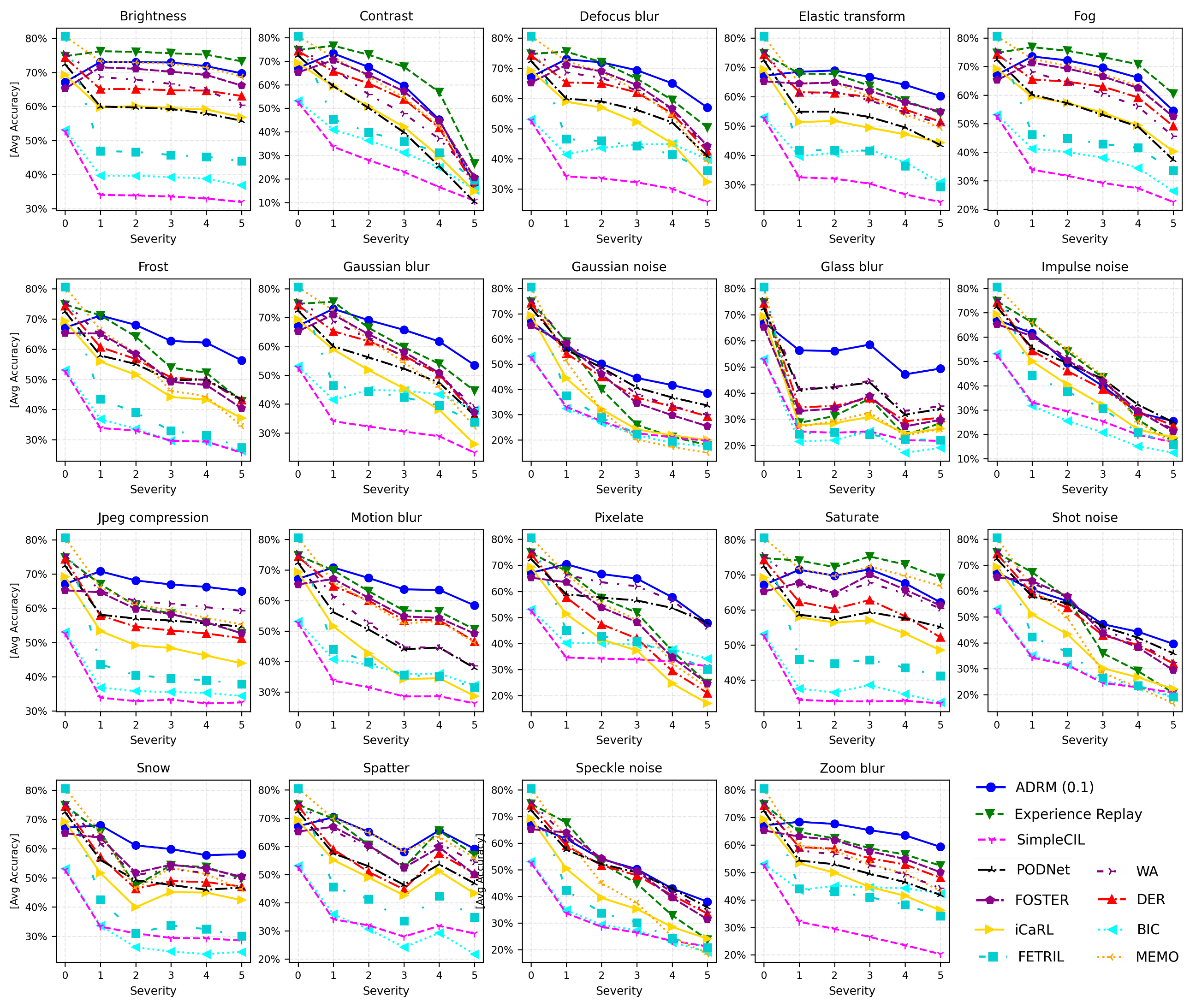
- Demonstrates superior robustness against noise: outperforms DER by +32.35% on the naturally corrupted CIFAR10-C dataset.
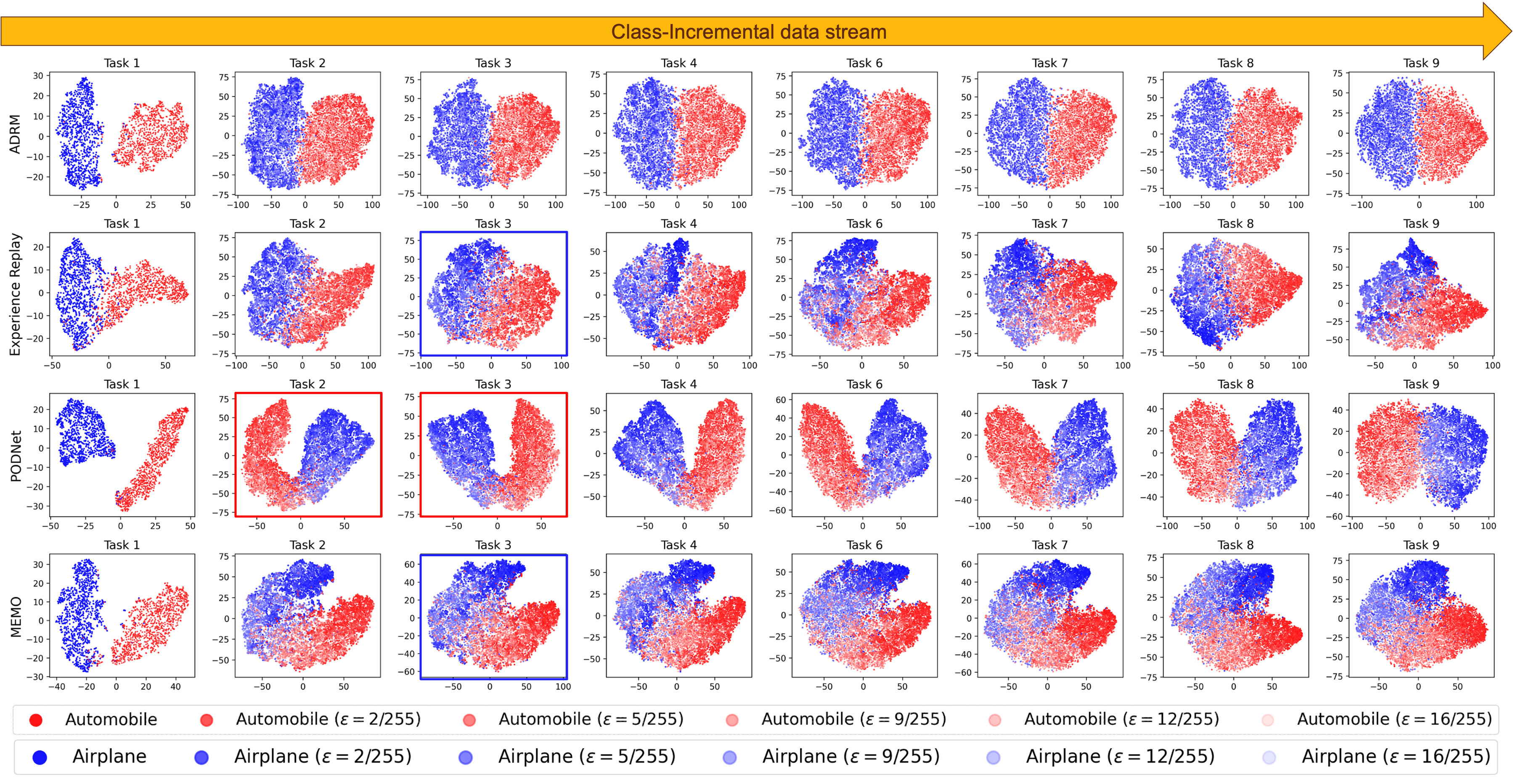
- Maintains higher feature stability: ADRM features drift less than baselines when subjected to adversarial noise, validated via CKA (Central Kernel Alignment) similarity analysis.
Breakthrough Assessment
6/10
A smart application of adversarial training to the specific problem of memory overfitting in CL. While the core technique (FGSM) is standard, its application to diversify replay buffers effectively addresses a key bottleneck in rehearsal methods.