📝 Paper Summary
Tree/graph-baesd memory
Multi-agent
Self-evolving Agentic reasoning
G-Memory enables multi-agent systems to self-evolve by organizing lengthy interaction histories into a three-tier graph hierarchy (insight, query, interaction) for retrieving both abstract wisdom and procedural details.
Core Problem
Current multi-agent systems (MAS) lack self-evolution capabilities because their memory mechanisms are either overly simplistic (ignoring interaction nuances) or lack cross-trial persistence.
Why it matters:
- MAS interactions generate up to 10x more tokens than single agents, overwhelming traditional retrieval contexts
- Existing systems like MetaGPT only store final results, discarding the valuable collaborative process that explains *why* a solution worked
- Without structured memory, agent teams repeat mistakes and fail to improve coordination strategies over time
Concrete Example:
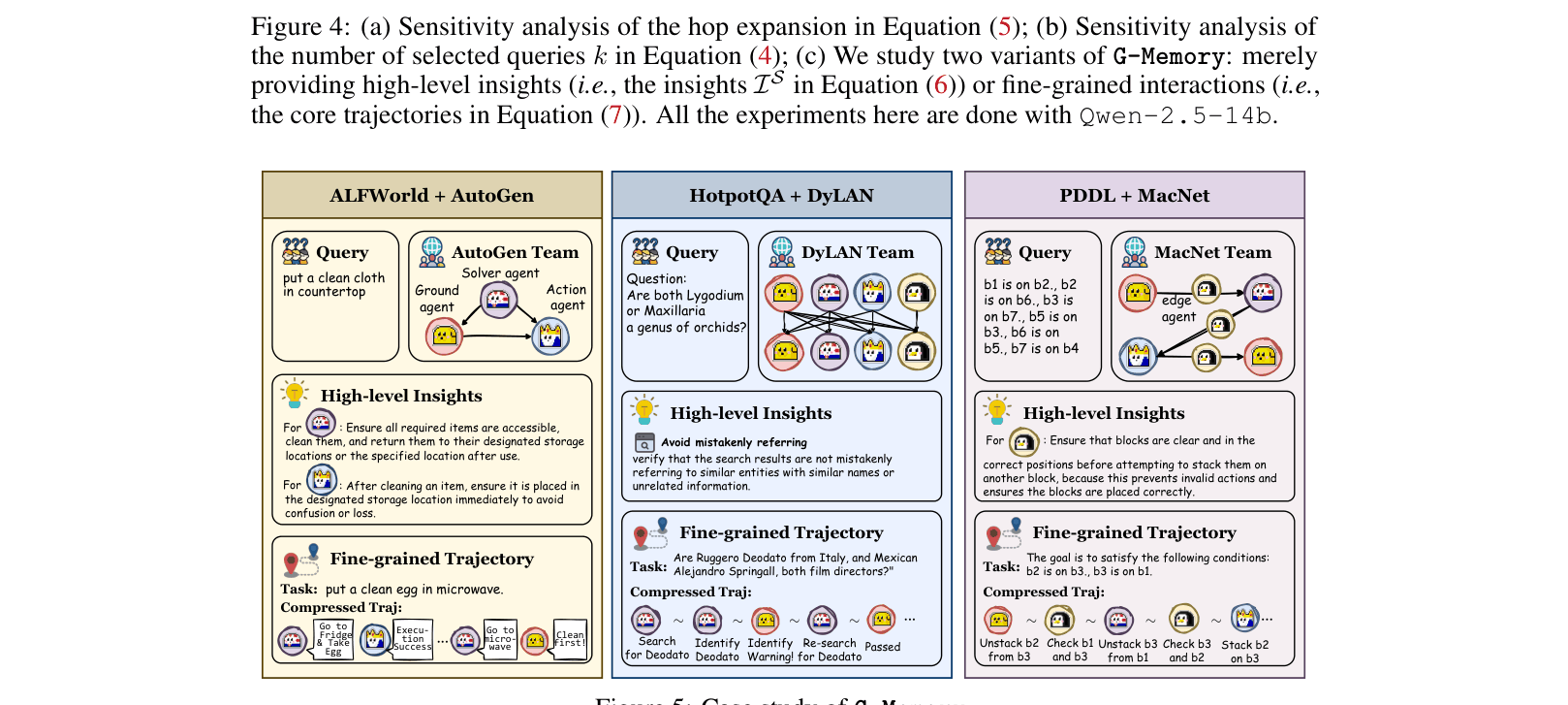
In an embodied task 'put a clean cloth in countertop', standard agents might fail by not cleaning the cloth first. G-Memory retrieves a past trajectory where an agent was corrected for putting a dirty egg in a microwave, successfully guiding the new team to clean the item first.
Key Novelty
Three-Tier Hierarchical Graph Memory for MAS
- Organizes memory into three levels: fine-grained utterance logs (Interaction), task metadata and status (Query), and abstract lessons (Insight)
- Uses bi-directional traversal: moving 'up' to find general strategies (insights) and 'down' to find specific procedural examples (interactions) based on the current task
- Updates continuously: successful or failed executions trigger the generation of new insights and graph connections, allowing the collective intelligence to grow
Architecture
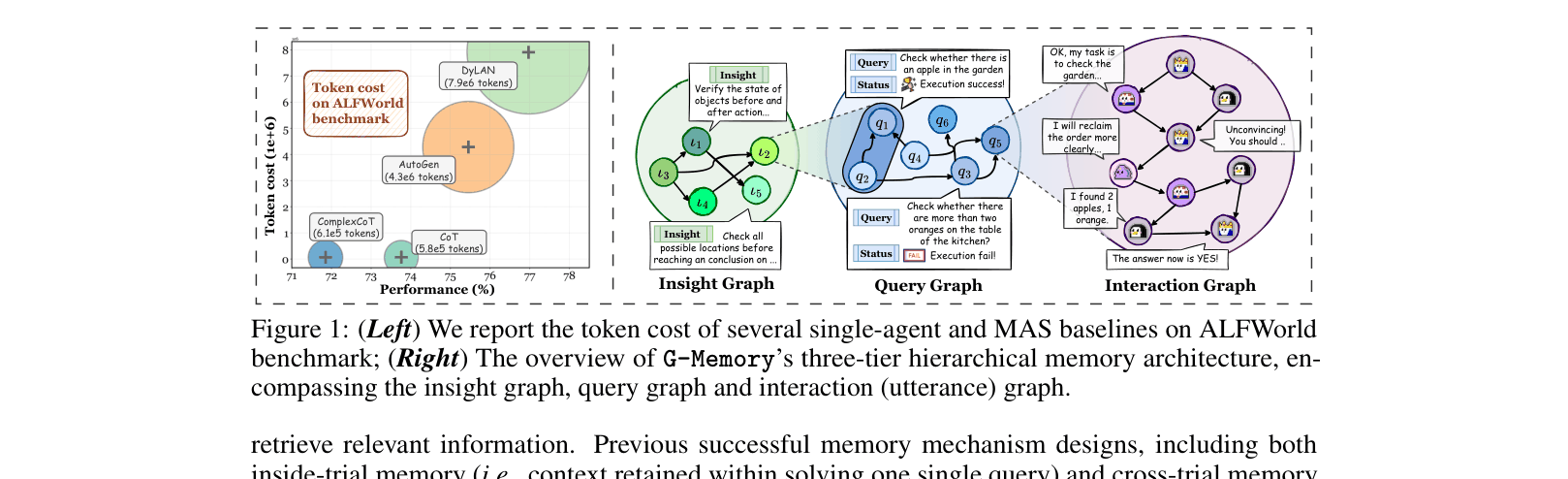
The three-tier hierarchical memory architecture of G-Memory.
Evaluation Highlights
- +20.89% success rate improvement on ALFWorld (embodied action) using MacNet + Qwen-2.5-14b compared to the original framework
- +10.12% accuracy gain on HotpotQA (knowledge reasoning) using DyLAN + GPT-4o-mini compared to DyLAN with no memory
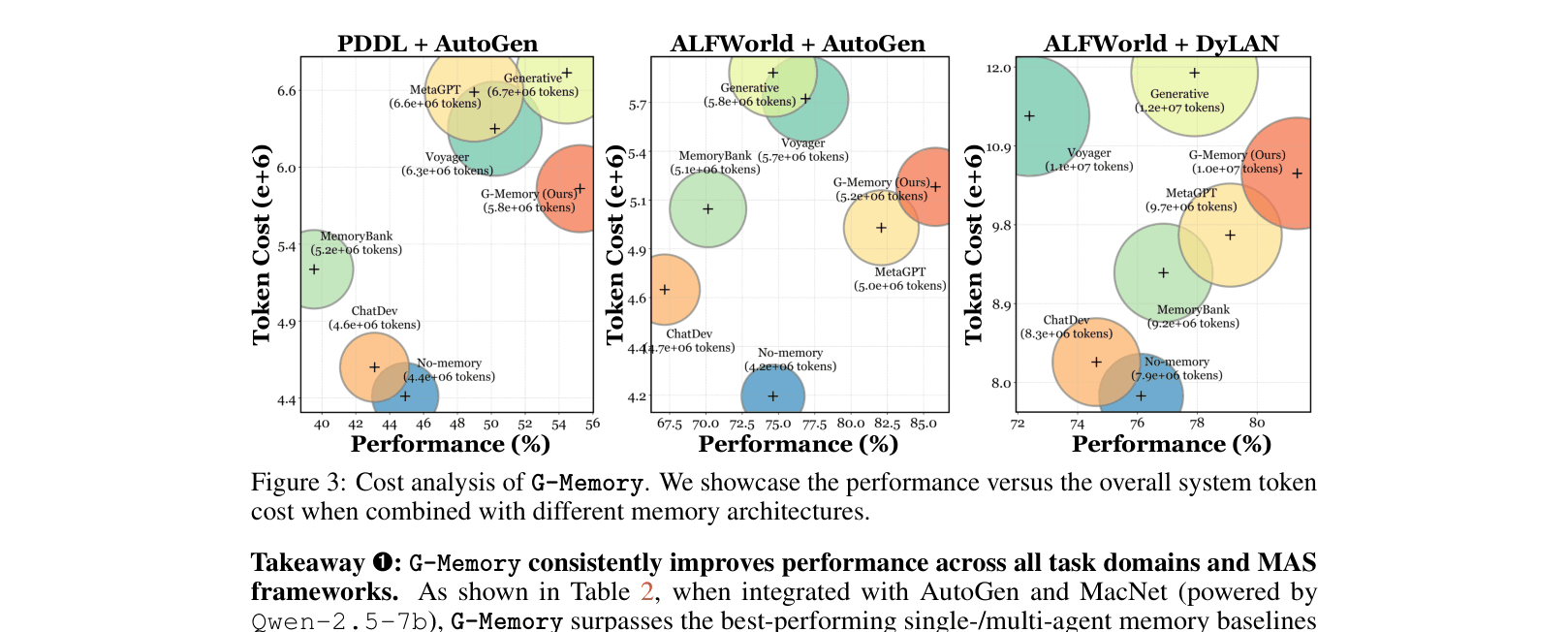
- Consumes only 1.4M additional tokens for a 10.32% performance gain on PDDL, whereas MetaGPT-M consumes 2.2M tokens for only a 4.07% gain
Breakthrough Assessment
8/10
Significant performance gains across diverse domains (up to ~20%) and a principled structural solution to the 'long context' problem in MAS interactions. Addresses a critical gap in MAS self-evolution.