📊 Experiments & Results
Evaluation Setup
Simulation of cognitive memory tasks (Cued Recall, Recognition) and impairment scenarios (Amnesia)
Benchmarks:
- Simulated Cued Recall (Memory Retrieval) [New]
- Simulated Recognition (Memory Verification) [New]
Metrics:
- Activation error / Recall accuracy
- Retention of remote vs. recent memory
- Statistical methodology: Not explicitly reported in the paper
Key Results
| Benchmark | Metric | Baseline | This Paper | Δ |
|---|---|---|---|---|
| The paper demonstrates qualitative replication of human memory phenomena rather than quantitative SOTA improvements. | ||||
| Simulated Cued Recall | Recall Accuracy | High accuracy for all time points | Low for recent, High for remote | Variable (replicates Ribot Gradient) |
| Concept Acquisition | Successful Abstraction | 0 | 1 | +1 |
Experiment Figures
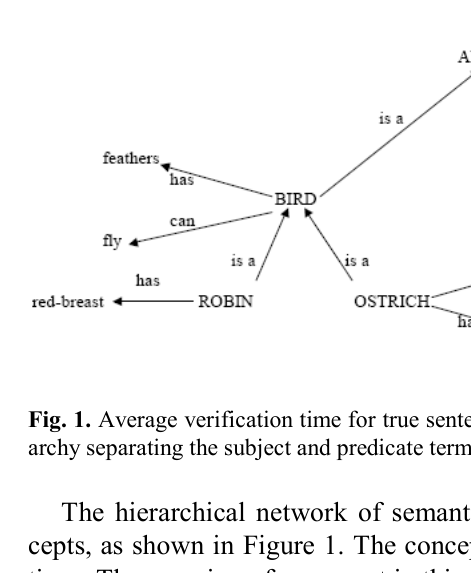
Collins and Quillian's 1969 Hierarchical Network Model results (reprinted for context), showing verification time increases with hierarchical distance.
Main Takeaways
- Successfully replicates the Ribot gradient, showing that older memories are more robust to hippocampal damage because they have been consolidated into the semantic system
- Demonstrates that semantic knowledge (general concepts) can be theoretically abstracted from episodic instances through a 'common feature' detection mechanism (Memory Triangle)
- Shows that damage to the episodic storage prevents new semantic learning (anterograde amnesia) but leaves old semantic knowledge intact, matching patient H.M. data