📝 Paper Summary
Memory Architecture
Cognitive Modeling
Autonomous Agents
The paper proposes a three-dimensional taxonomy (Object, Form, Time) for LLM-based AI memory systems, grounded in a systematic mapping to human memory mechanisms like sensory, working, and long-term memory.
Core Problem
Existing reviews categorize AI memory primarily by time (short-term vs. long-term), failing to account for the complexity of modern LLM agents that manage user-specific data alongside internal reasoning processes and external knowledge bases.
Why it matters:
- Classifying memory solely by duration overlooks the distinction between 'personal' memory (user data) and 'system' memory (intermediate reasoning/planning results)
- Current frameworks lack a unified structural mapping between established neuroscience concepts (episodic, semantic, procedural) and LLM engineering mechanisms (RAG, parameters, CoT)
- A lack of comprehensive categorization hinders the design of more intelligent, human-centric AI systems that can effectively balance parametric and non-parametric storage
Concrete Example:
A standard time-based classification treats all temporary data as 'short-term memory.' However, in an LLM agent, this conflates two distinct objects: the user's specific query inputs (personal memory) and the agent's internal Chain-of-Thought reasoning steps (system memory), which serve different functional roles.
Key Novelty
3D-8Q Memory Taxonomy (Three Dimensions, Eight Quadrants)
- Classifies AI memory along three dimensions: Object (Personal vs. System), Form (Parametric vs. Non-parametric), and Time (Short-term vs. Long-term)
- Establishes direct parallels between human cognitive processes (e.g., Sensory Memory, Episodic Memory) and AI engineering counterparts (e.g., Input embedding, Vector DB retrieval)
Architecture
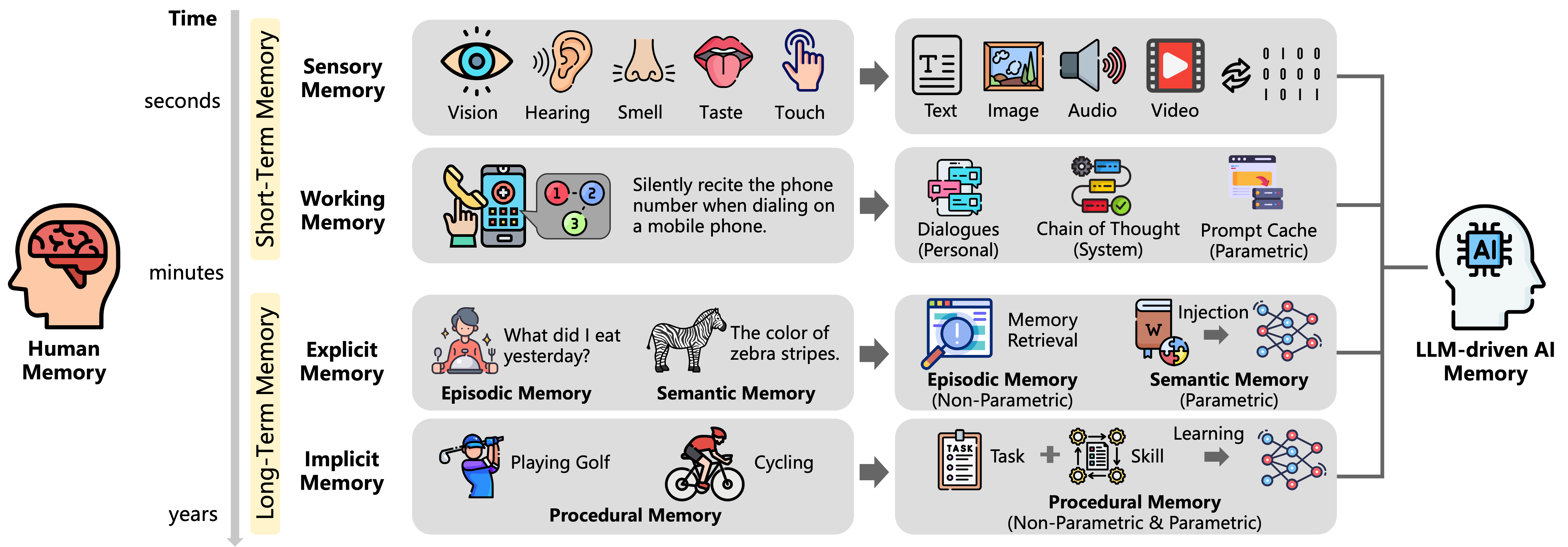
A conceptual mapping diagram illustrating the parallels between Human Memory mechanisms and AI Memory systems
Breakthrough Assessment
7/10
Provides a necessary and structured theoretical framework for the rapidly growing field of AI memory, though it is a survey/taxonomy paper rather than a method with empirical performance gains.