📝 Paper Summary
Tool profiling
User-profile based personalization
This paper introduces Personalized Tool Invocation, a task requiring LLMs to select tools and infer parameters based on user profiles, and proposes PTool, a framework for synthesizing the associated training data.
Core Problem
Existing tool learning focuses on syntax and explicit instructions, ignoring user-specific constraints (preferences for specific platforms) and implicit contexts (missing parameters like addresses) essential for real-world personalization.
Why it matters:
- Real-world users often omit crucial details (e.g., delivery address) expecting the system to know them from context
- Users have distinct preferences (e.g., speed vs. price) that dictate which tool to use among functionally similar options
- Current LLMs lack updated knowledge and personalization capabilities, leading to generic or failed tool calls when user intent is implicit
Concrete Example:
A user requests 'Order me a hamburger from KFC' without specifying the address. A standard model fails or hallucinates parameters, whereas a personalized model infers the 'work location' and 'current time' from the user profile to complete the API call.
Key Novelty
PTool (Personalized Tool Data Synthesis Framework)
- Defines two sub-tasks: 'Tool Preference' (selecting between similar tools based on user traits) and 'Profile-dependent Query' (inferring missing API parameters from user profiles)
- Constructs a hierarchical 'API Tree' to generate functionally similar yet distinct tools (e.g., YouTube vs. TikTok) to test preference capabilities
- Uses a bottom-up clustering approach to build feature trees and a top-down assignment strategy to generate diverse, realistic user profiles without redundancy
Architecture
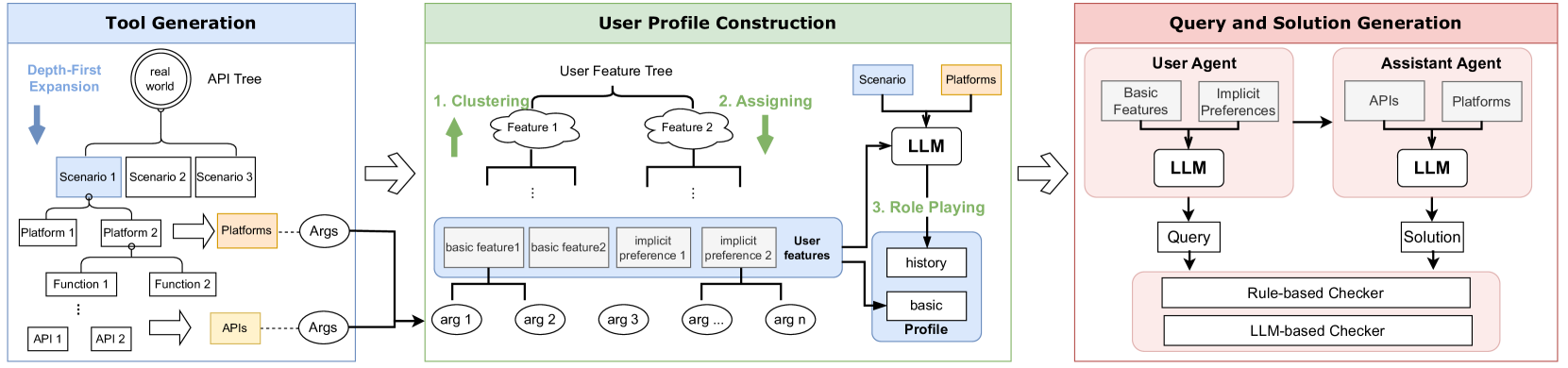
The PTool data synthesis framework workflow.
Evaluation Highlights
- Constructed PTBench (PersonalizedToolBench), the first benchmark for this task, containing 1,083 high-quality annotated data samples
- Developed a multi-agent synthesis pipeline (User Agent + Assistant Agent) to generate profile-dependent queries that intentionally omit information available in the user profile
Breakthrough Assessment
7/10
First formal definition and benchmark for personalized tool invocation, addressing a critical gap in agentic AI. Score is limited by the synthetic nature of the data and lack of reported performance gains in the provided text snippet.