📝 Paper Summary
Multi-call tool use with flexible plan
Retrieval-Augmented Generation
ToolGraphRetriever improves tool retrieval by modeling prerequisites as a dependency graph and propagating embeddings via graph convolution, ensuring necessary but semantically distinct tools are retrieved.
Core Problem
Existing tool retrievers rely on semantic similarity between queries and tool descriptions, failing to retrieve prerequisite tools that are necessary for execution but semantically unrelated to the user's specific request.
Why it matters:
- Complex tasks often require a sequence of tools (e.g., validation before action), where missing the first step causes total execution failure
- LLM context windows are finite, necessitating accurate retrieval rather than ingesting all available tool documentation
- Current semantic retrievers treat tools as independent items, ignoring the structural logic of API dependencies inherent in software systems
Concrete Example:
For the query 'Update my email to new@domain.com', a semantic retriever finds 'UpdateInfo' but misses 'Login' and 'Validate' because 'Login' is not semantically similar to 'Update email'. Without 'Login', the 'UpdateInfo' tool cannot be invoked, causing the agent to fail.
Key Novelty
ToolGraphRetriever (TGR)
- Constructs a directed graph where nodes are tools and edges represent functional dependencies (e.g., Tool A requires output from Tool B)
- Uses a trained BERT-based discriminator to automatically identify these dependencies from tool documentation
- Applies a graph convolution operation to update tool embeddings, mixing information from prerequisite tools into dependent tools to aid retrieval
Architecture
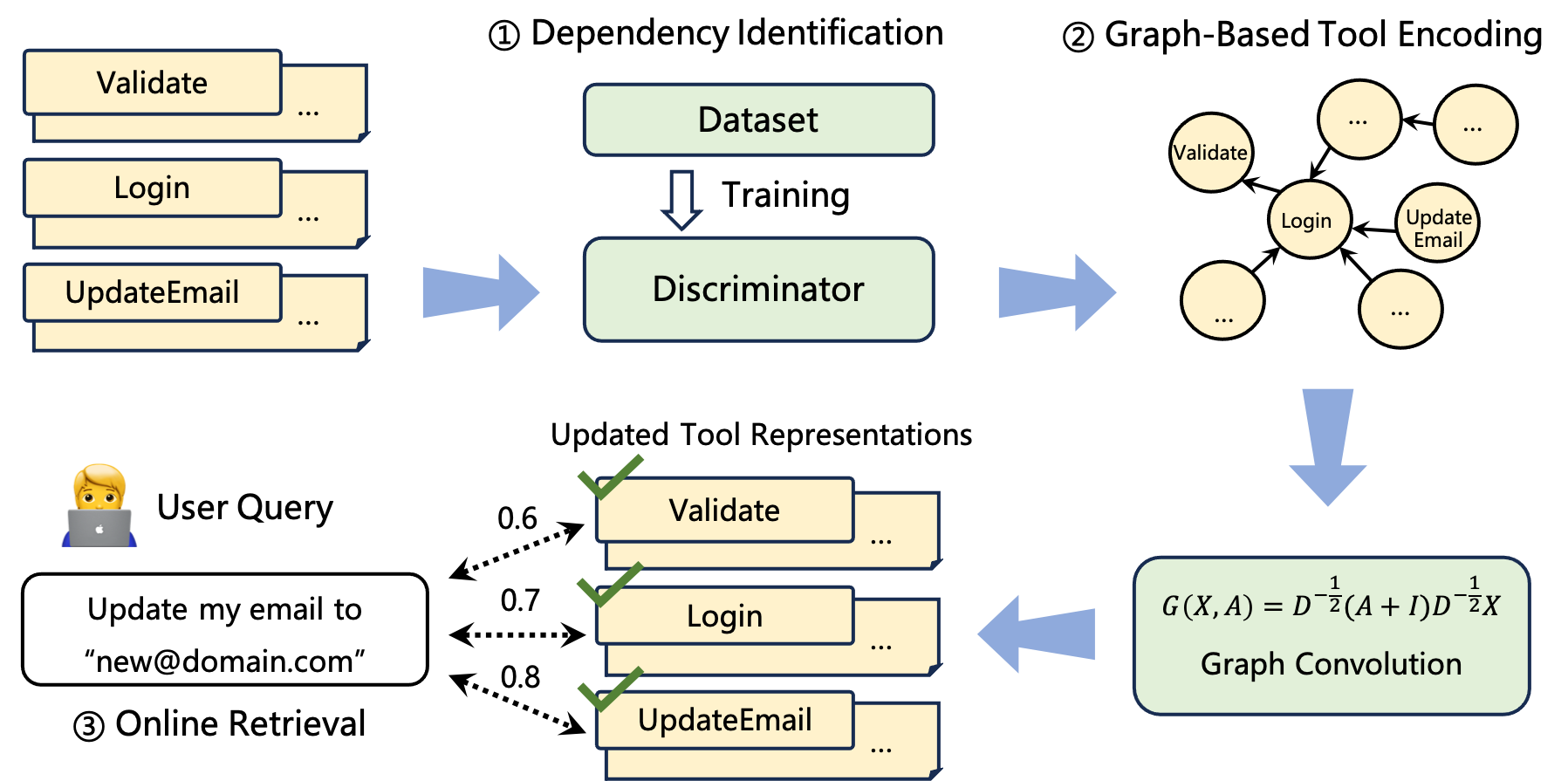
The three-step process of Tool Graph Retriever: Dependency Identification, Graph-Based Tool Encoding, and Online Retrieval.
Evaluation Highlights
- +0.065 Recall@5 improvement on API-Bank when adding TGR to the ToolBench-IR baseline (0.697 -> 0.762)
- +0.062 NDCG@5 improvement on API-Bank when adding TGR to ToolBench-IR (0.722 -> 0.784)
- +0.077 Pass Rate@5 improvement on API-Bank when adding TGR to ToolBench-IR (0.463 -> 0.540)
Breakthrough Assessment
6/10
Offers a logical and effective solution (dependency graphs) to a specific flaw in semantic retrieval (missing prerequisites). While the method is sound and results are positive, it relies on standard components (BERT, GCN) and the improvement on ToolBench is more modest than on API-Bank.