📊 Experiments & Results
Evaluation Setup
Agent-based simulation on a 20x20 grid with 400 agents under periodic boundary conditions
Benchmarks:
- Scenario 1: Joint Valence-Arousal Influence (Consensus formation with asymmetric initial emotions) [New]
- Scenario 2: Arousal Tie-Break (Consensus formation with matched valence but asymmetric arousal) [New]
- Scenario 3: Snowball Effect (Consensus formation with fully symmetric initial conditions) [New]
Metrics:
- Win Rate (proportion of runs an option wins)
- Consensus Time (steps to 100% agreement)
- Half-Life (steps to 50% commitment)
- Statistical methodology: Averages computed over 200 independent simulation runs per condition
Key Results
| Benchmark | Metric | Baseline | This Paper | Δ |
|---|---|---|---|---|
| Scenario 1 results demonstrate that high arousal and positive valence jointly accelerate consensus and increase win probability. | ||||
| Scenario 1: Joint Valence-Arousal | Win Rate | Not reported in the paper | Not reported in the paper | Not reported in the paper |
| Scenario 1: Joint Valence-Arousal | Consensus Time | Not reported in the paper | Not reported in the paper | Not reported in the paper |
| Scenario 2 shows that arousal alone can serve as a tie-breaker even when valence is identical. | ||||
| Scenario 2: Arousal Tie-Break | Win Rate | Not reported in the paper | Not reported in the paper | Not reported in the paper |
Experiment Figures
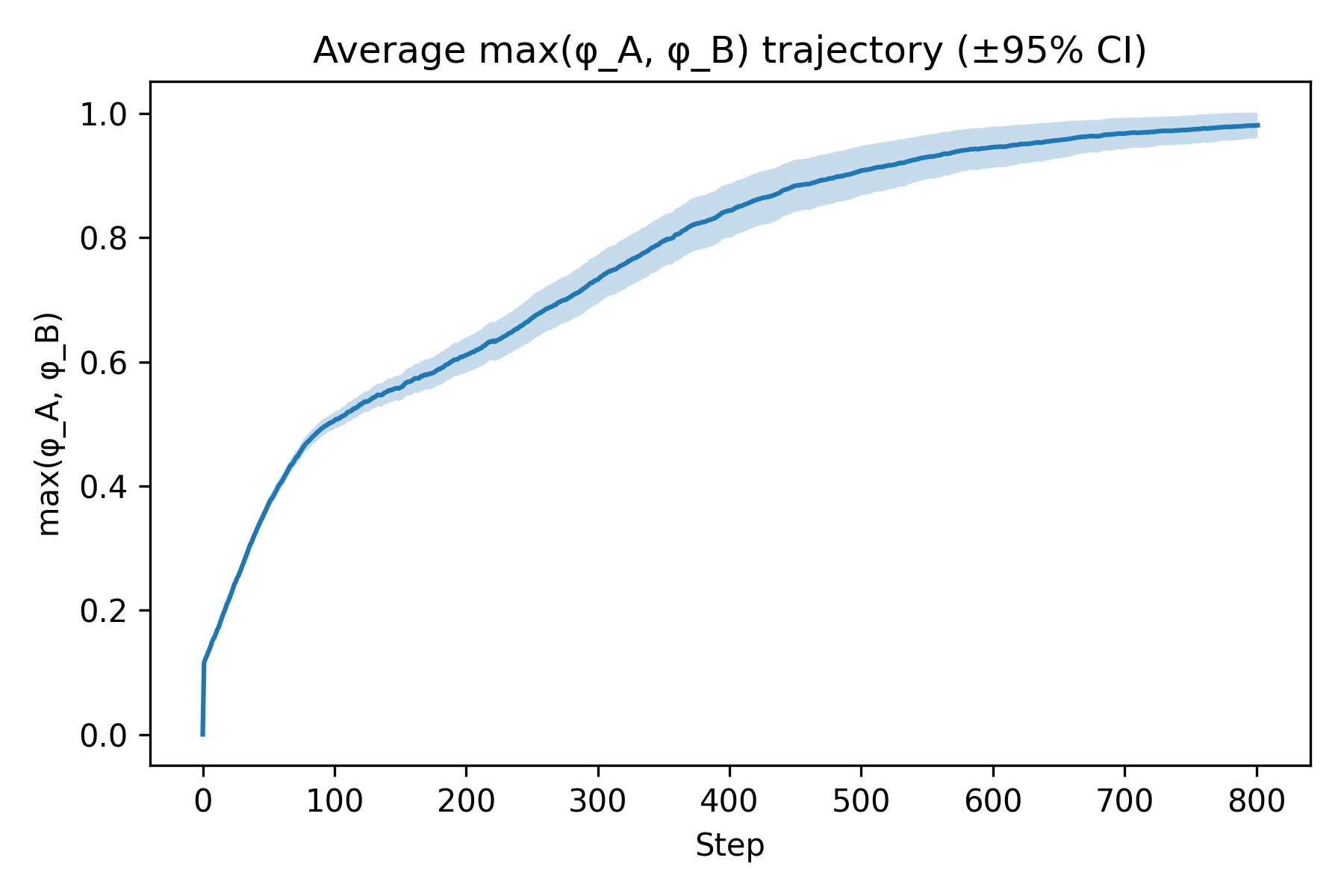
Temporal evolution of commitment levels in Scenario 3 (Snowball Effect)
Main Takeaways
- Interaction Effect: Neither valence nor arousal alone accounts for decision outcomes; their combination (e.g., 'excited support') is the strongest driver of consensus.
- Arousal as Amplifier: High arousal acts as a 'volume knob' for persuasion, breaking deadlocks when options are otherwise equal in quality (valence).
- Snowball Dynamics: Even in perfectly symmetric starts, small random fluctuations are amplified by the feedback loops, leading to decisive wins (tipping points) rather than permanent stalemate.
- Speed vs. Accuracy: Emotional intensity speeds up consensus but can bias the group towards potentially suboptimal choices if the excitement is misplaced.