PTA Studio,
Pennsylvania State University,
Beihang University,
East China Normal University
arXiv.org
(2023)
AgentBenchmarkMemory
📝 Paper Summary
LLM EvaluationAgentic SimulationMulti-Agent Systems
AgentSims is an interactive, open-source sandbox that evaluates LLMs by measuring their ability to complete long-term social and economic tasks in a simulated town.
Core Problem
Existing LLM benchmarks rely on static QA datasets or subjective black-box ratings, which fail to capture long-term planning abilities and are vulnerable to data leakage.
Why it matters:
Static benchmarks (like GRE/SAT tests) cannot evaluate an agent's ability to adhere to instructions in multi-turn dialogue or mimic human social interactions
Data contamination allows models to memorize test sets, making traditional benchmarks unreliable measurements of true capability
Subjective metrics (human or GPT-4 rating) are non-reproducible, costly, or biased, whereas task completion rates in a simulation provide objective success metrics
Concrete Example:In current benchmarks, an LLM might answer a multiple-choice question about leadership correctly. However, when placed in a simulated town as a 'Mayor' (the paper's case study), it might fail to actually resolve resident complaints or build necessary infrastructure because it lacks long-term planning and tool-use coordination.
Key Novelty
User-Friendly Sandbox Infrastructure for Task-Based Evaluation
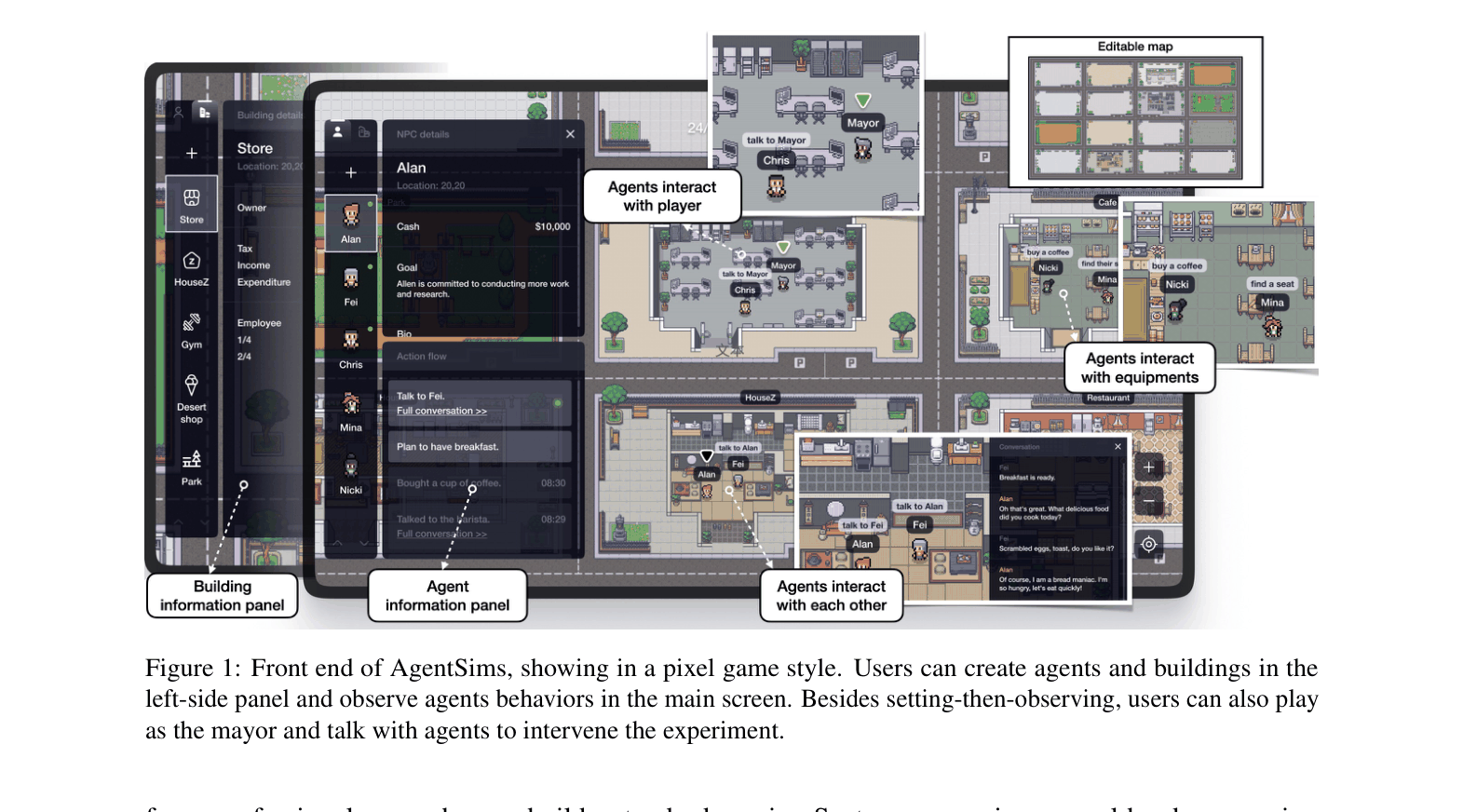
Provides a 'SimCity-like' interactive GUI where researchers can drag-and-drop buildings and agents without coding, lowering the barrier for interdisciplinary researchers
Modularizes agent support systems (Memory, Planning, Tool-Use) into pluggable components, allowing developers to test specific mechanisms by swapping Python classes
Architecture
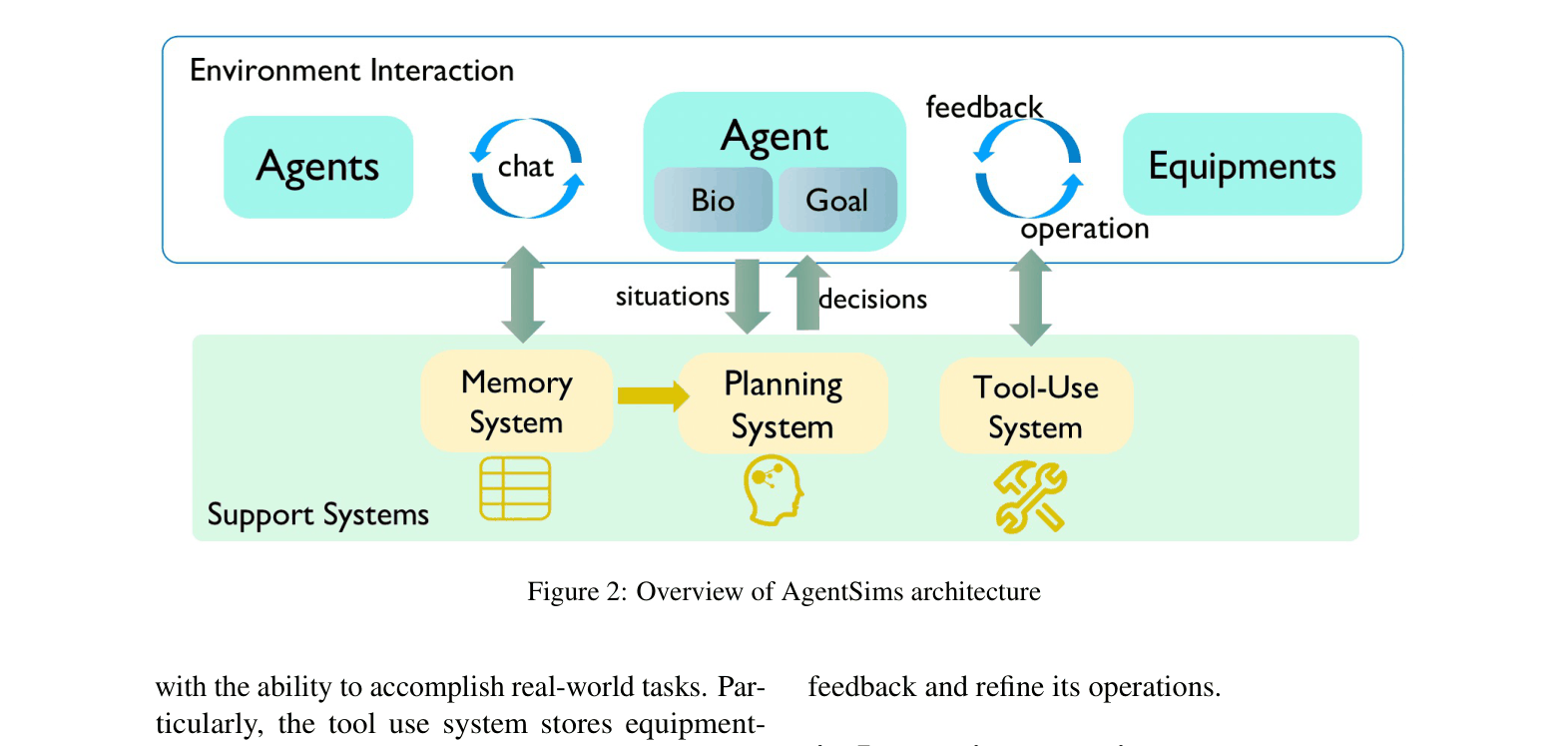
Overview of the AgentSims architecture, illustrating the loop between the Agent (Plan, Memory, Tool Use) and the Environment (Buildings, Equipment)
Breakthrough Assessment
7/10
Strong infrastructure contribution that democratizes agent evaluation with a GUI and modular design. However, the paper is a system description with no quantitative experimental results or baselines.
⚙️ Technical Details
Problem Definition
Setting: Task-based evaluation where LLM agents function within an artificial social-economic environment
Inputs: Task goals, environmental state (buildings, other agents), and user interventions
Outputs: Agent behaviors, task completion status (Success/Fail)
Pipeline Flow
Environment (Buildings/Equipment)
Agent Perception
Support Systems (Planning/Memory/Tool-Use)
Action Execution
System Modules
Planning System (Agent Cognition)
Decompose high-level goals into subtasks and summarize current conditions
Model or implementation: Pluggable LLM (user defined)
Memory System (Agent Cognition)
Store and retrieve agent experiences using vector embeddings
Model or implementation: Vector Database (backend)
Tool-Use System (Agent Cognition)
Store learned equipment-operation pairs based on feedback
Model or implementation: LLM Inference
Environment Interaction
Process agent actions and return feedback/results
Model or implementation: Rules or Support Model
Novel Architectural Elements
Interactive visual frontend (Unity-based) tightly coupled with a modular Python backend for real-time human-in-the-loop intervention (User Mode)
Abstracted 'LLMCaller' and 'Agent' classes allowing zero-code swapping of memory/planning modules via UI dropdowns
Modeling
Base Model: Model-agnostic (supports ChatGPT-like models via API)
Proposed infrastructure for defining tasks. No specific model evaluation results are reported in this paper.
Benchmarks:
Subject LLM as Participants (Social Adaptation/Theory of Mind) [New]
Subject LLM as Mayor (Long-term Planning/Management) [New]
Metrics:
Task passing rate
Statistical methodology: Not reported in the paper
Experiment Figures
Screenshot of the frontend interface showing the pixel-art town and the sidebar for agent/building creation
Main Takeaways
The paper introduces the AgentSims infrastructure but does not perform comparative experiments between models.
Proposed interaction modes allow 'User Mode' for non-coders (drag-and-drop design) and 'Developer Mode' for customized support systems.
The system supports human intervention, allowing a user to play as a 'Mayor' to guide or test agents dynamically.
📚 Prerequisite Knowledge
Prerequisites
Understanding of LLM-based autonomous agents
Familiarity with sandbox games (e.g., The Sims)
Basic knowledge of vector databases for memory
Key Terms
ToM: Theory of Mind—the ability to attribute mental states (beliefs, intents, desires) to oneself and others
NLU: Natural Language Understanding—the ability of a computer to interpret human language
NLG: Natural Language Generation—the ability of a computer to produce human-like text
Sandbox: A testing environment that isolates untested code or experiments from the production environment; here, a simulated game world
Vector Database: A database that stores data as mathematical vectors, enabling efficient similarity search for memory retrieval
Task-based evaluation: Assessing models based on their success rate in completing complex, multi-step objectives rather than answering static questions
Unity: A cross-platform game engine used here to render the visual frontend of the simulation