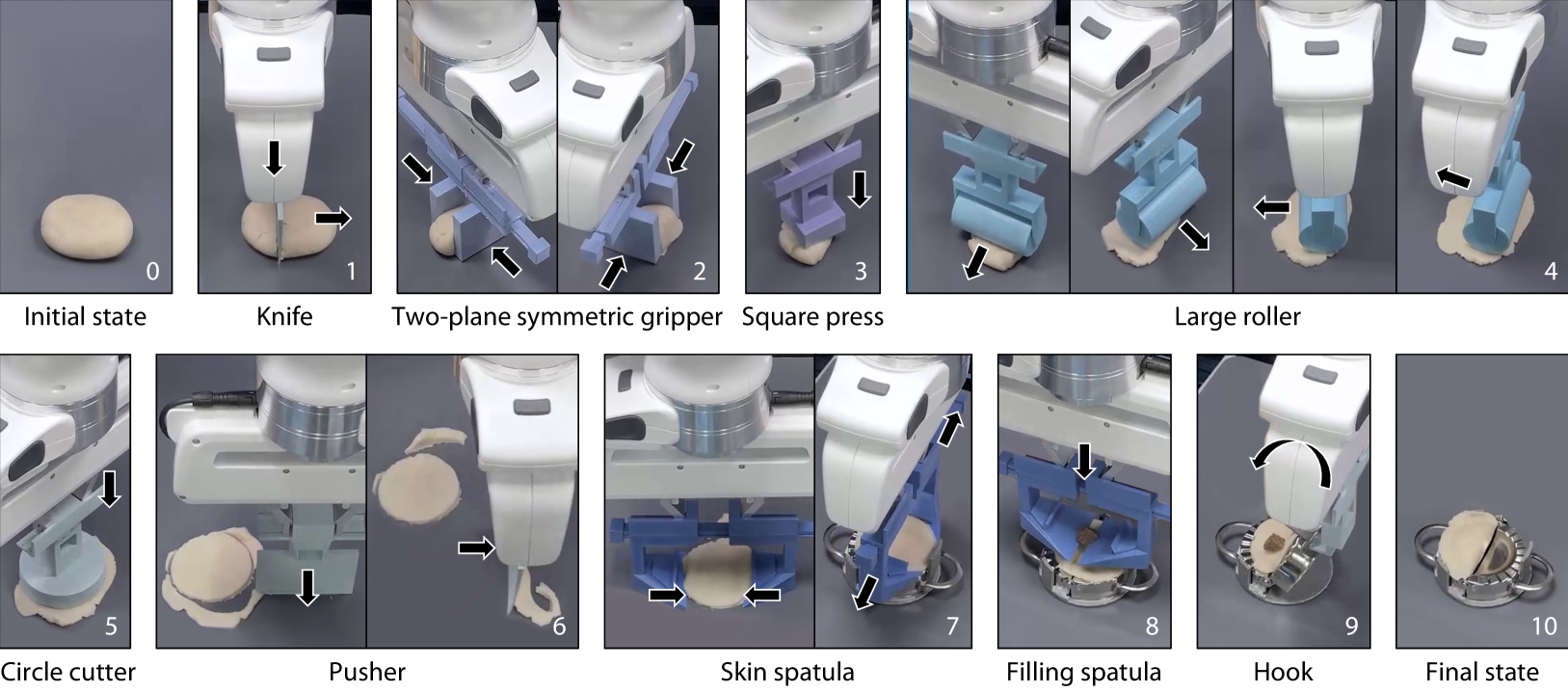
RoboCook masters complex soft-body manipulation tasks like dumpling making by learning a particle-based dynamics model from real-world data and using it to train a self-supervised policy for tool selection and control.
Core Problem
Manipulating deformable objects requires handling high degrees of freedom and complex non-linear dynamics, while long-horizon tasks demand both discrete tool selection and continuous motion planning.
Why it matters:
Traditional analytic models often suffer from large sim-to-real gaps due to approximations in modeling elasto-plastic materials
Existing learning-based methods typically focus on short-horizon tasks with single tools, failing to address multi-stage processes like cooking that require diverse tool usage
Human demonstration data for such tasks is expensive and difficult to acquire compared to robot self-exploration
Concrete Example:Making a dumpling requires a sequence: cutting dough (discrete tool choice: knife), rolling it flat (tool: rolling pin), and crimping (tool: gripper). A standard planner might fail to switch tools or misjudge the plastic deformation of the dough after rolling.
Key Novelty
Self-Supervised Tool-Use Planning with Learned Particle Dynamics
Models dough and tools as particle graphs, using Graph Neural Networks (GNNs) to learn complex interactions directly from point cloud observations
Combines a PointNet-based classifier for discrete tool selection with a regression policy for continuous action parameters, bridging the gap between high-level planning and low-level control
Trains the control policy using synthetic data generated by the learned dynamics model, enabling fast inference without expensive real-time simulation or human demonstrations
Architecture
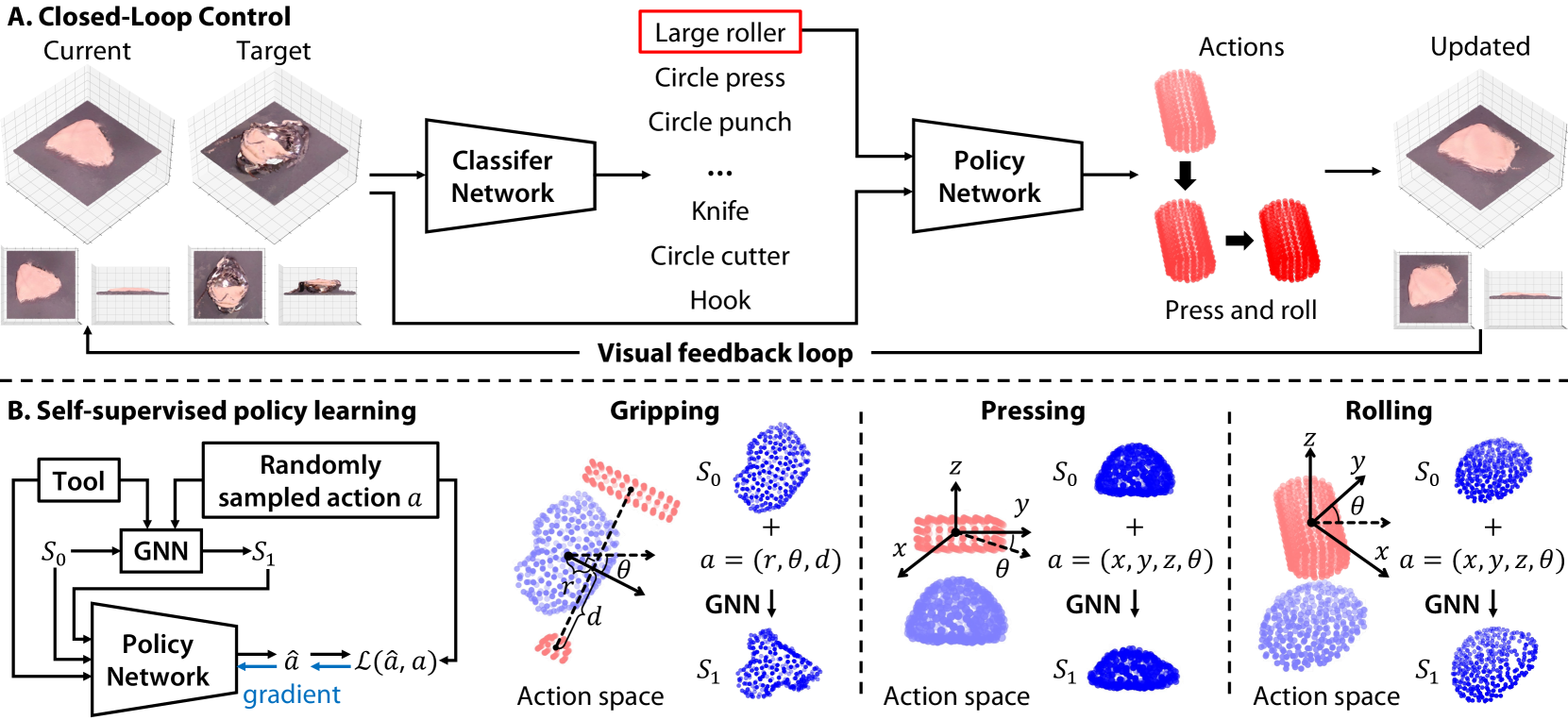
The closed-loop control pipeline showing perception, tool selection, and action planning.
Evaluation Highlights
Successfully performs long-horizon dumpling making from random initial dough shapes, even under severe external perturbations (e.g., human reshaping the dough mid-task)
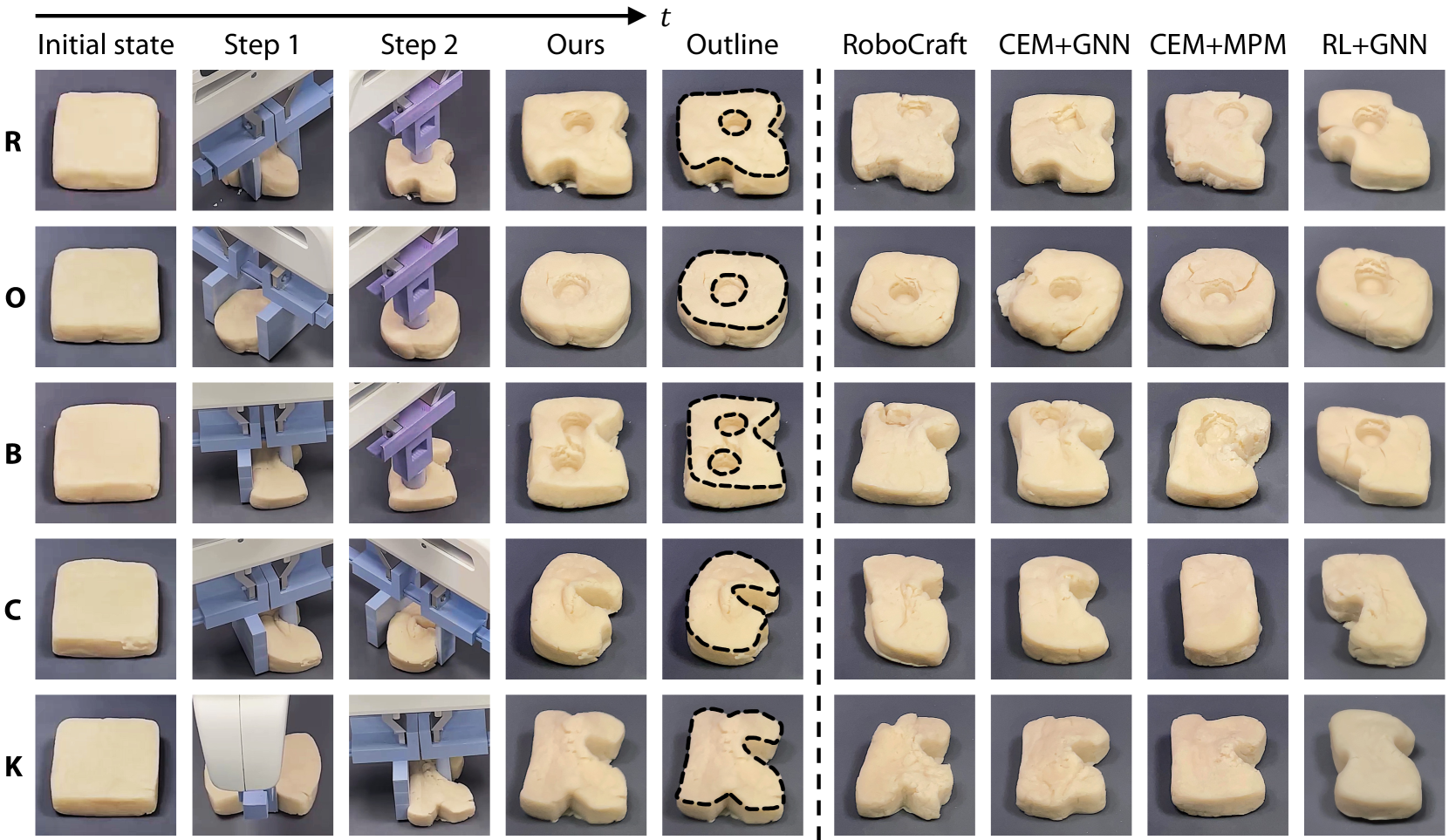
Generalizes to shaping alphabet cookies (R, O, B, C, K) better than strong baselines like RoboCraft and CEM-MPM (Cross-Entropy Method with Material Point Method)
Requires only 20 minutes of real-world interaction data per tool for training and achieves a planning speed of ~10 seconds per task
Breakthrough Assessment
8/10
Significant advance in manipulating deformable objects with diverse tools. The system demonstrates impressive robustness and generalization to new materials using a fully learned pipeline, moving beyond single-tool or simulation-only approaches.
⚙️ Technical Details
Problem Definition
Setting: Long-horizon manipulation of elasto-plastic objects using a library of tools
Inputs: Multi-view RGB-D images of the workspace and a target shape (point cloud)
Outputs: Sequence of tool selections and continuous action parameters to deform the object into the target shape
Pipeline Flow
Perception (RGB-D to Particles)
Tool Selection (PointNet++ Classifier)
Action Planning (Self-Supervised Policy Network)
System Modules
Perception Module
Converts RGB-D images into a clean, uniform particle representation of the dough
Model or implementation: Surface Reconstruction (Poisson/Alpha-shape) + Poisson Disk Sampling
Tool Classifier
Determines the most appropriate tool to achieve the target state from the current state
Model or implementation: PointNet++ Classification Head
Dynamics Model
Predicts future dough states given current state and tool actions; used to generate synthetic training data for the policy
Model or implementation: Graph Neural Network (GNN)
Policy Network
Generates optimal action parameters for the selected tool
Model or implementation: PointNet++ with Classification and Regression Heads
Novel Architectural Elements
Integration of a GNN-based dynamics simulator directly into the training loop of a self-supervised policy network
Hybrid architecture combining PointNet++ for discrete tool selection and continuous parameter regression
Modeling
Base Model: GNN for dynamics, PointNet++ for policy/classification
Training Method: Self-Supervised Learning
Objective Functions:
Purpose: Train dynamics model to match predicted particle positions to ground truth.
Formally: Weighted sum of Chamfer Distance (CD) and Earth Mover's Distance (EMD) over multiple time steps.
Purpose: Regularize long-term predictions.
Formally: Sum of distances between predictions and ground truth for steps t to t+s.
Training Data:
Real-world robot random-play data (20 minutes per tool)
Synthetic data generated by the learned dynamics model for policy training
Compute: Planning takes approx. 10 seconds (GPU details not reported)
Comparison to Prior Work
vs. RoboCraft: RoboCook adds discrete tool selection and uses a learned policy network instead of slow iterative optimization (L-BFGS)
vs. CEM-MPM: RoboCook learns dynamics from data, avoiding sim-to-real gaps inherent in analytical MPM simulators
vs. PlasticineLab: Focuses on single-tool manipulation in simulation, whereas RoboCook handles multi-tool long-horizon tasks in the real world [not cited in paper]
Limitations
Perception relies on surface reconstruction which can lose details in heavy occlusion (compensated partially by alpha-shapes)
Requires re-collecting 20 minutes of data for every new tool introduced to the system
Dynamics model training horizon (s=2) is short compared to inference horizon (15 steps), relying on inductive bias for generalization
Evaluation metrics (CD/EMD) may not perfectly align with human perceptual judgment of shape quality
Code available at https://hshi.github.io/robocook. Dataset collection required 20 minutes of real-world interaction per tool. Specific model weights and detailed hyperparameters beyond loss weights/particle counts are not explicitly detailed in the text snippet.
📊 Experiments & Results
Evaluation Setup
Real-world robotic manipulation of dough using a Franka Emika Panda arm and 15 diverse tools.
Benchmarks:
Dumpling Making (Long-horizon multi-stage manipulation) [New]
Human Prediction Accuracy (recognition of shaped letters)
Statistical methodology: Human study with 100 subjects to evaluate recognizability of shaped cookies.
Key Results
Benchmark
Metric
Baseline
This Paper
Δ
System Performance
Planning Time
Not reported in the paper
10 seconds
Not reported in the paper
System Performance
Training Data per Tool
Not reported in the paper
20 minutes
Not reported in the paper
Experiment Figures
A successful trial of making a dumpling, showing the sequence of steps: cutting, rolling, and folding.
Qualitative comparison of alphabet letter cookies (R, O, B, C, K) made by RoboCook versus baselines.
Main Takeaways
RoboCook successfully completes long-horizon tasks like dumpling making, which require sequential use of multiple tools (knife, roller, gripper), where baselines typically fail due to lack of tool switching logic.
The system exhibits strong robustness to external perturbations; it can recover and complete the task even when a human deforms or swaps the dough mid-operation.
The learned dynamics model generalizes well to unseen materials (Play-Doh, Air Dry Clay, Model Foam) without any retraining, despite being trained only on flour dough.
Qualitatively outperforms optimization-based (RoboCraft, CEM) and RL-based baselines in shaping alphabet cookies, producing more recognizable letters according to human evaluators.
📚 Prerequisite Knowledge
Prerequisites
Graph Neural Networks (GNNs)
Point Cloud Processing (PointNet++)
Deformable Object Dynamics
Self-Supervised Learning
Key Terms
Elasto-plastic: Materials that exhibit both elastic (reversible) and plastic (permanent) deformation, like dough or clay
GNN: Graph Neural Network—a neural network that processes data represented as graphs (nodes and edges), used here to model particle interactions
PointNet++: A deep neural network architecture designed to consume unordered point sets (point clouds) and extract hierarchical features
SDF: Signed Distance Function—a mathematical representation of a 3D shape describing the distance from any point to the nearest surface
Chamfer Distance (CD): A metric measuring the similarity between two point clouds by summing the distances between each point and its nearest neighbor in the other set
Earth Mover's Distance (EMD): A metric measuring the minimum cost to transform one probability distribution (or point cloud) into another
Poisson Disk Sampling: A technique to sample points randomly but uniformly across a surface, ensuring points are not too close to each other