📝 Paper Summary
LLM-based Recommendation
Collaborative Filtering Integration
SeLLa-Rec bridges the gap between collaborative filtering models and LLMs by bidirectionally aligning their semantic spaces via contrastive learning and projecting collaborative signals into special tokens.
Core Problem
LLMs struggle to model sparse user/item IDs effectively compared to collaborative filtering models (Collabs), while simply projecting Collab embeddings into LLMs fails due to significant distribution and semantic discrepancies.
Why it matters:
- Pure LLMs face performance bottlenecks in recommendation because they lack the specific collaborative signal processing of traditional models.
- Simple projection methods treat LLMs and Collabs as independent systems, failing to fully integrate the distinct knowledge distributions.
- Effective integration is crucial for handling cold-start scenarios where interaction data is sparse but semantic knowledge is available.
Concrete Example:
In a movie recommendation scenario, a standard LLM might know 'The Matrix' is a sci-fi film but fails to capture that User A, who liked 'Inception', usually clicks on 'The Matrix' (collaborative signal). SeLLa-Rec injects this collaborative affinity directly into the prompt via aligned tokens.
Key Novelty
Bidirectional Semantic Alignment & Hybrid Projection
- Distills semantic knowledge from a fine-tuned LLM to guide the training of a Collaborative Filtering model via contrastive learning, pre-aligning the Collab space to the LLM space.
- Uses a initialized 'warm-up' projection layer (from the alignment phase) to map collaborative embeddings into the LLM's input space with minimal information loss.
- Introduces three specific special tokens (<User_ID>, <Item_ID>, <Warm_ID>) to carry aligned collaborative and semantic signals into the LLM prompt.
Architecture
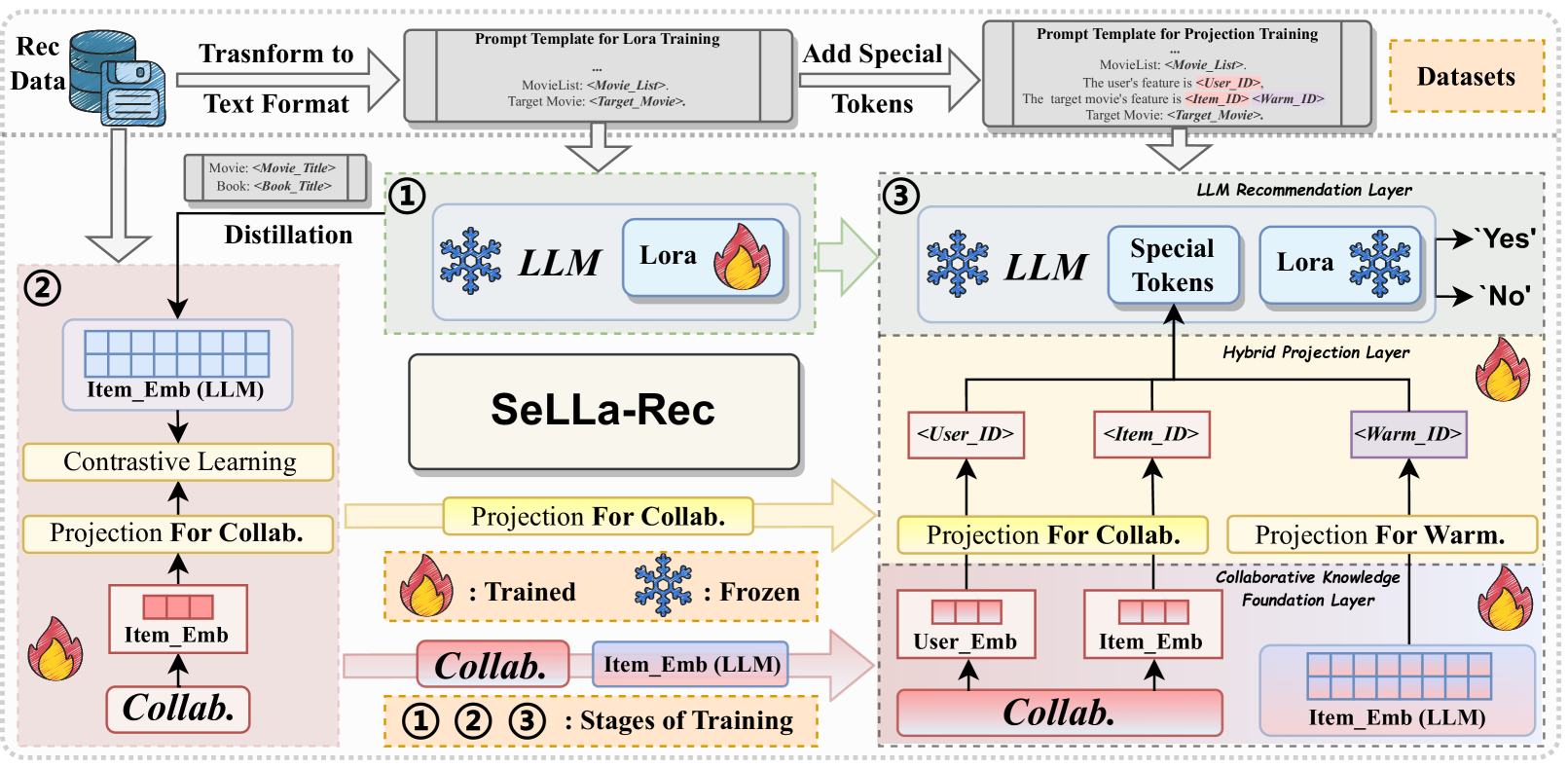
The three-layer architecture of SeLLa-Rec: Collaborative Knowledge Foundation Layer (bottom), Hybrid Projection Layer (middle), and LLM Recommendation Layer (top).
Evaluation Highlights
- Achieves state-of-the-art performance on MovieLens-1M and Amazon Book datasets compared to baselines like CoLLM and TallRec.
- Outperforms CoLLM (a strong LLM+Collab baseline) by effectively aligning semantic spaces before projection.
- Demonstrates superior effectiveness in cold-start scenarios by leveraging the <Warm_ID> token enriched with semantic knowledge.
Breakthrough Assessment
7/10
Offers a logically sound method for aligning heterogeneous embedding spaces (text semantic vs. interaction graph). While the architecture is an evolution of CoLLM, the bidirectional alignment strategy is a meaningful refinement.