📝 Paper Summary
Synthetic data generation for agents
Tool-use post-training
GEM extracts multi-turn tool-use trajectories from raw text corpora by identifying implicit workflows, synthesizing corresponding tools, and generating grounded user-agent interactions without requiring predefined APIs.
Core Problem
Training autonomous agents requires diverse, realistic multi-turn tool-use data, but existing methods rely on expensive, limited sets of predefined APIs, restricting generalization.
Why it matters:
- Real-world tool-use trajectories are scarce and hard to collect manually.
- Simulation methods based on fixed API sets fail to cover the broad range of scenarios needed for agents to generalize to unseen environments.
- Current LLMs struggle with realistic multi-turn interactions involving ambiguous instructions or long-context dependencies.
Concrete Example:
A raw text about 'hospital reimbursement claims' contains an implicit procedure (step-by-step logic) and implicit tools (forms, submissions) but is not structured as an agent trajectory. Existing methods miss this data source, whereas GEM extracts the workflow to create a simulated reimbursement agent.
Key Novelty
Text-Based Extraction Paradigm (GEM Pipeline)
- Treats raw text corpora as a source of implicit 'experience' containing procedural knowledge, rather than just knowledge facts.
- Synthesizes *both* the tools (APIs) and the interaction trajectories simultaneously from text, bypassing the need for a pre-existing tool library.
- Distills the multi-stage generation pipeline into a single 'Trajectory Synthesizer' model that converts text to agent data end-to-end.
Architecture
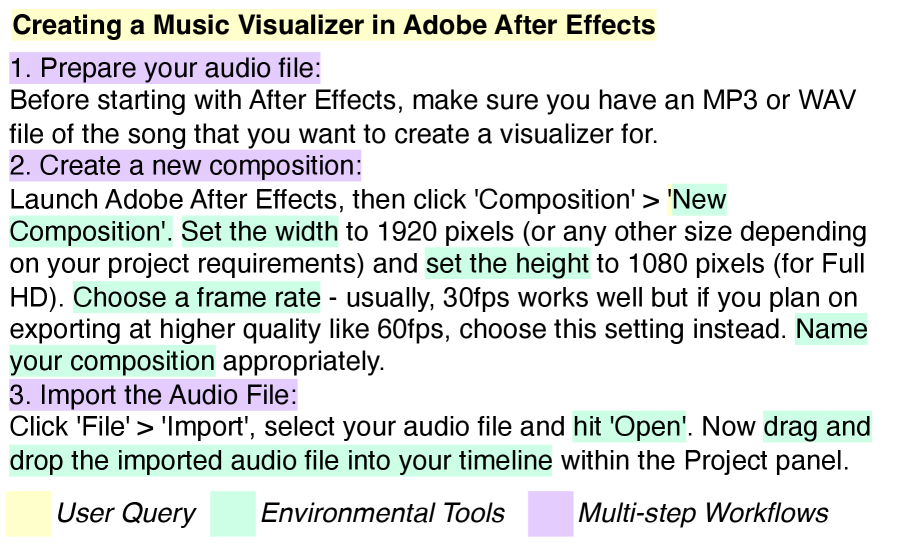
The GEM data synthesis pipeline, illustrating the flow from raw text to validated trajectories.
Evaluation Highlights
- +16.5% improvement on the BFCL V3 Multi-turn benchmark using GEM-32B compared to baselines.
- Achieves comparable performance on Tau-bench (Airline and Retail) using out-of-domain synthetic data as models trained on in-domain data, showing strong generalization.
- The distilled Trajectory Synthesizer matches the quality of the full multi-stage pipeline while significantly reducing inference costs.
Breakthrough Assessment
8/10
Proposes a significant paradigm shift from tool-centered simulation (needing fixed APIs) to text-centered extraction (creating APIs from text). The generalization results on Tau-bench are particularly impressive.