OPPO AI Center,
Guangdong University of Technology,
University of Illinois at Urbana-Champaign,
Beihang University,
Tsinghua University
arXiv.org
(2024)
MemoryP13NAgentBenchmark
📝 Paper Summary
User-profile based personalizationAgentic AI
AI Persona enables life-long personalization by modeling user profiles as dynamic structured dictionaries that are continuously updated by an LLM-based optimizer during interactions, without requiring model training.
Core Problem
Existing personalization methods treat user history as static RAG data, failing to adapt to evolving user traits, while benchmarks like LaMP lack realistic, life-long interaction scenarios.
Why it matters:
Real-world user attributes (location, preferences, budget) change over time; static models inevitably provide outdated or irrelevant assistance
Current personalization requires costly fine-tuning or fails to capture the implicit, dynamic profile information encoded in long interaction histories
Lack of realistic benchmarks hinders progress, as existing datasets (LaMP) focus on narrow tasks like citation prediction rather than interactive assistance
Concrete Example:For a query like 'reserve a restaurant,' a static agent might suggest a steakhouse based on year-old history, failing to realize the user recently became vegetarian or moved to a new city, resulting in a dissatisfied user.
Key Novelty
AI Persona Framework with Dynamic Dictionaries
Redefines user profiles as learnable dictionaries (keys: demographics, personality, patterns, preferences) rather than raw history logs
Uses a 'Persona Optimizer' (LLM-based) to continuously update specific profile fields after interaction sessions, keeping the 'AI Persona' up-to-date without gradient updates
Introduces PersonaBench, a synthetic benchmark generation pipeline that creates realistic, evolving user personas and function-calling scenarios
Architecture
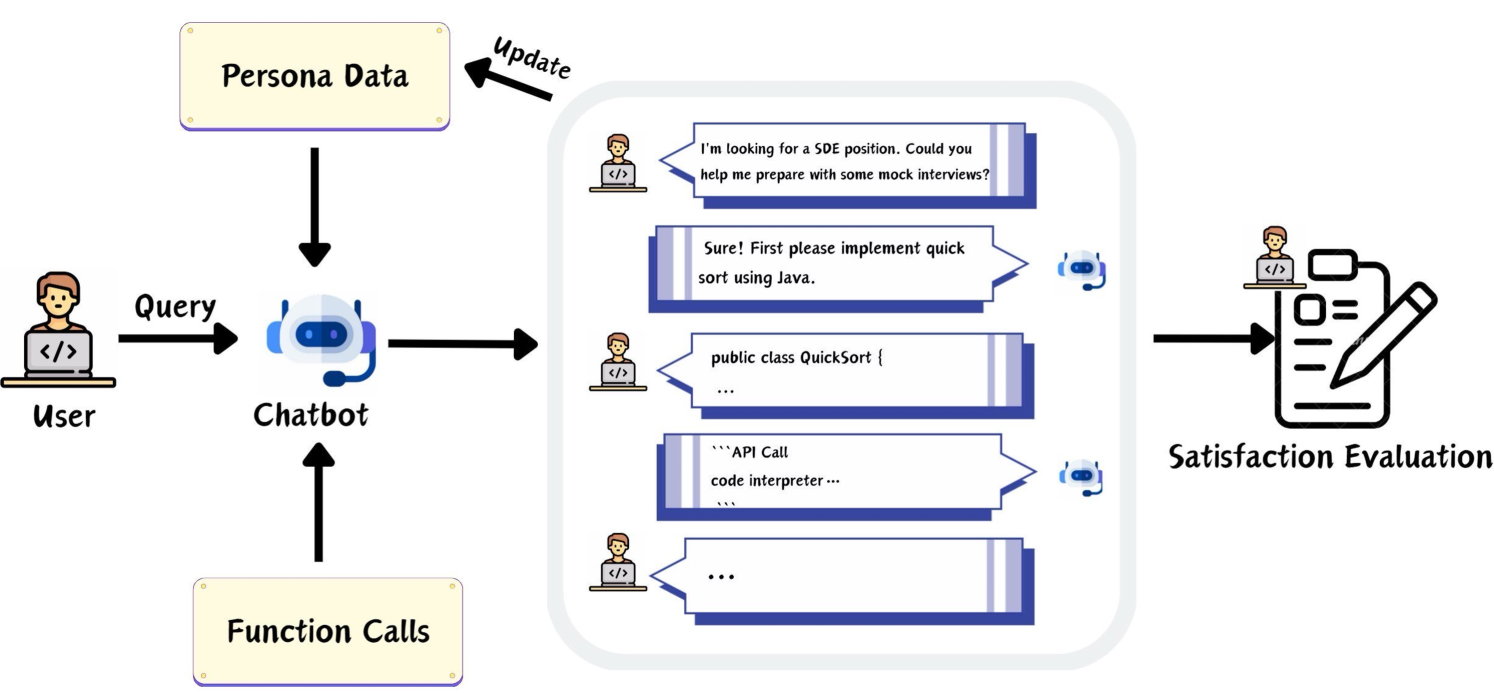
The inference workflow of the AI Persona framework, illustrating how the chatbot interacts with the user and tools while dynamically updating the user profile.
Breakthrough Assessment
7/10
Addresses a critical gap (life-long adaptation) with a scalable, training-free framework and a much-needed realistic benchmark. Score limited only because quantitative results are not present in the provided text snippet.
⚙️ Technical Details
Problem Definition
Setting: Life-long personalization where an agent P must generate responses y given query x and a dynamic user profile P_u that evolves over time t
Inputs: User query x_t, Current User Profile P_u^t (structured dictionary)
Outputs: Response y_t, Updated User Profile P_u^{t+1}
Pipeline Flow
Historical Session Manager (loads history)
User Simulator (generates query based on scene/persona)
Personalized Chatbot (generates response using profile + tools)
Tool Executor (simulates API results)
Persona Optimizer (updates profile dictionary post-session)
System Modules
Historical Session Manager
Manages storage, retrieval, and loading of conversation histories across sessions
Model or implementation: Not reported in the paper
Personalized Chatbot
Generates personalized responses and initiates function calls based on the dynamic user profile
Model or implementation: LLM backbone (Specific model variant not reported in text)
Tool Executor
Interprets function calls from the chatbot and generates simulated API responses
Model or implementation: Well-prompted LLM
Persona Optimizer
Updates the values in the user profile dictionary based on interaction history
Model or implementation: LLM-based agent (fixed parameters)
Novel Architectural Elements
Separation of static model parameters from dynamic, structured user profile dictionaries (Demographics, Personality, Patterns, Preferences)
Feedback loop where a dedicated 'Persona Optimizer' agent edits the profile dictionary after sessions to enable life-long adaptation
Modeling
Base Model: LLM-based (Exact model not reported in text snippet)
Training Method: Inference-time adaptation via prompting (Persona Optimizer)
Compute: Lightweight config file storage per user; no model training required
Comparison to Prior Work
vs. LaMP/RAG: AI Persona updates a structured dictionary rather than just retrieving raw static logs, allowing adaptation to changing traits
vs. Fine-tuning: AI Persona requires no gradient updates or per-user model storage, only a lightweight text/JSON profile, making it more scalable
Limitations
Relies on the capabilities of the underlying LLM to correctly infer and update profile attributes
Evaluation relies on a synthetic User Simulator, which may not perfectly reflect human nuance
Quantitative performance metrics are not included in the provided text snippet
Code and data promised at https://github.com/tml1026/Lifelong-Personalized-Agent. The paper describes a data synthesis pipeline using 'well-prompted LLMs' but does not specify which specific LLMs (e.g., GPT-4) were used for generation in the provided text.
📊 Experiments & Results
Evaluation Setup
Interactive evaluation using a User Simulator to chat with the Personalized Agent across multiple sessions
Benchmarks:
PersonaBench (Life-long personalized conversation & function calling) [New]
Metrics:
User Satisfaction (evaluated by Simulator)
Statistical methodology: Not explicitly reported in the paper
Main Takeaways
The paper introduces a pipeline to synthesize realistic, evolving persona data (PersonaBench), addressing the lack of dynamic benchmarks in current literature.
The proposed AI Persona framework enables continuous adaptation of user profiles (demographics, preferences) without model retraining, offering a scalable solution for real-world applications.
Note: The provided text snippet ends before the Experiments section results. Therefore, specific quantitative results (accuracy, satisfaction scores) could not be extracted.
📚 Prerequisite Knowledge
Prerequisites
Retrieval-Augmented Generation (RAG)
Large Language Models (LLMs) as Agents
Prompt Engineering
Key Terms
RAG: Retrieval-Augmented Generation—fetching relevant historical data to prompt the model
LaMP: Language Model Personalization—a widely used benchmark for personalized LLMs, criticized here for being static and task-specific
MBTI: Myers-Briggs Type Indicator—a personality taxonomy used here to structure user profiles
Persona Optimizer: An LLM-based module in this framework that updates the structured user profile dictionary based on recent interaction history
User Simulator: An LLM agent designed to role-play a specific persona to generate realistic queries and evaluate agent responses
Life-long personalization: The ability of an AI system to continuously adapt its internal model of a user over a long period of evolving interactions