📝 Paper Summary
Conversational personalization
Agentic AI simulations
This survey establishes a comprehensive taxonomy for Role-Playing with Language Models, distinguishing between coarse Persona-based approaches and fine-grained Character-based simulations while reviewing data, alignment, and agent architectures.
Core Problem
Generic LLMs prioritize helpfulness and compliance, which often contradicts role-playing requirements (e.g., playing an adversary), while existing research lacks a unified framework connecting early persona methods to modern agentic simulations.
Why it matters:
- Human demand for LLMs extends beyond productivity to psychological and entertainment needs (e.g., interacting with movie stars or relatives)
- Traditional metrics like 'helpfulness' fail in role-playing contexts; a villain character should not be helpful, creating a conflict in optimization objectives
- Prior work was fragmented between simple persona consistency (PLMs) and complex behavioral alignment (LLMs), slowing progress in creating immersive simulations
Concrete Example:
When an LLM is asked to play a user's enemy, a standard 'helpful' assistant model will refuse to be hostile or will break character to offer assistance, failing the primary objective of the role-play scenario.
Key Novelty
Unified Taxonomy for AI Role-Playing
- Categorizes the field into Persona-based Role-Playing (P-RP) for coarse traits and Character-based Role-Playing (C-RP) for fine-grained simulations
- Systematically reviews the pipeline from Data construction (crowdsourcing vs. extraction vs. generation) to Model Alignment and Agent Architecture
- Identifies the shift from static persona lists to dynamic, LLM-generated character profiles that include complex relationships and psychological states
Architecture
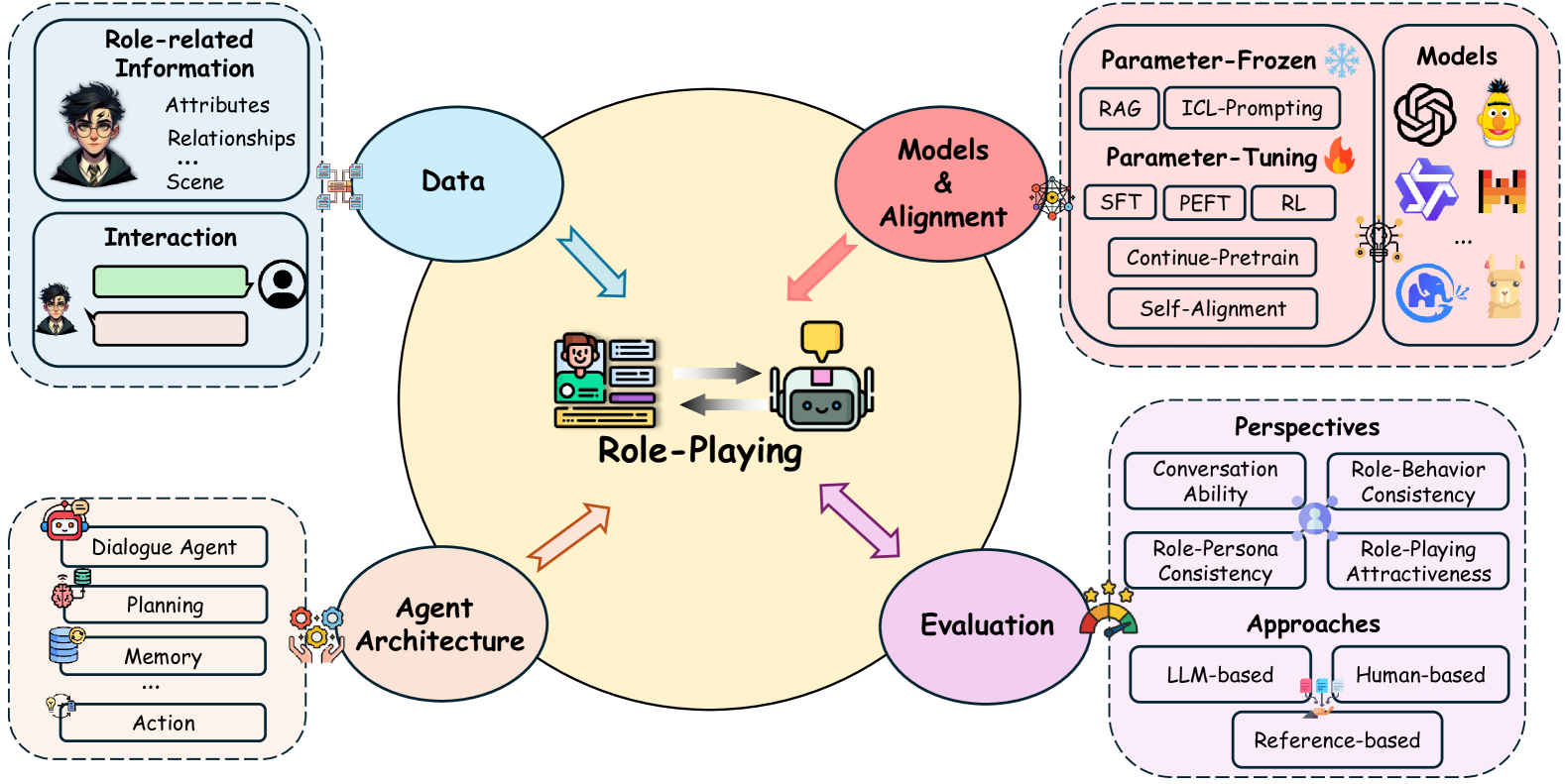
A taxonomy tree classifying Role-Playing data sources into Persona-based (Crowdsourcing, Social Media) and Character-based (LLMs as Data Generator, Literary Resources, Unpublished Resources, Human Role-Playing)
Breakthrough Assessment
7/10
A timely and necessary survey that formalizes the burgeoning field of LLM role-playing. While it doesn't propose a new model, its taxonomy (P-RP vs. C-RP) provides a clear framework for future research.