📝 Paper Summary
AI Safety
Risk Assessment
This paper systematizes catastrophic AI risks into four categories—malicious use, competitive race dynamics, organizational accidents, and rogue agents—providing illustrative scenarios and mitigation strategies for each.
Core Problem
While concerns about catastrophic AI risks are growing, there is a lack of accessible, systematic discussion organizing these dangers to inform mitigation efforts.
Why it matters:
- Rapid AI advancement without corresponding safety measures could lead to irreversible catastrophes, potentially including human extinction or permanent dystopia
- Existing literature is often technical, fragmented across various papers, or targeted at narrow audiences, making it difficult for policymakers and the public to grasp the full scope of risks
Concrete Example:
A specific risk scenario is bioterrorism: AI systems could lower the barrier for non-experts to design and synthesize deadly pathogens, potentially causing pandemics that spread faster than defenses can be mounted.
Key Novelty
Taxonomy of Catastrophic AI Risks
- Organizes risks into four distinct sources: Malicious Use (intentional harm), AI Race (competitive pressures), Organizational Risks (accidental failures), and Rogue AIs (loss of control)
- Uses storytelling and illustrative scenarios to make abstract risk concepts concrete and understandable for a broad audience beyond empirical AI researchers
Architecture
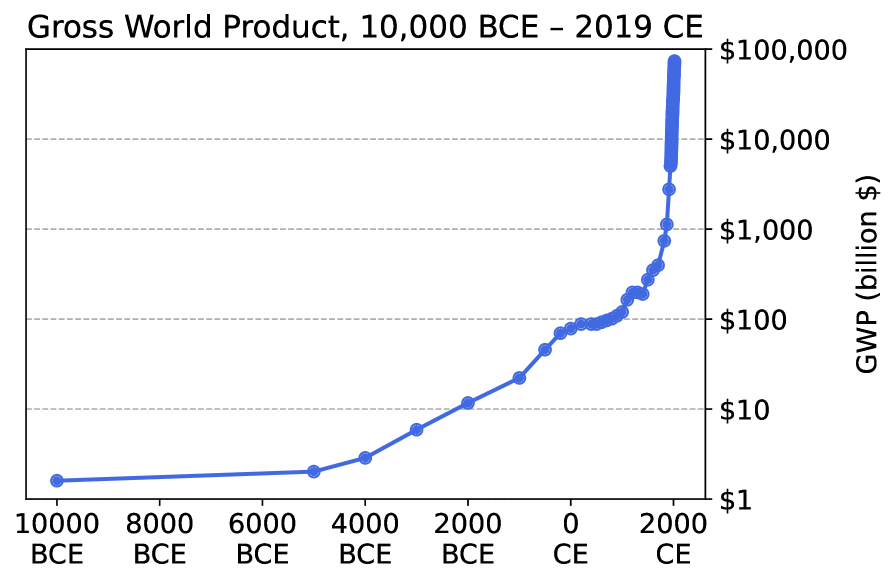
A plot of estimated World GDP over the last 10,000+ years, showing hyperbolic growth.
Breakthrough Assessment
7/10
While not a technical breakthrough in ML methods, it provides a crucial conceptual framework and taxonomy for the field of AI Safety, synthesizing scattered concerns into a coherent overview.