📝 Paper Summary
Human-AI Collaboration
Creative Design Support Tools
This paper proposes a nonlinear framework for human-AI co-design where agents act as opinionated colleagues offering alternative solutions and clarifying vague goals, rather than just executing linear commands.
Core Problem
Current AI design tools force a linear workflow where users must provide precise instructions upfront, ignoring the natural creative process where goals are open-ended and requirements evolve through iteration.
Why it matters:
- Linear command-execution models fail when users have abstract or vague requirements, leading to poor results and low success rates.
- Designers naturally work nonlinearly—refining goals and remixing ideas—but most AI tools do not support this exploratory alignment process.
Concrete Example:
In current tools like Copilot, a user commands 'make it better', and the AI produces one 'optimal' result without explanation. If the user dislikes it, they must guess how to rephrase the prompt, lacking the collaborative back-and-forth needed to refine the vague intent.
Key Novelty
Nonlinear Human-AI Co-design Framework
- Shifts the AI's role from a passive executor to an active collaborator that engages in clarification, offers alternative solutions, and explains its strategies.
- Introduces a workflow centered on 'requirement alignment' and 'remixing', allowing users to merge different AI-generated ideas rather than just accepting or rejecting a single output.
Architecture
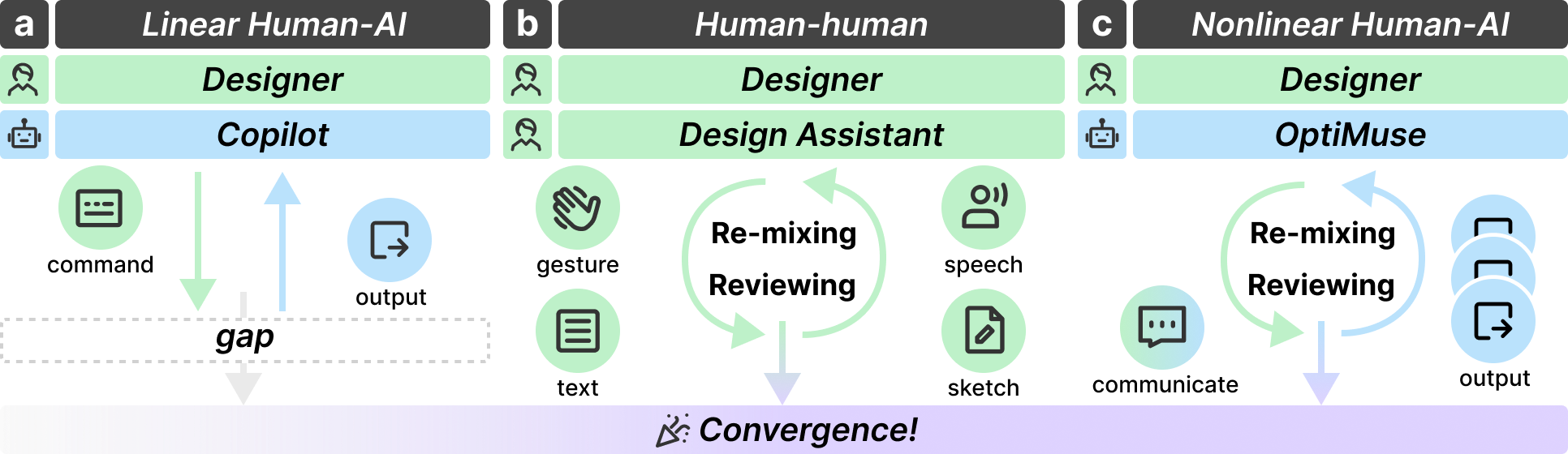
Comparison of Linear vs. Nonlinear Human-AI collaboration workflows.
Evaluation Highlights
- OptiMuse (the proposed prototype) achieved a significantly higher task completion rate compared to the baseline (Office 365 Copilot for PowerPoint).
- Participants shifted their perception of the AI from a 'mere executor' to an 'opinionated colleague' who fosters exploration and reflection.
- Users spent more time in the 'remixing' phase with OptiMuse, effectively combining aspects of multiple AI-generated alternatives to reach a satisfactory design.
Breakthrough Assessment
7/10
Provides a strong theoretical framework and qualitative validation for nonlinear human-AI interaction in design, addressing a critical gap in how AI tools currently handle creative ambiguity.
