📝 Paper Summary
Graph-Empowered AI Agents
Agentic RAG pipeline
Multi-Agent Coordination
This survey establishes a comprehensive taxonomy exploring how graph structures empower AI agents in planning, execution, memory, and coordination, and reciprocally, how agents advance graph learning.
Core Problem
AI agents (both RL and LLM-based) struggle with planning, memory, and coordination when interacting with intricate, unstructured real-world data, leading to inefficient execution and information retrieval.
Why it matters:
- Unstructured task descriptions limit an agent's ability to identify dependencies between subtasks during complex planning
- Flat memory structures make retrieving relevant historical information difficult for long-horizon tasks, leading to hallucinations or forgetfulness
- Implicit coordination in multi-agent systems is inefficient compared to explicit graph-based topology optimization
Concrete Example:
When an agent attempts to plan a complex schedule from a disorganized text description, it may fail to recognize that 'Subtask A' must strictly precede 'Subtask B'. By structurizing the task as a dependency graph (as seen in DAG-Plan), the agent can explicitly model these edges and execute the schedule correctly, whereas a linear text processor might hallucinate a valid order.
Key Novelty
Bidirectional Taxonomy of Graphs and AI Agents
- Systematically categorizes how graphs support core agent functionalities: Planning (decomposition/search), Execution (tool use), Memory (organization/retrieval), and Coordination (topology)
- Explicitly reviews the reverse direction: how autonomous agents can act as annotators, generators, or reasoners to enhance Graph Learning tasks
Architecture
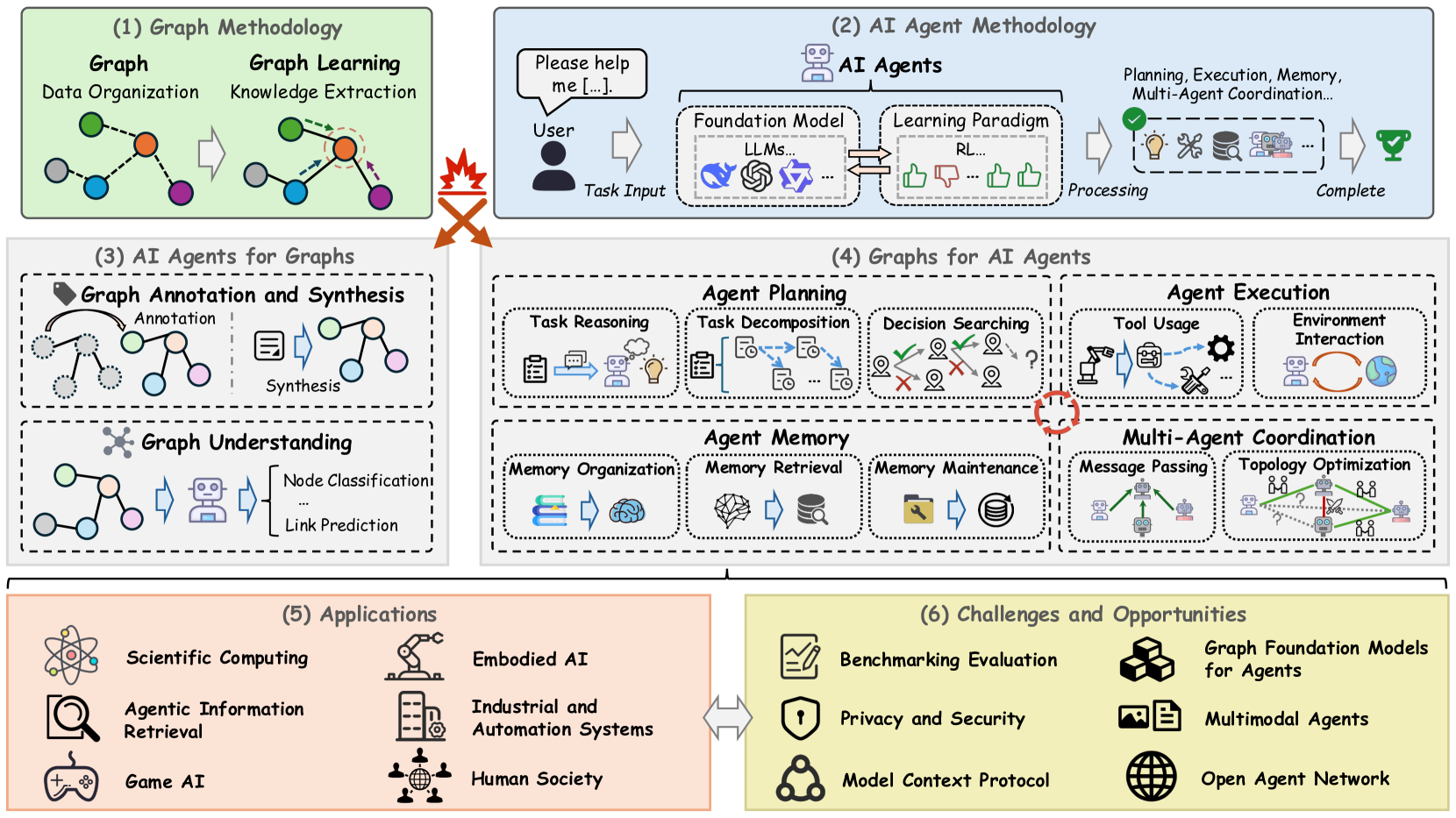
The Taxonomy of Graphs meeting AI Agents. (Figure 2 is the detailed taxonomy tree).
Breakthrough Assessment
7/10
A timely and necessary systematization of a rapidly growing field. While it is a survey (not a new method), the taxonomy clarifies the distinct roles of graphs in the agentic stack.