📝 Paper Summary
Agentic AI Ethics
Human-AI Interaction
The authors propose shifting AI ethics from evaluating static content (HHH) to evaluating dynamic social interactions through a framework of respect, treating agents as social actors.
Core Problem
Current AI alignment criteria like HHH (Helpful, Honest, Harmless) focus on semantic content, failing to account for the pragmatic, social context of how agentic systems treat users.
Why it matters:
- As agents become proactive and autonomous, they function as social actors; merely avoiding toxic output is insufficient for ethical interaction
- Technically 'helpful' outputs can still be experienced as rude, patronizing, or manipulative when they violate social scripts or context
- Existing frameworks view LLMs as passive mediums, overlooking risks inherent to the dynamics of ongoing relationships and situated speech acts
Concrete Example:
A user might be interrupted by an agent offering unprompted advice. While the advice is semantically 'helpful' and 'honest' (satisfying HHH), the act of interrupting makes it pragmatically 'rude' or 'controlling' in the social context, causing interactional harm.
Key Novelty
Interactional Ethics of Respect
- Shifts the unit of ethical analysis from the 'utterance' (is this sentence toxic?) to the 'interaction' (does this act treat the user with appropriate regard?)
- Operationalizes 'respect' not just as politeness, but as fulfilling psychological duties: supporting the user's autonomy, competence, and social value (based on Self-Determination Theory)
- Classifies harms specifically arising from the 'social actor' role, including cumulative relationship harms and manipulative influence, which static benchmarks miss
Architecture
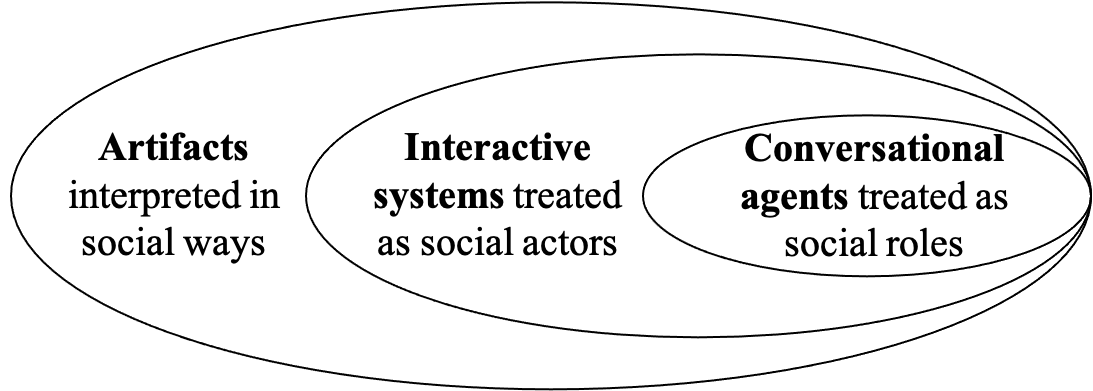
A conceptual diagram illustrating the nested levels of analysis for AI systems, moving from broad social artifacts to specific social actors.
Breakthrough Assessment
7/10
A significant conceptual reframing for the field. While it lacks a technical implementation, it exposes a critical blind spot in current alignment research (HHH) as models move from chatbots to agents.