📝 Paper Summary
Autonomous scientific discovery
Agentic AI
Scientific Large Language Models (Sci-LLMs)
The paper formalizes 'Agentic Science' as a distinct evolutionary stage of AI for Science, proposing a unified framework that connects foundational capabilities (reasoning, tools, memory) to autonomous discovery workflows across natural science domains.
Core Problem
Existing research on autonomous scientific discovery is fragmented, treating LLM capabilities, research processes, and autonomy levels in isolation without a unified framework.
Why it matters:
- AI is shifting from passive computational tools to active research partners, but lack of a structured paradigm hinders systematic design of these agents
- Current surveys focus only on one aspect (e.g., just the process or just the tools), missing the holistic connection between core cognitive capabilities and domain-specific realizations
- Rapid progress in separate fields (biology, physics, etc.) needs synthesis to identify common challenges like reproducibility and human-agent collaboration
Concrete Example:
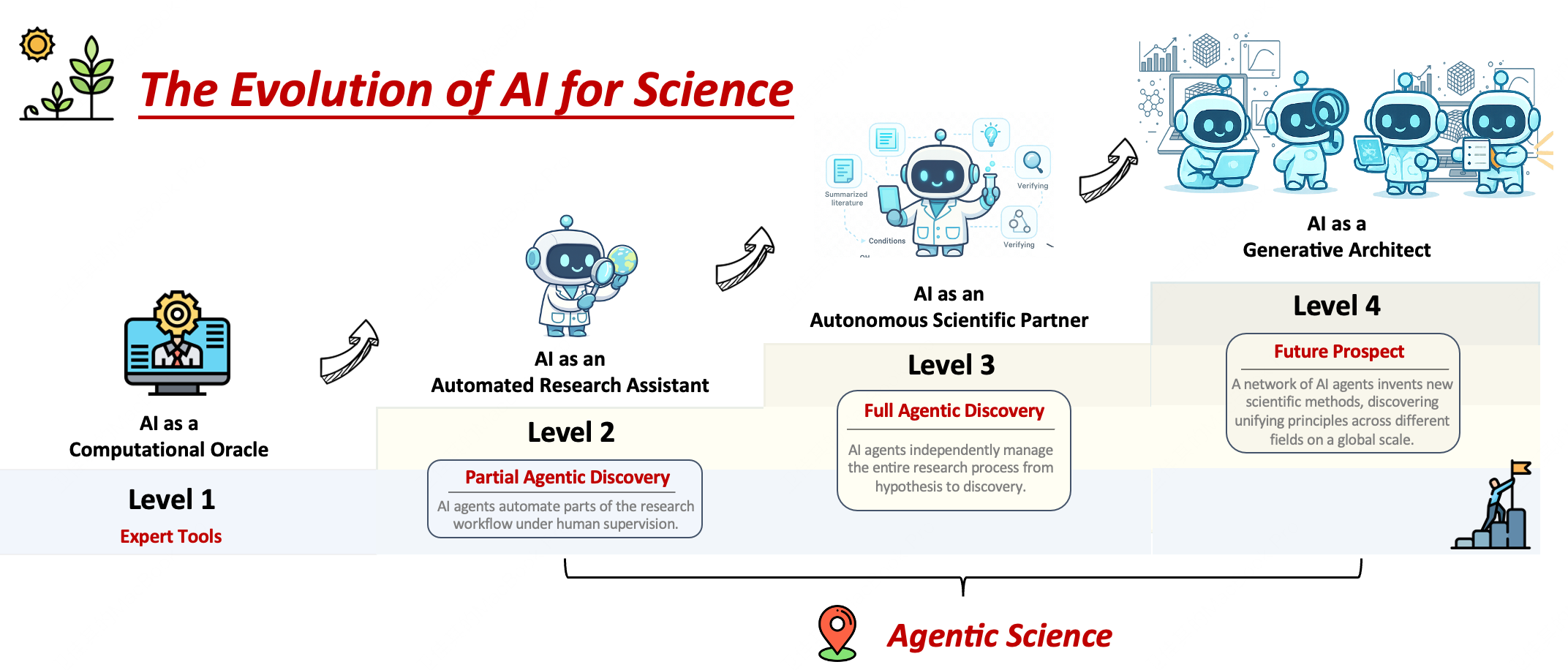
A traditional AI model might predict a protein structure (Level 1), but cannot independently hypothesize why that structure matters, design a wet-lab experiment to test it, or refine the hypothesis based on results—capabilities required for true 'Agentic Science' (Level 3).
Key Novelty
Unified Three-Level Framework for Agentic Science
- Formalizes the evolution of AI for Science into distinct levels: from Computational Oracles (tools) to Automated Assistants (partial autonomy) to Autonomous Partners (full agency)
- Proposes a 'Comprehensive Framework' connecting three layers: (1) Foundational Capabilities (reasoning, memory), (2) Core Processes (hypothesis, experiment), and (3) Domain Realizations
- Integrates previously fragmented perspectives (process-oriented, autonomy-oriented, mechanism-oriented) into a single domain-oriented review structure
Architecture
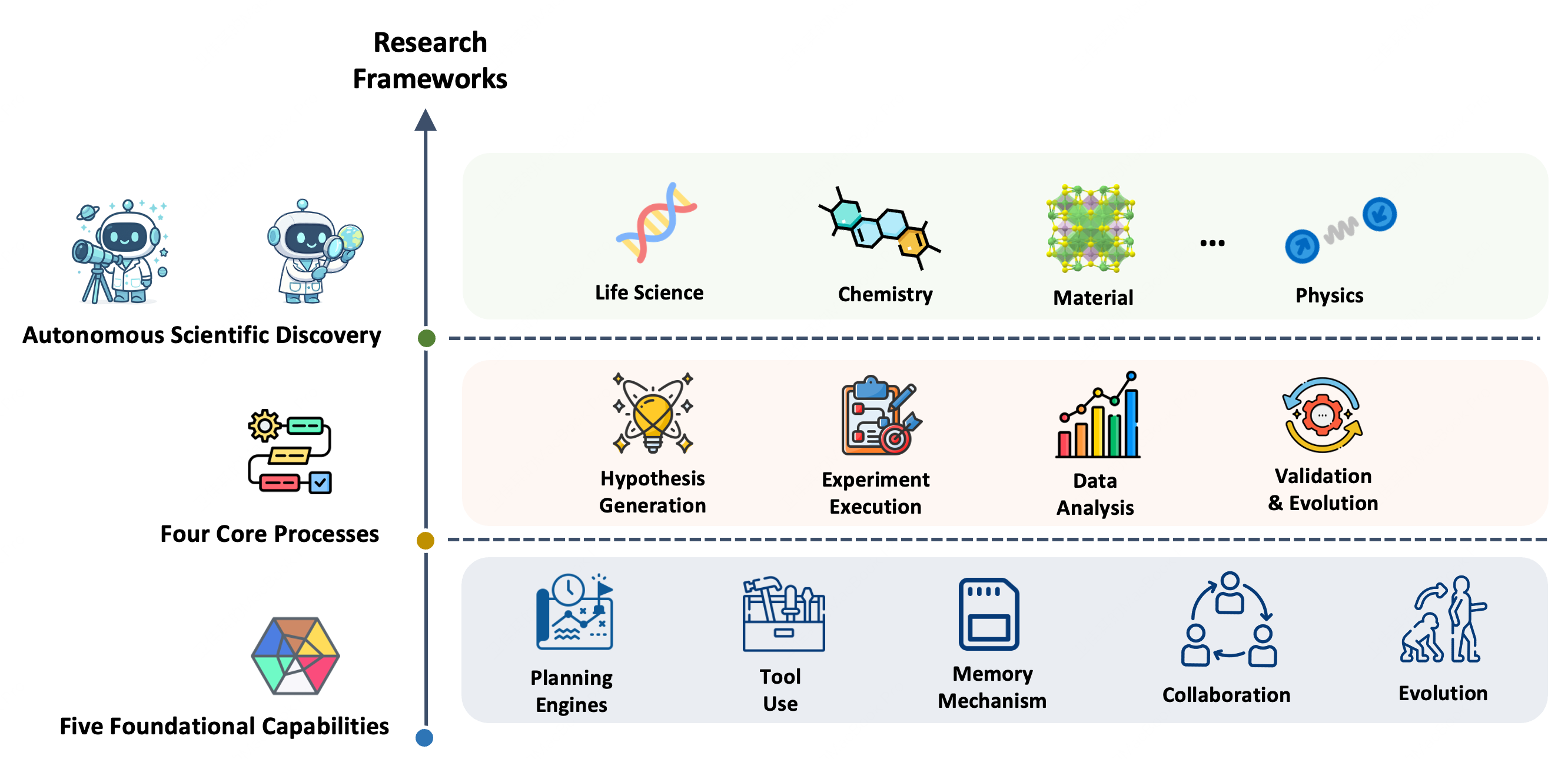
The Comprehensive Framework of Agentic Science, connecting Foundational Capabilities (bottom), Core Processes (middle), and Domain Realizations (top)
Evaluation Highlights
- Review spans 4 major domains (Life Sciences, Chemistry, Materials, Physics) and over a dozen subfields
- Identifies 5 core capabilities: Reasoning/Planning, Tool Integration, Memory, Multi-Agent Collaboration, and Optimization/Evolution
- Categorizes existing systems into levels, distinguishing between Level 2 (Automated Assistants) and Level 3 (Autonomous Partners) systems like Coscientist and ChemCrow
Breakthrough Assessment
9/10
This is a foundational survey that defines the lexicon and structure for the emerging field of Agentic Science. It unifies scattered developments into a coherent paradigm.