📝 Paper Summary
Safety-critical autonomous agents
Control systems automation
Human-in-the-loop planning
Osprey provides a safety-critical agent framework for large scientific facilities that generates reviewable execution plans and enforces hardware limits before any control system interaction.
Core Problem
General-purpose agent frameworks lack the transparency, protocol awareness, and safety safeguards required to operate hazardous scientific hardware like particle accelerators.
Why it matters:
- Particle accelerators and fusion experiments involve high-energy hazards where uncontrolled actions can damage sensitive components or cause radiation safety issues.
- Existing agents (e.g., ReAct) execute steps iteratively without visibility into future actions, making them unsafe for environments requiring strict operator oversight.
- Facilities operate on complex, heterogeneous protocols (EPICS, etc.) that standard LLM tools cannot reliably interface with out-of-the-box.
Concrete Example:
In a standard ReAct loop, an agent might decide to write a value to a magnet magnet based on a hallucinated channel name or unsafe value. By the time the operator sees the action, the write command has already been sent to the hardware, potentially tripping a machine protection interlock.
Key Novelty
Plan-First Safety-Critical Orchestration
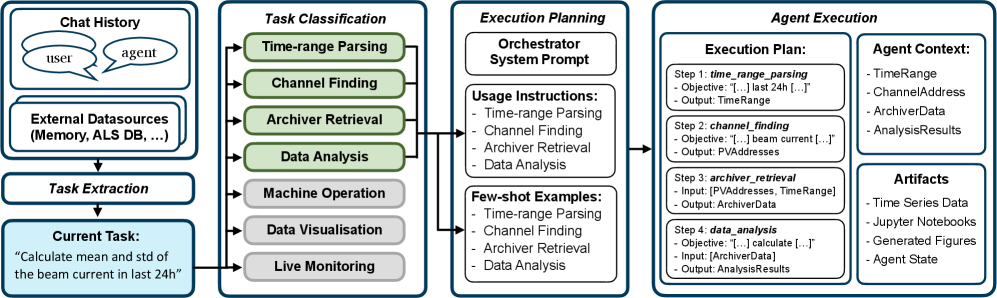
- Decouples reasoning from action by generating a complete, dependency-aware execution plan (steps, inputs, outputs) for human review *before* any hardware interaction occurs.
- Implements a 'defense-in-depth' safety layer where generated code is statically analyzed for write patterns and checked against a facility database of allowed process variable (PV) limits.
- Uses a relevance classifier to dynamically select tools from massive inventories (thousands of channels) to prevent prompt context explosion.
Architecture
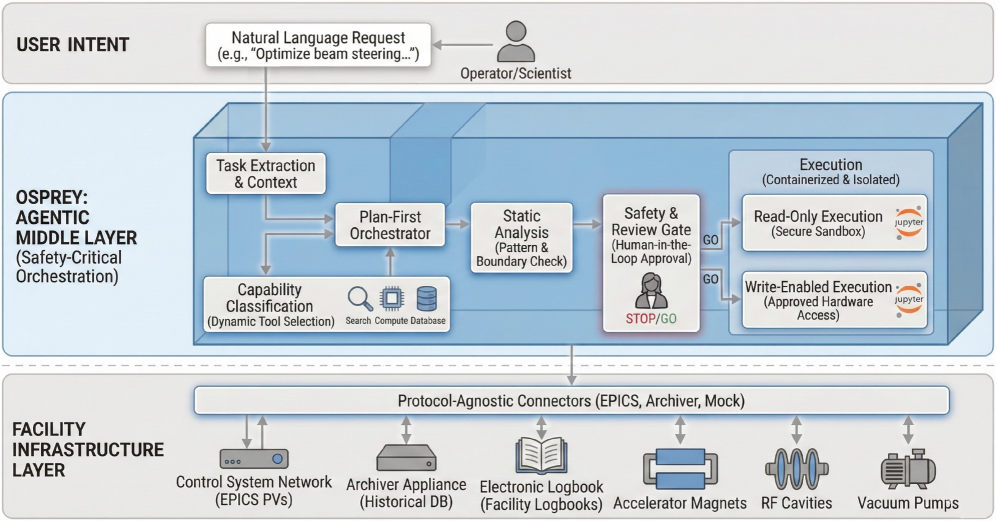
High-level architecture of the Osprey framework, illustrating the flow from operator request to hardware interaction.
Evaluation Highlights
- Successfully deployed for real-time operations at the Advanced Light Source (ALS), managing interactions across hundreds of thousands of control channels.
- Demonstrated capable of semantic channel mapping and historical data integration in a production control-assistant tutorial.
- Establishes a fail-secure architecture where read-only code runs in isolated containers while write operations require explicit operator approval.
Breakthrough Assessment
8/10
Significant practical contribution bridging the gap between stochastic LLM agents and deterministic, high-safety control systems. While the ML techniques are standard, the architectural integration for safety-critical hardware is novel and production-proven.